TLDR;
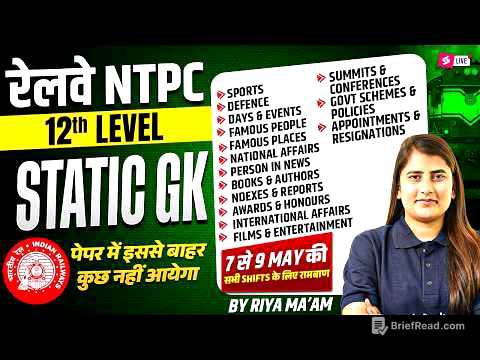
Alright, folks, this session is all about rapid-fire revision for your Railway exams! We're diving into 100 questions across History, Polity, Geography, and Economics, aiming to give you a solid practice run. Plus, there's info on grabbing a संजीवनी 2.0 batch with tons of practice PDFs for just ₹1!
- Quick revision across key subjects
- Tips on accessing practice materials
- Info on topic-wise classes for focused prep
History Questions [1:11]
The session kicks off with History, covering questions from the Mughal empire's establishment in 1526 to identifying the Viceroy during the passage of the Vernacular Press Act. It touches upon ancient Indian texts like the Agam Sutra (related to Jainism) and the meaning of 'Kalp' in the context of Vedangas. Key battles like the Third Battle of Panipat (1761) are discussed, along with the origins of the phrase 'Satyamev Jayate' from the Mundaka Upanishad. The meaning of 'Gopati' (lord of cattle) in the Vedic age is explained, and the birthplace of Lord Mahavira (Kundagrama, Vaishali) is highlighted.
Jainism and Buddhism [5:59]
Moving on, the discussion covers Jain philosophy, explaining 'Jina' as a conqueror of desires and the birthplace of the first and fourth Jain Tirthankaras (Ayodhya). The division of Jainism into Digambara (sky-clad) and Svetambara (white-clad) sects is mentioned. The concept of the Four Noble Truths is linked to Buddhism, and Gautam Buddha's birthplace (Lumbini, Nepal) is identified. The terms 'Chaitya' (place of worship) and 'Vihara' (Buddhist monastery) are explained. The five great vows of Jainism are discussed, pointing out that 'Bhakti' (devotion) isn't one of them.
Medieval Indian History [10:57]
The focus shifts to medieval Indian history, with the title 'Gangai Kond Chol' being attributed to Rajendra Chola for his victories up to Ganga. The Khajuraho monuments in Madhya Pradesh are linked to the Chandela dynasty. The marriage of Chandragupta I to Lichchavi princess Kumaradevi, resulting in the acquisition of Pataliputra (Patna) as dowry, is mentioned. The Barabar Caves in Bihar are associated with the Mauryan empire.
Mauryan Empire and Gupta Period [13:23]
Megasthenes' book 'Indica' is described as a biography of India during the Mauryan period, and his visit is linked to Chandragupta Maurya's reign. The authorship of 'Arthashastra' is attributed to Chanakya (Kautilya). Harisena is identified as the court poet of Samudragupta, known as the "Napoleon of India," with mentions in the Allahabad Pillar inscription (Prayag Prasasti). A question about Gautam Buddha's birthplace being in present-day Bihar is corrected to Lumbini, Nepal. Gold coins during the Gupta period were called 'Dinaras,' and the Gupta era is hailed as the Golden Period of India.
Polity Questions: State Legislature [17:07]
The Polity section starts with the maximum number of members in a State Legislative Assembly (500) as per Article 170, based on population. The State Council is collectively responsible to the Legislative Assembly, similar to the central government's accountability to the Lok Sabha. Bihar is mentioned as the first state to impose agricultural income tax. The power to dissolve the Legislative Assembly rests with the Governor.
Legislative Council and Non-Cooperation Movement [19:56]
The discussion moves to the Legislative Council, noting that it's a permanent house with members serving six-year terms, and 1/3 of members retiring every two years. Currently, six states in India have a Legislative Council: UP, Bihar, Maharashtra, Karnataka, Andhra Pradesh, and Telangana. A question about the Non-Cooperation Movement highlights that the establishment of Panchayats for settling disputes wasn't part of it. The Andhra Pradesh Legislative Council was abolished in 1985 but revived in 2007.
State Legislature and Governor [22:25]
Article 168 deals with the State Legislature. The smallest Legislative Assembly is in Sikkim, while the largest is in Uttar Pradesh. The minimum age for membership in the Legislative Assembly is 25 years. The Speaker of the Legislative Assembly decides on disqualifications of members. The maximum gap between two sessions of the State Legislature is six months. The minimum number of members in the State Legislative Council is 40.
Ordinances and Governor's Responsibilities [27:18]
The approval of an ordinance promulgated by the Governor is necessary from the State Legislature. While the President appoints the Governor, the Chief Justice of the High Court administers the oath. The Governor's salary comes from the Consolidated Fund of the State. The Governor is responsible to the President, while the CM and Council of Ministers are responsible to the Legislative Assembly.
Governor's Appointment and First Lady Governor [29:05]
The Governor holds office at the pleasure of the President. Sarojini Naidu was the first woman to become a Governor of a state in India (Uttar Pradesh). High Court judges are not appointed by the Governor; they are appointed by the President. Article 35 gives Parliament the power to make laws related to Fundamental Rights. Article 169 deals with the Governor's oath.
Economics: Key Economic Indicators [33:42]
The Economics section begins with Lakshadweep being the most literate Union Territory in India. A high population growth rate is characterized by a high birth rate and a low death rate. GDP stands for Gross Domestic Product. The 2011 census was the 15th overall and 7th after independence; the upcoming 2027 census will be the 16th. The first governor of RBI was Mr. Osborne Smith.
Population Density and Coal Reserves [35:26]
Bihar has the highest population density among Indian states. Jharkhand is estimated to have the largest coal reserves in India. Fiscal deficit is defined as revenue minus expenditure. The fiscal deficit for the budget 2026 is estimated at 4.3% of GDP, and the revenue deficit at 1.5% of GDP. Singhbhum is famous for iron ore.
GDP Contribution and Railways [37:11]
Maharashtra contributes the most to India's GDP. The first railway in India ran in 1853 from Bori Bunder (Mumbai) to Thane, covering 34 km. The government launched the Pradhan Mantri Jan Dhan Yojana in 2015 to promote financial inclusion. Agriculture has the largest share in India's employment.
Standard of Living and Five-Year Plans [38:42]
A country's standard of living is represented by its per capita income. The National Development Council had the authority to give final approval to India's Five-Year Plans. India's first Five-Year Plan was based on the Harrod-Domar model (1951-56), focusing on increasing agricultural production. Disguised unemployment is found in India's agricultural sector.
Mixed Economy and NITI Aayog [39:58]
India adopted a mixed economy in the Second Five-Year Plan. The chairman of NITI Aayog is the Prime Minister. The Community Development Programme was launched on October 2, 1952, by Jawaharlal Nehru. NABARD (National Bank for Agriculture and Rural Development) was established in 1982.
Banking Sector and Government Enterprises [41:06]
The oldest bank in India is the State Bank of India (originally the Bank of Bengal, established in 1806). The biggest enterprise of the Government of India is Indian Railways. The Pradhan Mantri Awas Yojana, launched in 2015 (urban) and 2016 (rural), aimed to provide housing for all by 2022. The ₹1 coin and ₹1 note are circulated by the Government of India (Finance Ministry).
Geography: River Systems [43:27]
The Geography section starts with the Indus River originating from the Mansarovar Range in the Kailash Mountains. The Tapti River flows westward. The Kaveri River originates in Karnataka and flows to Tamil Nadu. The land between two rivers is called a Doab. The Teesta River is a tributary of the Brahmaputra.
River Flows and Brahmaputra [45:08]
The Krishna River flows from Maharashtra to Karnataka. The Brahmaputra River is known as Yarlung Tsangpo in Tibet (China) and Dihang in Arunachal Pradesh. The Satpura mountain range is between the Narmada and Tapti rivers. The largest canal in India is the Indira Gandhi Canal, which carries water from the Sutlej and Beas rivers in Punjab to Rajasthan.
Rivers of Sorrow and Tributaries [46:26]
Before entering India, the Yarlung Tsangpo River is found in Tibet. The Kosi River is known as the "Sorrow of Bihar." The Godavari River is known as Vriddha Ganga or Budhi Ganga. The Indravati River is not a tributary of the Ganga; it's a tributary of the Godavari. The correct order of rivers from South to North is Kaveri, Krishna, Godavari, and Mahanadi.
Tributaries and Planetary Temperatures [48:50]
The Amravati, Bhavani, Hemavati, and Kabini rivers are tributaries of the Kaveri. Venus has the highest average surface temperature due to its thick atmosphere. Lake Superior is located in North America. The largest freshwater lake in India is Wular Lake in Jammu and Kashmir.
Hydroelectric Plants and Volcanoes [50:33]
The Srisailam hydroelectric power plant is located on the Krishna River. The largest volcano in the solar system, Olympus Mons, is located on Mars.
Additional Resources and Offers [51:23]
The session concludes with information about the संजीवनी 2.0 batch, offering 3000 MCQs, 20 mock tests, and extra PDFs for just ₹1. Instructions are provided on how to access the batch and download the materials. A topic-wise Static GK series on the Textbook channel is also mentioned for focused preparation.