TLDR;
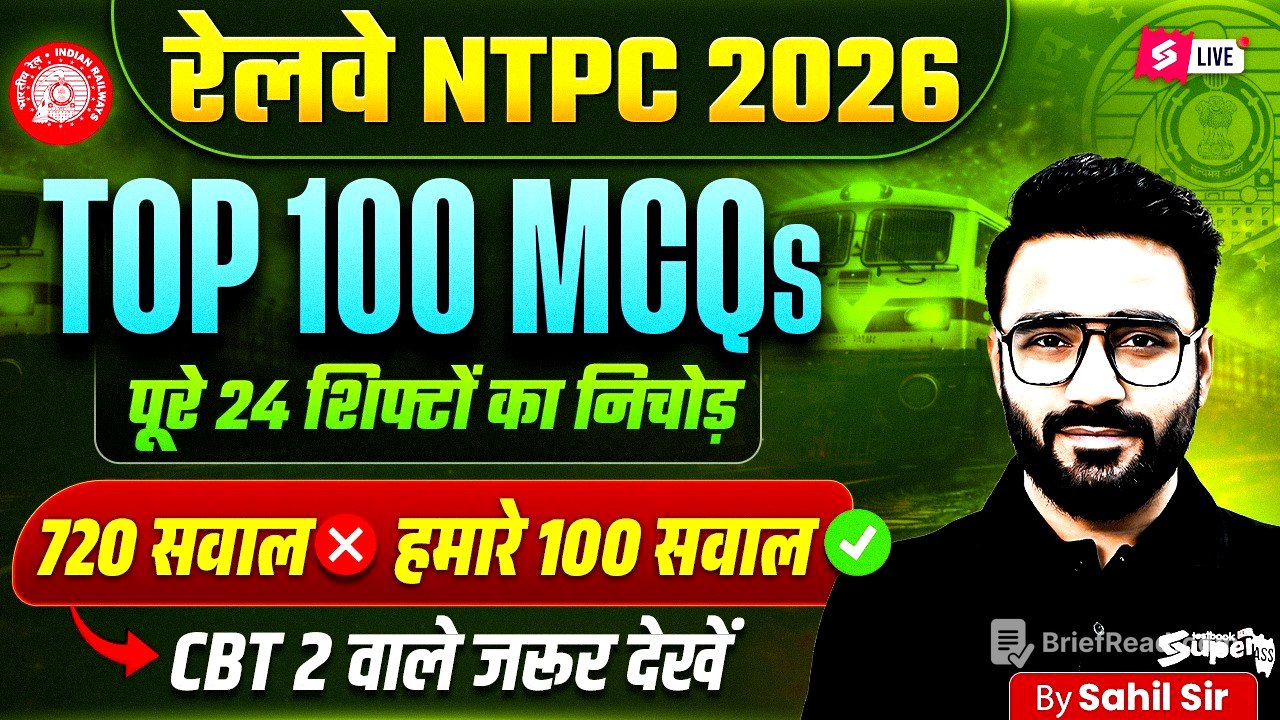
The video is a prep session for Railway NTPC exams, focusing on important MCQs from previous years' papers. It covers topics like geography, history, polity, economics, and current affairs, with explanations and memory tricks. The instructor also discusses a potential GS + Current Affairs course and promotes a monthly current affairs e-book.
- Covers important MCQs from previous NTPC exams.
- Includes explanations and memory tricks for various topics.
- Discusses a potential GS + Current Affairs course.
- Promotes a monthly current affairs e-book.
Introduction [0:04]
The instructor welcomes students preparing for NTPC Under Graduate and CBT2 exams. He mentions that in 2020-21, the Railway NTPC exam had 24 shifts with a total of 720 questions. The class aims to cover the top 100 MCQs from those exams. Even if all 100 aren't covered, the important ones will be. These questions are from previous NTPC Graduate exams, and this session is useful for those preparing for Under Graduate, CBT2, or RRB Group D exams. If students have seen these questions before, they can use this session for revision.
Geography: Summer Solstice and Earth's Movements [1:27]
The instructor explains the concept of the summer solstice in the Northern Hemisphere. He uses a diagram of the Earth to illustrate the Northern and Southern Hemispheres. The longest day in the Northern Hemisphere is called the summer solstice, while the longest day in the Southern Hemisphere is called the winter solstice. When day and night are equal, it's called an equinox. He further explains that when the sun is directly over the Tropic of Cancer, the Northern Hemisphere experiences summer, while the Southern Hemisphere experiences winter, and vice versa. For example, when it's June in India (summer), it's winter in Australia and New Zealand. The summer solstice occurs around June 20-22, and the winter solstice occurs around December 21-22.
History: Bardoli Satyagraha [4:06]
The instructor discusses the Bardoli Satyagraha, which took place in Bardoli, Gujarat, due to the British tax system. Vallabhbhai Patel received the title "Sardar" during this movement, given by Mahatma Gandhi. He also mentions that Rabindranath Tagore gave Mahatma Gandhi the title "Mahatma," and Subhas Chandra Bose gave him the title "Bapu."
Polity: Constitutional Amendments and Languages [5:01]
The instructor discusses the constitutional amendment that added Bodo, Dogri, Maithili, and Santhali to the Indian Constitution. He explains that the 21st Amendment added the Sindhi language, the 71st Amendment added Manipuri, Nepali, and Konkani, and the 92nd Amendment added Bodo, Dogri, Maithili, and Santhali in 2003. The 96th Amendment changed the spelling of "Oriya" to "Odia." He provides a memory trick to remember the 92nd Amendment: adding 9 and 2 gives 11, and the amendment happened in 2003, linking the "3" in 2003 to the three languages added in the 71st Amendment.
General Knowledge: Switzerland and European Arrivals in India [6:34]
The instructor mentions that Geneva, Switzerland, is home to the headquarters of many organizations like WHO, WTO, and ILO, but the capital of Switzerland is Bern. He then discusses the arrival of Europeans in India, noting that their initial focus was on trade rather than conquest. The Portuguese were the first to arrive in 1498 and the last to leave in 1961. Operation Vijay was launched by the Indian government to take Goa, Daman, and Diu from the Portuguese, which were then made Union Territories in 1961.
Geography: Himalayan Ranges [8:31]
The instructor discusses the northernmost range of the Himalayas, known as Himadri or the Greater Himalayas, where the highest peaks like Mount Everest, Kanchenjunga, and Annapurna are located. He explains the division of the Himalayas from north to south: Karakoram Range, Ladakh Range, Zaskar Range, and Kailash Range in Tibet. The Greater Himalayas are followed by the Pir Panjal range in Jammu & Kashmir and the Dhauladhar range. The Shiwaliks, also known as the Outer Himalayas or Foot Hills Himalayas, are the southernmost range. The area including Karakoram, Ladakh, Zaskar, and Kailash ranges is called the Trans-Himalayas.
Geography: Regional Division of Himalayas [11:01]
The instructor explains the regional division of the Himalayas from west to east. The Punjab Himalayas lie between the Indus and Sutlej rivers, the Kumaon Himalayas between the Sutlej and Kali rivers, the Nepal Himalayas between the Kali and Teesta rivers, and the Assam Himalayas between the Teesta and Brahmaputra (or Dihang) rivers.
Polity: Lawmaking Process and Central Administrative Tribunal (CAT) [12:44]
The instructor explains that a bill becomes a law only after the President signs it. He then discusses the Central Administrative Tribunal (CAT), established in 1985, which handles cases related to government jobs. He recalls a Group D case that went to CAT.
Polity: Directive Principles of State Policy (DPSP) [13:54]
The instructor discusses the promotion of cottage industries, stating that it is a Gandhian principle under the Directive Principles of State Policy (DPSP). He mentions Article 40 (village panchayats), Article 43 (cottage industries), Article 43B (cooperative societies), Article 46 (promotion of SC/ST), Article 48 (animal husbandry), and Article 47 (prohibition of alcohol and drugs) as examples of Gandhian principles.
Polity: Pardoning Powers and Ordinances [15:19]
The instructor discusses the President's pardoning power under Article 72 and the Governor's similar power under Article 161. He also mentions the President's power to issue ordinances under Article 123 and the Governor's power under Article 213.
History: Regulating Act of 1773 [16:32]
The instructor explains that under the Regulating Act of 1773, the Governors of Madras and Bombay reported to the Governor-General of Bengal. The Act changed the post of Governor of Bengal to Governor-General of Bengal, and Warren Hastings was the first Governor-General. The Charter Act of 1833 changed the post to Governor-General of India, and William Bentinck was the first Governor-General of India. The Government of India Act of 1858 changed the post to Viceroy of India, and Canning was the first Viceroy.
History: Newspapers and Editors [18:27]
The instructor asks who edited the newspaper "Young India," answering that it was Mahatma Gandhi. He also mentions other newspapers and their editors: Kesari and Maratha (Bal Gangadhar Tilak), Amrit Bazar Patrika (Sisir Kumar Ghosh/Motilal Ghosh), The Hindu (G.S. Iyer), Vande Mataram (Arvind Ghosh), Indian Opinion (Gandhi), The Tribune (Sardar Dayal Singh), Comrades (Maulana Muhammad Ali), and New India (Annie Besant).
History: Prati Sarkar and Border Sharing with China [19:33]
The instructor discusses the "Prati Sarkar," a parallel government formed in 1943 and dissolved in 1946 by Nana Patil. He then asks which state shares the largest border with China, providing the trick "SHUKLA" to remember the states: Sikkim, Himachal Pradesh, Uttarakhand, Ladakh, and Arunachal Pradesh. Arunachal Pradesh shares the longest border, and the border between India and China is called the McMahon Line.
Economics: LPG Reforms and Types of Gases [21:00]
The instructor discusses the LPG reforms of 1991, where LPG stands for Liberalization, Privatization, and Globalization. He notes the current Iran-Israel-US situation has made LPG relevant. He explains that LPG contains propane and butane, while PNG (Piped Natural Gas) contains methane.
Ancient History: Samanta System [22:43]
The instructor explains the meaning of "Samanta" in ancient India, referring to subordinate rulers working with a Maharaja.
Economics: Fiscal Policy and Fiscal Deficit [24:01]
The instructor differentiates between Monetary Policy, made by RBI, and Fiscal Policy, made by the Ministry of Finance. He mentions that the fiscal deficit estimated in the 2026 budget is 4.3% of GDP.
Art and Culture: Mohiniyattam [26:37]
The instructor shows a video of a Mohiniyattam performance, a dance form from Kerala performed by female artists.
History: Land Gifts to Temples and Computer Generations [27:05]
The instructor explains that land gifted to temples during the Chola dynasty was called "Tirunama-ttukkani" or "Devadana." He then discusses computer generations: first generation (vacuum tubes), second generation (transistors), third generation (integrated circuits), fourth generation (microprocessors), and fifth generation (artificial intelligence).
History: Arya Samaj and Revolt of 1857 [28:19]
The instructor mentions that Swami Dayanand Saraswati founded the Arya Samaj in 1875. He then discusses why the Revolt of 1857 failed, citing lack of unity among Indians, better administration and management by the British, and the revolt not spreading to South India.
Computer Knowledge: Shortcuts and Sangam Literature [29:02]
The instructor explains computer shortcuts: Ctrl+S (save), Ctrl+F (find), Ctrl+C (copy), Ctrl+V (paste), Ctrl+X (cut), Ctrl+Z (undo), and Ctrl+Y (redo). He then asks which language is associated with Sangam Literature, answering that it is Tamil.
Polity: Equal Pay for Equal Work and MS Word Margins [29:51]
The instructor mentions that "equal pay for equal work" is mentioned in Article 39. He then explains that the space left on the sides of an MS Word document is called the margin.
Geography: Damodar River and Indian Plateaus [30:49]
The instructor asks through which plateau the Damodar River flows, answering that it is the Chota Nagpur Plateau in Jharkhand. He then shows a map of South India, pointing out the locations of various plateaus: Malwa Plateau, Bundelkhand Plateau, Baghelkhand Plateau, Chota Nagpur Plateau, Shillong Plateau, Deccan Plateau, Telangana Plateau, and Karnataka Plateau.
Polity: Citizenship Articles [32:27]
The instructor explains that Articles 5-11 deal with citizenship, which is borrowed from the UK, and India has single citizenship. Article 6 deals with citizenship for people who migrated to India from Pakistan. Article 7 deals with people who went from India to Pakistan and then returned to India.
Geography: Beas River and National Development Council [34:00]
The instructor mentions that the Beas River originates in the Pir Panjal range near the Rohtang Pass in Jammu & Kashmir. He then discusses the National Development Council, established in 1952, which approves Five Year Plans made by the Planning Commission.
Geography: Shilla Peak and Census 2011 [35:07]
The instructor states that the height of Shilla peak in the Zaskar mountain range is 6132 meters. He then discusses the 2011 census, stating that the total literacy rate increased by 9.21% from 2001 to 2011. The male literacy rate increased by 6.88%, and the female literacy rate increased by 11.79%. He mentions that the Registrar General and Census Commissioner, under the Ministry of Home Affairs, conducts the census. The current Census Commissioner is Shri Mrityunjay Kumar Narayan. The 2027 census will be the first digital census in India, with mascots named Pragati (female) and Vikas (male). It will be conducted in two phases and will include a caste census.
Books and Authors, Fundamental Rights, and Computer Shortcuts [38:23]
The instructor asks who wrote "The Discovery of India," answering that it was Jawaharlal Nehru. He also mentions other books and authors. He then discusses the fundamental right inserted in 2002 by the 86th Amendment: the Right to Education under Article 21A. He revisits computer shortcuts: Ctrl+C (copy), Ctrl+V (paste), Ctrl+X (cut), Ctrl+Z (undo), and Ctrl+Y (redo).
Delhi Sultanate and Fundamental Duties [41:16]
The instructor mentions that Iltutmish established the "Chalisa Dal" or "Turkan-i-Chahalgani" in the Delhi Sultanate. He also started the "Itaadari" system and introduced the copper coin "Jital" and the silver coin "Tanka." Iltutmish made Delhi the capital of the Delhi Sultanate. He then asks which fundamental duty was added by the 86th Amendment, answering that it is the duty to provide opportunities for education to children aged 6-14, which is the fundamental duty of parents.
Economic Sectors and Cricket Trivia [42:55]
The instructor explains that the tertiary sector includes the service sector. Agriculture and mining are in the primary sector, and manufacturing is in the secondary sector. He then asks who India defeated in the ICC Champions Trophy, answering that it was New Zealand. He also mentions India winning the T20 World Cup in 2024, defeating South Africa, and the Asia Cup, defeating Pakistan.
Article 173B and Course Announcement [46:14]
The instructor mentions that based on the NTPC Graduate papers, 20-25 topics are frequently repeated. He is considering launching a GS + Current Affairs course to cover these topics for NTPC Under Graduate, Group D, and ALP exams. He asks for feedback on whether to launch the course and at what price. He clarifies that the Foundation Course, which started on April 10th, is different and is for exams after the upcoming NTPC exam in May. The Foundation Course covers math, reasoning, GK, GS, current affairs, static GK, and computer science.
Monthly Current Affairs E-book [51:01]
The instructor promotes a monthly current affairs e-book covering January to December 2026. It costs ₹499 with the coupon code AVS and provides monthly current affairs updates. The e-book covers all exams and ensures exam readiness for current affairs.