TLDR;
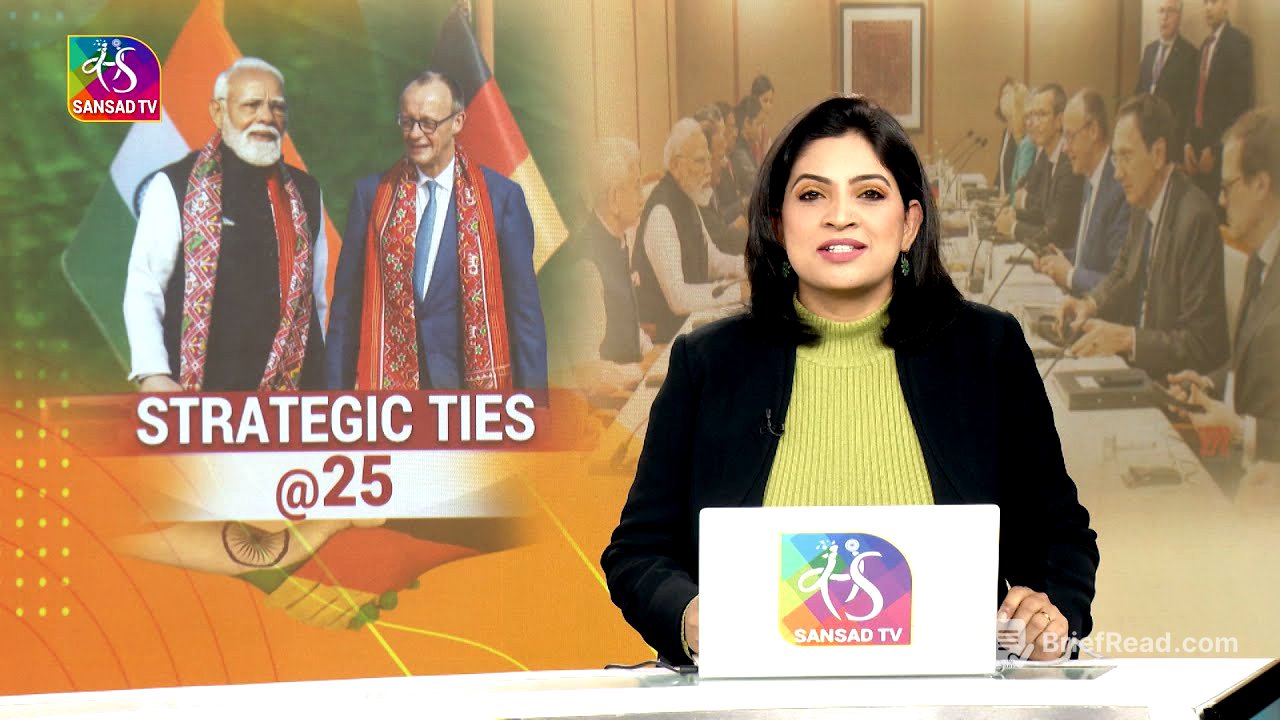
The discussion revolves around German Chancellor Frederick Merz's visit to India, marking his first to Asia since assuming office. The visit underscores the strengthening India-Germany strategic partnership, especially as they approach milestones like 25 years of strategic partnership in 2025 and 75 years of diplomatic relations in 2026. Key areas of focus include defense and security, trade and economy, technology and innovation, green energy, and skill development. The experts highlight the significance of this visit in the context of a disrupted global order, with India and Germany seeking to foster stability and explore opportunities for joint ventures and diversification away from traditional economic dependencies.
- India and Germany are trying to bring stability to a disrupted world.
- Germany sees India as a key strategic partner, especially in the Indo-Pacific region.
- Skill development and mobility are crucial for addressing demographic advantages and labor shortages.
Introduction: Chancellor Merz's Visit to India [0:14]
The program starts with an introduction to German Chancellor Frederick Merz's official visit to India, noting it as his first visit to Asia since taking office. The visit includes a high-level delegation of German CEOs, highlighting the strong economic focus. The leaders paid respects to Mahatma Gandhi and participated in Gujarat's kite festival, followed by discussions aimed at boosting India-Germany ties and their strategic partnership. These talks covered key areas such as defense, trade, technology, green energy, and people-to-people exchanges, with several agreements and announcements made to foster new opportunities for both countries.
Significance of the Visit [5:31]
The experts discuss the importance of Chancellor Merz's visit in the context of India and Germany's long-standing relationship and the upcoming milestones of 25 years of strategic partnership and 75 years of diplomatic relations. The visit is seen as an effort to bring stability to a world facing geopolitical disruptions, broken friendships, and disordered supply chains. India and Germany aim to demonstrate how middle powers can provide stability and promote multilateralism in both the EU and the Indo-Pacific region.
Adapting to Global Shifts [7:16]
The discussion shifts to how India and Germany have adapted to global changes, from the post-Cold War era to today's technology-driven geopolitics. India's ambition to become a developed economy by 2047 identifies Europe, particularly Germany, as a key partner in trade, investment, technology, and green transition. Germany, facing economic challenges and a need to diversify its economy, sees India as a promising partner for diversification and growth. This includes potential co-production in the defense industry, aligning with India's "Make in India" initiative.
First Visit to Asia: A Strategic Message [12:03]
The fact that Chancellor Merz chose India as his first destination in Asia sends a significant message, considering Germany's substantial trade and economic ties with China. This choice indicates a strategic intent to diversify and explore new opportunities with India, potentially leading to increased production and collaboration for both bilateral and third-country markets. The visit underscores a clear geopolitical, economic, and strategic alignment between India and Germany.
Game Changers in Defense and Security [13:45]
Defense and security cooperation is highlighted as a key area, with positive movement towards more exchanges, exercises, and participation in each other's activities. Germany's Indo-Pacific policy prioritizes India, leading to increased engagement and the establishment of a foreign and security policy dialogue. With Germany allocating $500 billion to new defense production, India is seen as a trusted partner with the skills and environment for joint development and production of defense-related equipment, benefiting Germany's defense industrial complex.
Trade and Economy: Unlocking Potential [16:11]
The potential negotiation of the India-EU FTA is a major focus, with Germany strongly supporting and pushing for its conclusion. This agreement could significantly impact trade, supply chains, development partnerships, and connectivity. Germany is also a crucial partner for India's green transition, with substantial development projects in renewables, climate, sustainable urbanization, and sanitation. Triangular cooperation projects in Africa and Latin America further strengthen this partnership.
Green Technologies and Climate Transition [19:24]
India and Germany are committed to implementing their green agendas together, with the strategic partnership heavily focused on sustainability and renewables. Green hydrogen is identified as a significant business opportunity, with a roadmap for cooperation allowing sales to German industry in Europe. While German grants and JDIs support innovation and infrastructure, there's a need for better joint ventures to leverage business opportunities in areas like metros and battery production. The green partnership extends to battery utilization for EVs, semiconductor and critical mineral partnerships, the charging industry, and recycling.
Skill Development and Mobility [22:06]
Skill development and mobility are crucial for addressing India's demographic advantage and Germany's labor shortages. A successful mobility agreement between India and Germany, signed three years prior, serves as a model for potential replication with other countries. Germany is becoming an attractive alternative for Indian students and high-skill professionals, with a significant Indian diaspora already present. This bilateral cooperation is thriving, independent of broader EU agreements.
Germany's Role in the Indo-Pacific Strategy [24:30]
Germany's approach to the Indo-Pacific is functional rather than strategic, but its India strategy paper highlights India's strategic role in its Indo-Pacific policy. While Germany is a smaller Indo-Pacific power compared to France or the UK, its intent is valued. Germany co-chairs the maritime security capacity building pillar of India's Indo-Pacific Oceans Initiative. Collaboration should extend to ASEAN, augmenting their role in the Indo-Pacific. Germany is seen as a vital partner for the next 25 years, with the strategic partnership potentially evolving into a comprehensive strategic partnership.