TLDR;
This video explores a mysterious region at the center of the Milky Way Galaxy, speculated to harbor a supermassive object influencing nearby stars. It delves into the debate regarding whether this object is a black hole or a dense core of dark matter. Key points include:
- The discovery of Sagittarius A*, suspected to be a black hole due to its immense gravitational influence on surrounding stars.
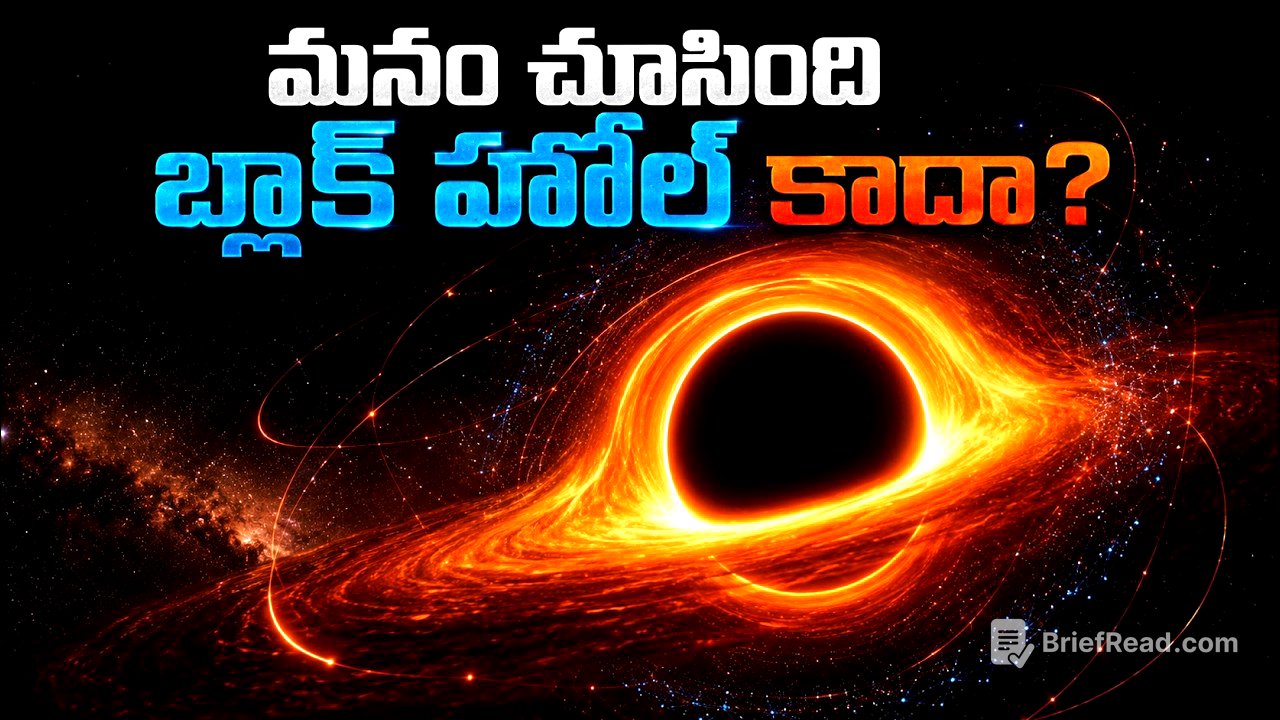
- The mystery surrounding this object remains unresolved, even after the famous orange ring image captured in 2022.
- Recent scientific theories propose that the core could be dark matter rather than a black hole, potentially changing our understanding of the universe.
Mystery at the Center of the Milky Way [0:00]
The video begins by discussing a peculiar location at the center of the Milky Way Galaxy where the typical path of stars is disrupted. Surrounding an invisible object, numerous large stars orbit, specifically one named S2, which approaches the object every 16 years. As it gets closer, its speed increases to thousands of kilometers per second, suggesting the influence of an unseen force. This region is believed to contain an object with nearly 4 million times the mass of our Sun, yet no prominent star or planet is visible—only stars rotating around what appears to be an empty space.
Discovery of Sagittarius A* [1:00]
For decades, scientists have concluded that a supermassive black hole resides in the center of our galaxy, known as Sagittarius A*. In 2022, an image showcasing a bright orange ring surrounding the black hole emerged, leading many to believe this explained the mystery. However, the captured image depicted only a dark shadow situated amidst bright hot gas, leaving questions about the true nature of the unseen mass unaddressed.
New Hypotheses on Galactic Center [2:00]
A team of scientists proposed in February 2026 that the central object might not be a black hole but a dense core filled with dark matter, which also causes the surrounding stars to orbit similarly to how a black hole would. This new theory raises questions about the accuracy of the previously accepted black hole concept. It provokes thought on whether the orange ring photograph from 2022 could represent an entirely different cosmic phenomenon.
Uncovering Neptune’s Influence [4:00]
The discussion dives into historical context, referencing the year 1846 when astronomer Urbain Le Verrier calculated the possible existence of Neptune based on anomalies in the orbit of Uranus. Le Verrier predicted the location of this unseen planet using mathematics rather than direct observation, illustrating how significant celestial objects can affect their surroundings without being directly visible.
Sounds from the Cosmos [6:00]
The narrative advances to an era 90 years ago when a scientist identified strange radio waves from space that eventually led to the discovery of Sagittarius A*. Initially thought to be just noise, the signals were traced back to a singular point, suggesting a massive, yet invisible, object. Observers noted that stars were orbiting around this dark mass, indicating the presence of a significant gravitational influence, raising further curiosity about its true nature.
The Weighty Mystery [8:20]
Calculations revealed that the mysterious object in the center weighs approximately 4.3 million times that of the Sun, confined within a small area. The initial belief aligned with it being a black hole, but documents indicating a Nobel Prize awarded for this discovery never explicitly used the term "black hole," hinting at the scientists' uncertainty regarding what lies within.
The Enigma of Formation [10:00]
The video's theory tackles the puzzling formation of such a massive object, as stellar collapse theories cannot account for a mass as heavy as this, which suggests a lack of understanding about its origin. Intriguingly, the video discusses the invisible properties of black holes and dark matter, stating that their existence often relies on their influence on nearby matter rather than direct observation.
Dark Matter and Cosmic Models [13:00]
Researchers, including a team from Argentina, have suggested alternative views on the galactic core, proposing it might be a dense core of dark matter. Dark matter, which constitutes around 85% of the universe, lacks visibility, consisting instead of tiny, elusive particles that are theorized to exert a force when pressure is applied, akin to a spring.
Conclusion on Cosmic Mysteries [15:00]
This conclusion touches upon the notion that the object at the heart of the galaxy and the vast dark matter that permeates the universe might be related, possibly representing two manifestations of a single phenomenon. It suggests that historical views separating black holes and dark matter may have overlooked a unifying truth about the cosmos that remains to be fully understood.