TLDR;
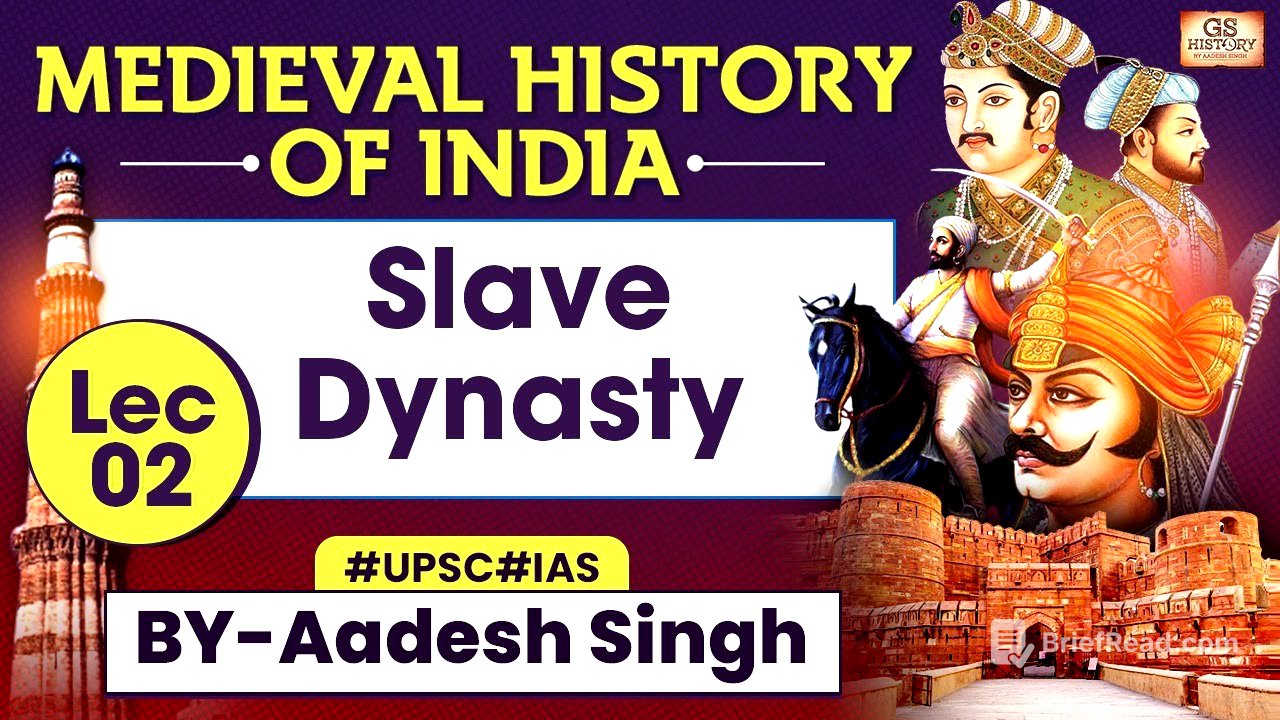
Alright, so this video is all about the Slave Dynasty in North India, which came about after Muhammad Ghori's death in 1206. It covers the key rulers like Qutbuddin Aibak, Iltutmish, and Balban, and how they consolidated Turkish power in the region. The video also touches upon their administration, challenges, and the eventual decline of the dynasty, leading to the rise of the Khiljis.
- Qutbuddin Aibak established the dynasty and prevented Delhi Sultanate from getting entangled in Central Asian politics.
- Iltutmish consolidated the empire, defended it from Mongols, and introduced key administrative and economic reforms.
- Balban strengthened the monarchy, suppressed internal rebellions, and defended against Mongol invasions.
The Slave Dynasty [0:00]
The video starts by setting the stage, explaining that from 1000 to 1200 AD, North India was a battleground for dominance. This period saw the decline of the Pratihara Empire, the rise of Rajput states, and invasions from the northwest by the Turks. This struggle ended in 1206 with Muhammad Ghori's death, leading to the establishment of the Slave Dynasty.
Background [0:46]
The Slave Dynasty was founded by Qutbuddin Aibak, a Turkish Mamluk general of Muhammad Ghori. Mamluks were basically slave soldiers. After the Battle of Tarain in 1192, Ghori appointed Aibak to manage Indian affairs. Aibak acted as an administrator for the Ghurid Dynasty until Ghori's death in 1206. The Ghurids started as vassals of Mahmud of Ghazni but became independent later. Muhammad Ghori, who took the throne in 1173, aimed to establish a kingdom in India, unlike Mahmud of Ghazni, who only wanted to plunder. At its peak, the Ghurid Dynasty stretched from Khurasan in West Asia to Bengal in North India. Because Ghori had no successor, his empire split into smaller sultanates, each led by a Mamluk general. Aibak then established the Slave Dynasty in India in 1206.
Qutbuddin Aibak (1206-1210) [2:12]
Qutbuddin Aibak's significant role began in 1192, but he became the Sultan of Delhi in 1206 after Ghori's death. Between 1192 and 1194, Aibak conquered the Ganga-Yamuna Doab region. In 1197, he defeated Bhima II of Gujarat, capturing Anhilwara and destroying several towns. By 1202, Aibak had also captured Kalinjar, Mahoba, and Khajuraho. After Ghori's death in 1206, another of his slaves, Taj al-Din Yildiz, took control of Ghazni and claimed authority over Delhi. Aibak, who was in Lahore at the time, refused to accept this, effectively cutting off the Delhi Sultanate's ties with Ghazni. This decision prevented India from getting involved in Central Asian politics and allowed the Delhi Sultanate to develop independently. Aibak's rule was short-lived, as he died in 1210 due to injuries. He was succeeded by Aram Shah, a weak ruler, who was then defeated by Iltutmish.
Iltutmish (1210-1236) [3:54]
Iltutmish, Aibak's son-in-law, succeeded him, showing that hereditary succession wasn't a strict principle early on. In 1211, Iltutmish shifted the capital from Lahore to Delhi. His forces captured Bihar in the 1210s and invaded Bengal in 1225. In the early 1220s, Iltutmish ignored the Indus Valley region, which was under threat from the Mongols, the Khwarazmian Empire, and Qubacha. After the Mongol threat subsided, Iltutmish incorporated the Indus Valley territories into the Delhi Sultanate in 1228-29. Iltutmish defended his empire from Mongol invasions and checked Rajput expansion. In 1221, he prevented an invasion by Genghis Khan. He also completed the construction of the Qutub Minar, which Aibak had started. The tower was named after the Sufi saint Qutbuddin Bakhtiyar Kaki. Iltutmish introduced two coins: the silver tanka and the copper jital. He also initiated the Iqta system, where Turkish chiefs were granted land (Iqta) in exchange for collecting land revenue and maintaining troops for the ruler's service. These grants were not hereditary and were given at the Sultan's pleasure. Iltutmish is considered the real consolidator of the Turkish conquest in North India. He died in 1236 and was succeeded by his daughter, Razia Sultana.
Razia Sultana (1236-1239) [6:11]
In the last years of his reign, Iltutmish was worried about succession. He didn't consider his sons worthy of the throne, so he nominated his daughter Razia as his successor, which was quite a novel step at the time. Razia was the first and last Muslim woman to rule Delhi. Her rule lasted only three years but had several interesting features. Razia's reign marked the beginning of a power struggle between the monarchy and the Turkish chiefs, known as Chahalgani, who were 40 important nobles in the Sultanate. After Iltutmish's death, these chiefs wanted to install a puppet ruler they could control. Iltutmish had always ignored these chiefs, and their growing arrogance led to friction. Razia discarded female attire and started conducting court proceedings without a veil. She also led the army in war, sending expeditions against the Ranthambore Rajputs to control them and establish law and order. A rebellious governor, Altunia, rose against her. Razia fought bravely but was defeated and killed. Her brother, Muizuddin Bahram Shah, succeeded her.
Era of Balban (1265-1287) [8:07]
The power struggle between the Turkish chiefs and the monarchy continued. In 1246, Iltutmish's younger son, Nasiruddin Mahmud, ascended the throne. Balban held the position of Naib (deputy) to Mahmud, who was a weak ruler. Balban was the effective ruler, governing with the help of the Chahalgani. He strengthened his position by marrying one of his daughters to Nasiruddin. However, Balban's increasing authority alienated many Turkish chiefs, as their power and influence over the Sultan diminished. In 1253, a conspiracy led to Balban's expulsion from his position, and an Indian Muslim, Imaduddin Rihan, was appointed Naib. Balban stepped down but, within a year and a half, won over many of his opponents and prepared for a military showdown. Sultan Nasir, recognizing Balban's superior strength, expelled Rihan and reinstated Balban as Naib. In 1265, Nasir died without a male heir, and Balban finally succeeded to the throne.
Administration Under Balban [9:41]
Balban's reign is known for a strong and highly centralized government. He aimed to increase the prestige and power of the monarchy to face internal and external dangers. To strengthen his claim to the throne, Balban claimed to be a descendant of the legendary Iranian king Afrasiab. He positioned himself as a champion of Turkish nobility, ensuring that only those from noble families were allowed to hold important government posts. Despite claiming to be a champion of Turkish nobility, Balban was not prepared to share power with anyone, not even his family members. He was a strict ruler, and strict obedience was enforced in his court. Severe punishments were given for even minor offenses. To keep the nobles in check, he created a system of spies. Balban introduced the Persian festival of Navroz to India. During his rule, there were large-scale conversions to Islam in Punjab. Balban broke the power of the Chahalgani and established the power and prestige of the monarchy. He demonstrated extreme impartiality in justice administration, punishing anyone who transgressed his authority, regardless of their status. Balban organized a centralized army to suppress internal disturbances and repel the Mongols. He reorganized the military department, Diwan-i-Arz, for this purpose. While Delhi was secure during Balban's reign, the law and order situation deteriorated in the surrounding areas.
Conclusion [12:41]
After Balban's death, the Delhi Sultanate faced another succession crisis. Eventually, Balban's grandson, Qaiqabad, took the throne but proved to be a weak ruler. The constant power struggles and internal friction damaged the long-term integrity of the Sultanate. Several weak rulers followed, leading to fresh disturbances and troubles. Taking advantage of these weaknesses, the Khiljis replaced Balban's successors in 1290, ending the Mamluk Dynasty and establishing the Khilji Dynasty.