TLDR;
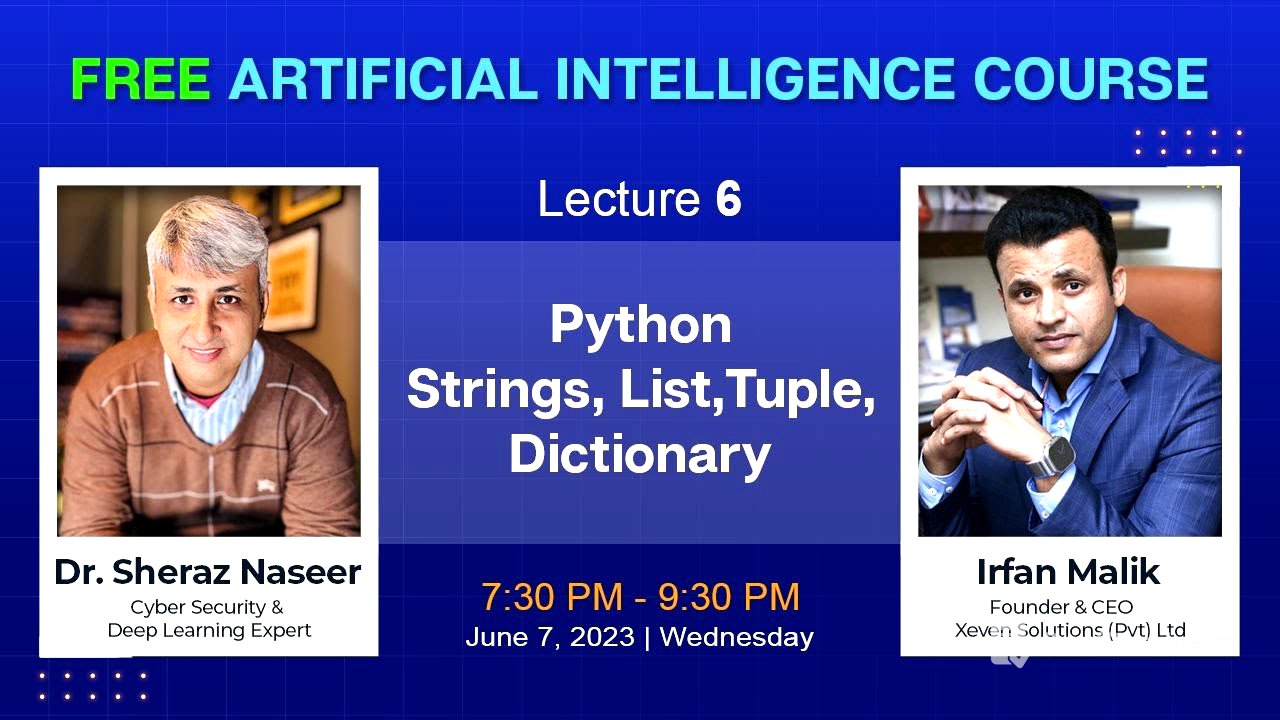
In this video, Irfan Malik outlines essential Python concepts such as strings, built-in functions, data structures, and decision-making using if-else statements. The focus is on how to effectively manipulate strings, the use of data structures like lists, tuples, sets, and dictionaries, and implementing logical and relational operators for programming decisions.
- Overview of strings and their manipulation.
- Introduction to data structures: lists, tuples, sets, and dictionaries.
- Explanation of if-else statements and the use of logical and relational operators.
Session Introduction [0:08]
Haris begins by summarizing the key points covered in the last session and highlighting the practical aspect of the current lesson. He emphasizes the importance of grasping concepts from the previous lecture as they will be applied practically. Everyone is encouraged to pray for the success of all team members involved in the lecture.
Explaining Python Basics [3:28]
The session progresses with a brief overview of the recently uploaded Python video, which is linked to the current lecture. Haris encourages students who have watched the video to engage actively during the quiz that focuses on technical aspects of the lesson.
Diving Deeper into Strings [3:30]
The main focus is on strings in Python. The instructor explains string definitions, how they can be defined using single or double quotes, and the importance of using proper quotes to avoid errors. He discusses multi-line strings requiring triple quotes for proper definition.
Built-in String Functions [6:42]
Key built-in string functions are introduced, such as converting strings to uppercase or lowercase, removing white spaces with the strip function, and replacing substrings within strings. The replace and split functions are explained, and students are encouraged to practice these functions.
Introduction to Data Structures [14:02]
The discussion shifts to data structures in Python. Lists, tuples, sets, and dictionaries are introduced. Lists are described in detail regarding their properties, including the ability to hold multiple values, their ordered nature, and how to create and modify lists after initialization.
Overview of Tuples [24:46]
Tuples are explained next, highlighting their similarity to lists but with the key difference that they are immutable. The instructor demonstrates how to define tuples and the requirement for a comma when defining single-item tuples.
Understanding Sets [24:57]
Sets are covered next. The instructor explains that sets are unordered collections, do not allow duplicates, and are defined using curly braces. Demonstrations are provided showing how to create sets and the significance of their unordered nature.
Introducing Dictionaries [28:02]
The concept of dictionaries in Python is introduced, explaining them as collections of key-value pairs. The instructor illustrates how to create dictionaries, the significance of keys, and how to retrieve values using associated keys.
Decision-Making with If-Else Statements [35:45]
The instructor describes if-else statements in Python, which allow for decision-making in code. The significance of indentation is emphasized when writing if statements. Examples explain the syntax and functionality of if, elif, and else, allowing conditional execution of code blocks.
Logical and Relational Operators [49:17]
Logical operators such as 'and', 'or', and 'not' are explained, emphasizing how they can be used in if statements to evaluate multiple conditions. The instructor elaborates on how these operators function in conjunction with relational operators to determine true or false outcomes in conditions.
Conclusion and Looking Forward [53:33]
As the session concludes, students are encouraged to practice the concepts discussed and explore additional resources available online. The instructor mentions the upcoming topics in future lectures, including APIs and their practical applications using tools like Swagger.