TLDR;
This video is about how food companies engineer food to make it hyper-palatable and addictive, often at the expense of our health. It exposes the tactics used by these companies, including manipulating the balance of salt, sugar, and fat to hit the "bliss point," using "vanishing caloric density" to trick our brains, and exploiting the "health halo" to mislead consumers. The video also highlights regulatory failures and the double standards applied to developing countries. Ultimately, it encourages viewers to become more aware of these tactics and to take control of their food choices by reading labels and supporting those who fight for change.
- Food companies engineer food to be addictive.
- They exploit regulatory loopholes, especially in developing countries.
- Consumers need to be aware and read labels to make informed choices.
The Midnight Snack Battle [0:01]
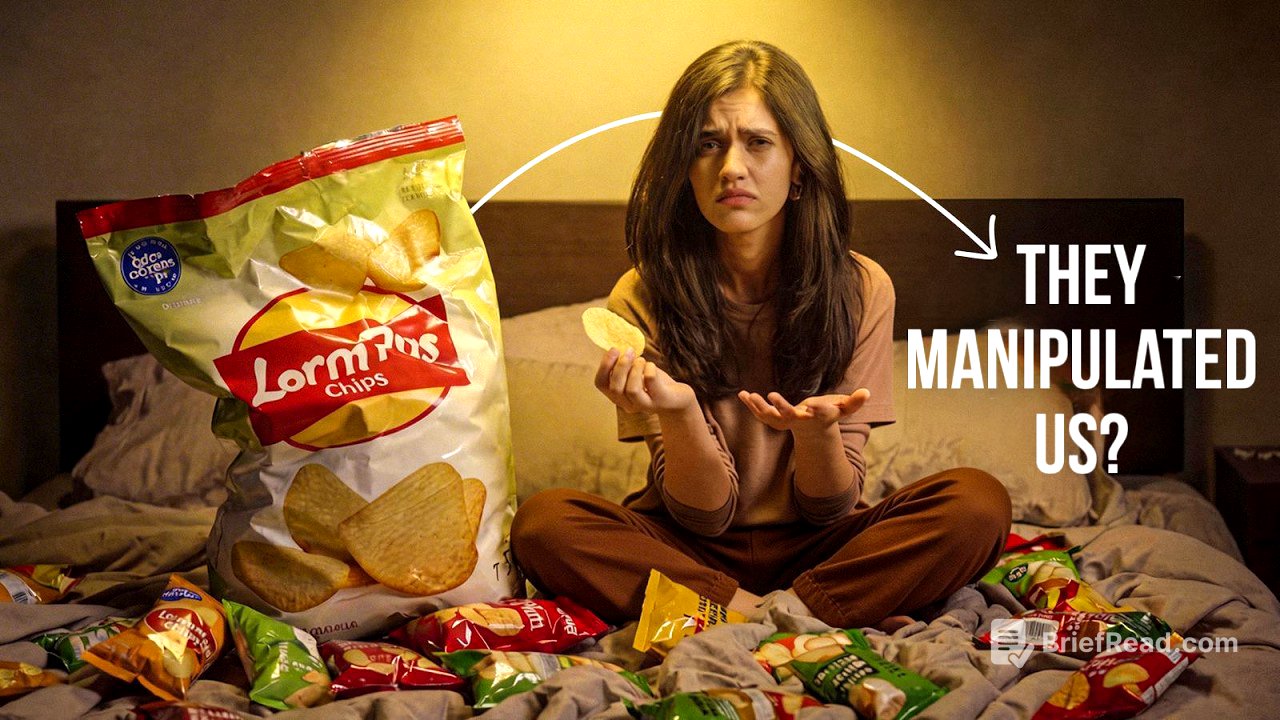
The video starts with a relatable scenario: resisting late-night cravings. It highlights the internal battle between wanting to feel good tomorrow and the immediate satisfaction of indulging in a tasty snack. The presenter emphasizes that this battle is rigged because the food industry spends billions to make saying "no" almost impossible. The video aims to explore the history of food engineering and how companies manipulate our brains for profit.
The Bliss Point: Hacking Your Taste Buds [2:03]
For a long time, food companies focused on taste. But around 1969, that changed. They started trying to "hack" our biology. Howard Moskovitz, a Harvard-trained mathematician, discovered "sensory-specific satiety" while working for the US Army. This means that overly bold and distinct flavors overwhelm the brain, signaling us to stop eating. Moskovitz wondered if he could bypass this mechanism by creating flavors that are interesting enough to keep us eating but not distinct enough to trigger the "stop" signal. This led to the discovery of the "bliss point," a precise mathematical balance of salt, sugar, and fat that makes food hyper-palatable. Food engineering was born.
Grocery Store Traps: The Illusion of Choice [4:09]
The video then takes us to the grocery store to show how food companies manipulate the nutritional content of products. For example, ata noodles might have less fat but more sugar and sodium than regular instant noodles. Similarly, sugar-free crackers can have three times the salt of regular biscuits. This demonstrates how companies replace one harmful ingredient with another to create the illusion of a healthier choice. The presenter encourages viewers to flip the packet and check the nutritional information themselves.
Ultra-Processed Foods: Molecular Manipulation [5:09]
The video explains what ultra-processed foods are, using Cheetos as an example. Cheetos have "vanishing caloric density," meaning they dissolve quickly in the mouth, tricking the brain into thinking you're not consuming calories. Ultra-processed foods are disassembled into molecular components (fiber, starch, fats, sugars) and then reassembled. This predigests the food, preventing satiety signals from firing properly, leading to overeating. This can result in obesity and malnourishment at the same time. Food companies also manipulate the sensory experience of eating, including the sound, to make food more addictive. They hire neuroscientists to study how food affects the brain and use this knowledge for marketing.
The Diet Product Deception [9:20]
Food companies profit not only from addiction but also from the shame associated with it. They sell diet products that are often sneakily packaged lies. These products may replace one harmful ingredient with another or use misleading labels to appear healthy. For example, an oats and almond cookie may have oats listed first on the packaging, but it's not even the first ingredient, and almonds make up a tiny percentage. The industry uses the "health halo" by slapping words like "protein," "fiber," "multigrain," "natural," and "organic" on the package to distract consumers from the unhealthy ingredients.
The Pillsbury Meeting: Profits Over Health [11:24]
In 1999, executives from major food companies met to discuss the growing obesity and diabetes epidemics. One executive proposed reducing salt, sugar, and fat and stopping marketing to kids. However, the CEO of General Mills refused to "screw around with the company jewels" (their formulas). The other executives agreed, choosing profits over health. This playbook mirrors that of the tobacco industry, which perfected the art of manufacturing doubt about science and prioritizing profits. In fact, cigarette companies eventually bought food companies, transferring their addiction knowledge to the grocery store.
Double Standards: Exploiting Developing Countries [13:15]
The video highlights how food companies often have different standards for developed and developing countries. For example, Nestle Cerelac infant cereal contains added sugar in India and other developing countries but not in Switzerland, Germany, the UK, and France. Similarly, Sprite contains significantly more sugar in India than in Austria. This is because regulations are weaker in developing countries. The presenter points out the inefficiency of FSSAI, India's regulatory body, and cites examples of banned products still being sold in India. This has contributed to India becoming the diabetes capital of the world.
The Blame Game: It's Not Your Fault [15:40]
The video argues that it's unfair to blame individuals for their lack of willpower when they are up against the manipulative tactics of the food industry. Society often shames overweight people, but it's important to recognize the systemic factors at play. The presenter uses the analogy of a blindfolded boxer fighting an opponent armed with neuroscience and billions in research. The video highlights the sharp increase in obesity rates in America since the mid-1970s, coinciding with the rise of high fructose corn syrup and ultra-processed foods.
Weaponizing Awareness: Taking Control [21:05]
The video concludes by urging viewers to "weaponize" their awareness and take control of their food choices. This starts with learning how to read labels and being mindful of ingredients. If sugar is in the top three ingredients or if you can't pronounce half of what's listed, you know what you're signing up for. The presenter also encourages viewers to support people who expose the food industry's tactics and fight for change. Ultimately, the goal is to feel like your decisions are your own, free from manipulation.