TLDR;
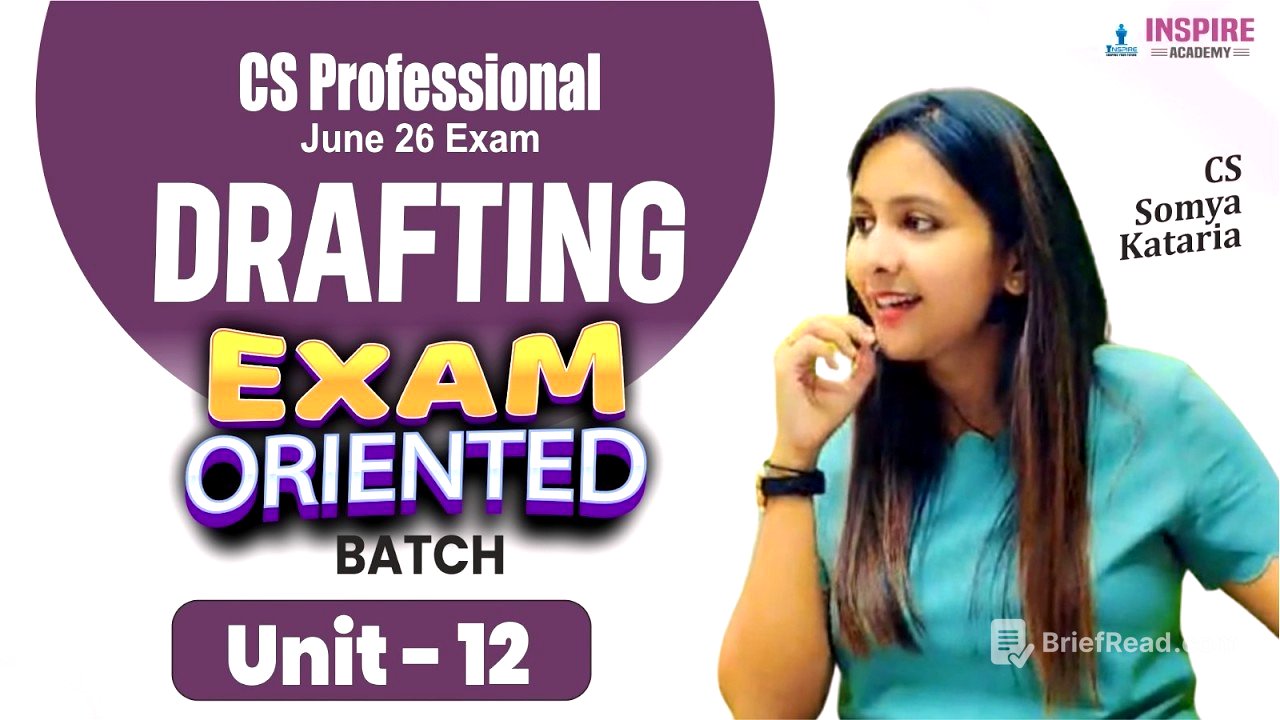
Alright, so this session is all about tackling Unit 12 of your course, which many find daunting. The speaker breaks down the unit into manageable chunks, focusing on the National Company Law Tribunal (NCLT) procedures, applications for AGMs, compromises, takeovers, and more. Plus, there's a pep talk about staying strong through the challenges of the course.
- NCLT procedures for filing applications and petitions.
- Key forms and timelines for various corporate actions.
- Tips for handling operation and mismanagement issues.
- Encouragement to keep pushing through the course's difficulties.
NCLT Applications and Petitions [5:27]
The speaker starts with the basics of filing applications or petitions with the NCLT. The initial application goes in NCLT-1, with attachments in NCLT-2, all in triplicate. A verification affidavit in NCLT-6 and an index are also required. When a petition is filed, the notice to the opposite party is sent via NCLT-5. Processing fees must be paid.
Lodging a Caveat [9:06]
Moving on, the speaker explains lodging a caveat, which is like filing a petition in advance to inform the NCLT that the company anticipates a class action suit. This is done using NCLT-3C. The idea is to get the NCLT to inform the company before accepting any petition against them, giving the company a chance to settle. The process is similar, but no notice is sent to the opposite party since it's a precautionary measure.
Important Points for Filing [13:29]
All documents must be in English. If an application is defective, it needs to be returned for rectification within seven days. The notice to the opposite party, sent via NCLT-5, is delivered by hand if within jurisdiction or by speed post if outside. The NCLT can direct both parties to produce evidence. If the petitioner appears but the respondent doesn't, an ex-parte order can be passed. If the petitioner doesn't appear but the respondent does, the NCLT may proceed or dismiss the case. If neither appears, the case is dismissed.
Dos and Don'ts Before NCLT [17:22]
The speaker highlights the importance of knowing the dos and don'ts when appearing before the NCLT, referencing page 454 in the module. This includes thoroughly reading the case, preparing documents, dressing well, and respecting the judge.
Share Transfer Application [18:37]
The speaker discusses share transfer applications, explaining that if a board rejects a share transfer application, you can file an NCLT petition. For private companies, the board has 30 days to reply. If rejected, you have 30 days to apply to the NCLT. If no reply is received, you have 60 days from the initial application date. For public companies, the timelines are 30 days for the board to reply, 60 days to apply to the NCLT if rejected, and 90 days if no reply is received. The NCLT can direct the company to transfer the shares, record reasons for rejection, or impose fines for non-compliance.
Hearing and Advertisement [23:50]
Before a hearing, Rule 35 requires an advertisement in NCLT-3A, 14 days before the hearing, in both vernacular and English newspapers. The advertisement must include the filing date, applicant's name and address, nature of the application, actual hearing date, and a statement that objections can be raised two days before the hearing. An affidavit confirming the advertisement must be submitted three days before the hearing.
Rights of Parties and Legal Proceedings [27:40]
Parties can appear in person or through an authorized representative with a Vakalatnama. The Registrar of Companies (ROC) must submit any documents requested by the NCLT. Audio-video recording of hearings is not done. If a party dies or becomes insolvent during proceedings, the proceedings can continue with a legal representative, who must apply to the NCLT within 90 days.
Application for AGM [32:25]
If a company defaults on conducting an AGM, a member can apply to the NCLT to conduct the AGM. The process is the same: application in NCLT-1, attachments in NCLT-2, notice to the company (opposite party) in NCLT-5, and affidavit in NCLT-6. If a representative appears, a Vakalatnama in NCLT-12 is needed. The advertisement is given in NCLT-3A, 14 days prior, with the same contents as before.
Compromise and Takeover Application [34:40]
For mergers, amalgamations, compromises, and takeovers, the process starts with a board meeting and resolution. Then, an application is filed in NCLT-1 with attachments in NCLT-2 and an affidavit in NCLT-6. A registered valuer's report, based on the highest price paid for shares in the last 12 months and fair price considering factors like goodwill, must be attached.
Directions from NCLT and Further Procedures [38:30]
After the initial application, the NCLT determines the creditors and members for calling a meeting, fixes the date, time, and place, appoints a chairperson and scrutinizer, fixes the quorum, and orders notices to regulatory bodies. Notice to members and creditors (CAA-2) should include a copy of the valuation report and its impact on creditors, KMPs, and promoters. This notice is also updated on the website and published in vernacular and English newspapers 30 days before the meeting. Regulatory bodies are notified via CAA-3.
Post-Meeting and Final Orders [43:47]
Voting results are sent by the chairperson to the NCLT in CAA-4 within three days of the meeting. If the results are positive, a petition for sanctioning the compromise is applied for in CAA-5 within seven days. A statement of compliance (CAA-8) must be filed with the ROC every financial year until the merger is complete, detailing all steps taken. The final NCLT order includes the transfer of assets and liabilities from the transferor to the transferee company from the effective date, allotment of shares to transferor company shareholders, continuation of the transferee company, dissolution of the transferor company, and transfer of employees.
Reverse Merger and Special Cases [51:38]
If a listed company is acquired by an unlisted company, the transferee must first get listed. Dissenting shareholders must be given an exit opportunity (CAA-14). The transferee company's auditor must provide a certificate to the NCLT confirming compliance with accounting standards and policies.
Merger of Certain Companies [54:15]
For mergers of small startups, the application is filed in NCLT-1 as usual. A notice inviting objections is published in the newspaper in CAA-9, and a declaration of solvency (CAA-10) is filed with the NCLT. The CAA-9 notice goes to the newspaper, ROC, official liquidator, members, creditors, and regulatory bodies. After the meeting, all details are filed in CAA-11, including the scheme copy, petition for sanction, and voting results. This is known as a fast-track merger under Section 233(1). With 90% approval, you can proceed to the Central Government without NCLT approval. All NCLT orders are filed with the ROC in INC-28 within 30 days.
Application for Operation and Mismanagement [1:03:50]
Operation and mismanagement, as defined in the VS Krishnan vs Westford High-tech Hospital Limited case, includes harsh or burdensome conduct, malicious intent, lack of good conduct, and oppressive legal conduct. If there is operation and mismanagement, the NCLT can order the purchase of shares by other members, reduction of capital, termination of agreements, setting aside sales, removal of directors, appointment of a nominee director, and imposition of costs. Failure to comply with NCLT orders can result in penalties.
Conditions for Filling and Case Laws [1:14:52]
To file against operation and mismanagement, if the company has share capital, it requires 100 members or 1/10th of the total members, whichever is less, or any member with 1/5th of the issued capital. If the company doesn't have share capital, 1/5th of the total members can file. Case laws related to corporate democracy are important, such as the validity of notices sent from distant post offices and the consequences of removing a director without proper notice.
Class Action Suit [1:19:06]
Class action suits can be filed for product liability, consumer issues, employment discrimination, and unfair trade practices. The issue must be common, and the people must be large in number. Eligible filers include subscribers of the memorandum, members in the register, beneficial owners, and depositors. For companies with share capital, it requires 5% of total members or 100 members, whichever is less. For those without share capital, 1/5th of the total members is needed.
Orders from NCLT and Publication of Notice [1:25:16]
The NCLT can restrain the company from going ultra vires, breaching MOA/AOA, declare resolutions void, restrain directors from acting, and compensate the aggrieved. The company bears the costs if it loses the case. The NCLT consolidates multiple applications with the same cause. After the NCLT accepts the class action suit, an advertisement must be published in NCLT-13 within seven days, including the lead applicant's name, grounds for the suit, relief sought, and hearing date.
Compounding Application [1:31:09]
Compounding applications are for compoundable offenses, which include those punishable with a fine only, fine or imprisonment, or penalty only. Non-compoundable offenses include imprisonment only or fine and imprisonment, as well as cases with pending investigations or those compounded in the last three years. Applications go to the Regional Director (RD) if the penalty is up to ₹25 lakhs, or to the NCLT if higher. A board resolution is passed, attached to GNL-1, and filed with the ROC. The final order is filed in INC-28 within seven days.
Adjudication [1:34:14]
A show cause notice is issued by the adjudicating officer (not below the level of registrar), and a reply must be given within 30 days in electronic form. Physical appearance may be required. The AO passes an order within 90 days if physical appearance is required, or 30 days if not. Penalties are based on the size of the company, nature of business, public interest, undue gain, and repetitive defaults. Appeals are filed with the RD within 60 days, and then with the Supreme Court.
NCLAT [1:39:01]
Appeals from NCLT orders go to the National Company Law Appellate Tribunal (NCLAT) within 45 days, with a possible 45-day extension. The NCLAT can confirm, modify, or set aside the NCLT order. Appeals from NCLAT go to the Supreme Court within 60 days, with a possible extension. The application is filed in NCLT-1, with the NCLT order attached. An interlocutory application goes in NCLT-2. A copy is delivered to the opposite party, and all documents must be in English. The affidavit goes in NCLT-4. The Gregorian calendar must be followed, and applications must be divided into paragraphs and numbered.