TLDR;
This video explores the mysteries and untold stories of the Jagannath Temple in Puri, Odisha. It covers topics like the divine heart of Krishna (Brahma Padartha), prophecies from the ancient text Bhavishya Malika, historical events like Mughal invasions and British interference, and unique aspects of the temple like its kitchen and the enigmatic third step. The video suggests that the temple is not just a place of worship but a nexus of faith, science, and unexplained phenomena.
- The Brahma Padartha, believed to be Krishna's heart, is transferred every 12 years in a secretive ritual.
- The Bhavishya Malika prophecies foretold events like the COVID-19 pandemic.
- The temple's kitchen defies conventional cooking methods.
The Mughal Invasion and Divine Intervention [0:00]
In 1558, the Mughal army, led by a fierce Afghan general named Kala Pahad, advanced towards the Jagannath Temple with the intention of destroying it. As the army approached the main sanctum, an unusual storm arose, plunging the area into darkness. A bright light emerged from within the temple, accompanied by a terrifying presence. This caused the soldiers to flee in fear, suggesting a divine intervention protecting the temple.
Mysteries of the Jagannath Temple [0:51]
The Jagannath Temple in Puri is full of mysteries. The temple flag always flies in the opposite direction of the wind, and the Sudarshan Chakra atop the temple appears to look at you from every direction. The ancient book Bhavishya Malika contains prophecies about the temple and the Kali Yuga, many of which have come true, including the COVID-19 pandemic, which was foretold when the temple's oldest tree fell. The temple also houses the Brahma Padartha, believed to be the heart of Krishna, which is transferred to a new idol every 12 years in a highly secretive ritual.
Unheard Secrets of Jagannath Temple [2:17]
For the past 800 years, the temple flag has been changed daily, and it is believed that if this ritual is not performed, the temple will have to be closed for 18 years. When the British tried to stop this practice, they faced unexpected consequences. The temple's main entrance has 22 steps, but stepping on the third step is strictly prohibited. The temple kitchen has seven pots in which prasad is cooked simultaneously, but the pot on top cooks first, defying the laws of science.
The Brahma Padartha: The Divine Heart of Krishna [3:45]
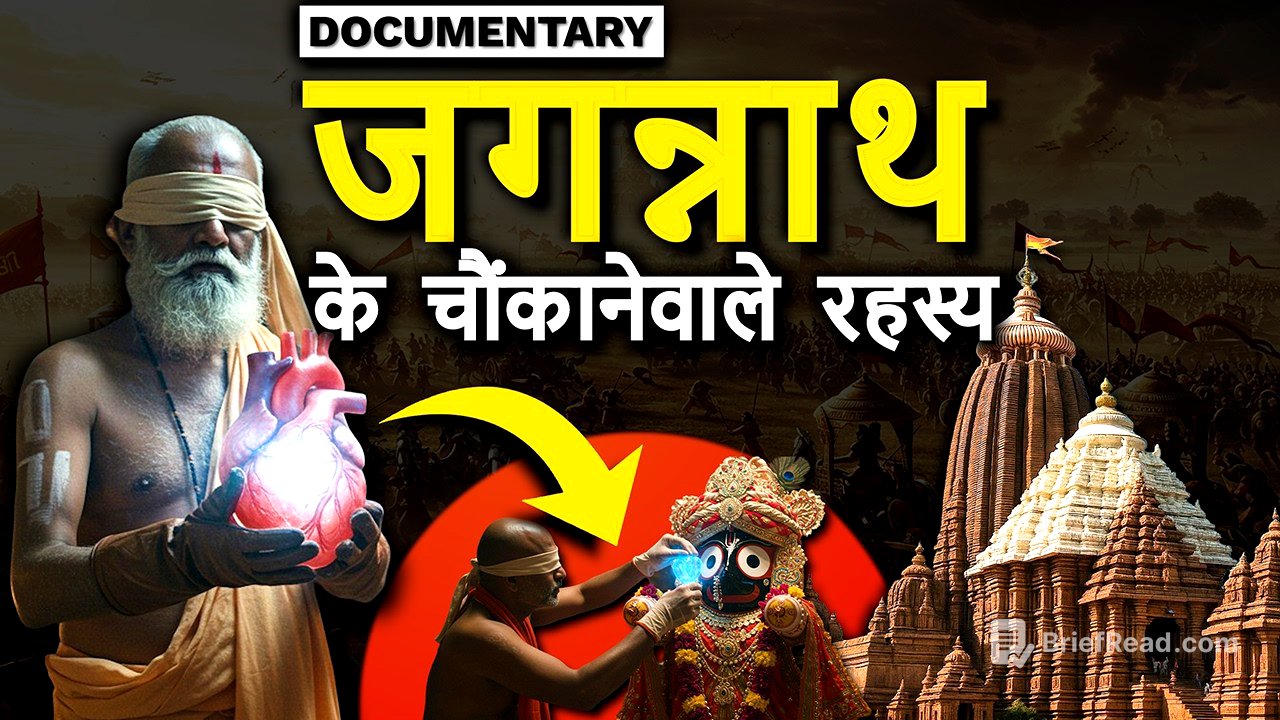
On June 15, 2015, the entire city of Puri experienced a power outage as the temple priests performed a ritual in the dark to transfer the Brahma Padartha, believed to be the heart of Krishna, from the old idol to the new one. This ritual, known as Navakalevara, is performed every 12 years. The priests are blindfolded and wear thick gloves to prevent them from seeing or feeling the Brahma Padartha. It is believed that anyone who sees it will die. During the ritual, the temple is heavily guarded by CRPF personnel, and no one is allowed inside.
The Mystery of Brahma Padartha [6:21]
The Brahma Padartha is believed to be a powerful divine energy source that emits constant vibrations. According to Indian archaeologist Praveen Mohan, Krishna was a supreme being, and the Brahma Padartha is an arc reactor that generates immense energy. The idols are made of wood because wood does not conduct electricity, which helps contain the electromagnetic energy emitted by the Brahma Padartha. About 50 years ago, a person claimed to have seen the Brahma Padartha and described it as a silver liquid that weakens the wood, necessitating the replacement of the idols every 12 years.
The Origin of the Brahma Padartha [8:18]
After the Mahabharata war, Gandhari cursed Krishna, leading to the destruction of his clan. Thirty-six years later, Krishna was accidentally shot by a hunter and died. When his body was cremated, his heart remained intact and began to pulsate with energy. This heart came to be known as the Brahma Padartha. Arjuna placed the heart on a wooden raft and set it adrift in the river. The Brahma Padartha eventually reached the coast of Odisha, where it was discovered by the tribal chief Vishwavasu, who worshipped it as Neel Madhav.
The Legend of King Indradyumna and the Temple's Creation [11:31]
King Indradyumna, a devotee of Vishnu, dreamt of building a grand temple for the divine idol Neel Madhav. He sent his priest Vidyapati to find the idol, which was hidden in a cave by the tribal chief Vishwavasu. Vidyapati married Vishwavasu's daughter Lalita and convinced him to show him the idol. However, when King Indradyumna arrived, the idol had disappeared. Vishnu then appeared in the king's dream and instructed him to make a new idol from a neem tree that would wash ashore on the coast of Puri.
The Making of the Idols and Their Incomplete Form [12:56]
A large neem tree washed ashore, but no artisan could carve the idols from it. Finally, Lord Vishwakarma appeared as an old साधु and offered to carve the idols in 21 days, on the condition that he be left undisturbed in a closed room. After 15 days, the sounds of carving stopped, and the queen, worried about the old man's well-being, urged the king to open the door. When they did, the old man had vanished, leaving behind three incomplete idols. The king installed these idols, and they are worshipped as Lord Jagannath, Balabhadra, and Subhadra in Puri.
Bhavishya Malika: Prophecies of the Future [15:16]
The history and present of the Jagannath Temple are linked to the Bhavishya Malika, a divine text written about 500 years ago by Achyutananda Das, a saint from Odisha. The text contains prophecies about the Kali Yuga, many of which have come true. One notable prophecy was the prediction of the COVID-19 pandemic, which stated that a major disease would spread and people would be confined to their homes.
Prophecies and Omens [17:01]
The Bhavishya Malika also mentions an incident of fire in the temple's cloth. A few years ago, the clothes of the deities caught fire, leading to discussions about the end of Kali Yuga. The text also predicted that birds like vultures, eagles, and hawks would be seen on the temple's dome, which happened after July 2020. According to the Bhavishya Malika, the Neel Chakra (Sudarshan Chakra) of the Jagannath Temple will become crooked due to a storm, which occurred in May 2019 due to Cyclone Fani.
Historical Challenges and Divine Protection [19:09]
In 1558, the Mughal army tried to destroy the temple but faced a divine intervention. The Bhavishya Malika also predicted that the British would try to close the temple. When the Mughal army advanced towards the temple, the weather changed suddenly, and a bright light emerged from the temple, causing the soldiers to retreat. In 1803, when the British took control of Puri, they tried to interfere with the temple's rituals, calling them superstitions. In 1806, they planned to stop the Rath Yatra, but widespread protests forced them to allow it.
Mysteries of the Temple: Steps, Chakra, and Kitchen [22:50]
The Jagannath Temple has 22 steps, but stepping on the third step, known as Yamashila, is considered inauspicious. It is believed that whoever steps on this step loses their merits and goes to Yamaloka. The Sudarshan Chakra atop the temple appears to look at you from any direction, an optical illusion that science has yet to explain. The temple's kitchen is the world's largest and most mysterious, where food is cooked in seven pots placed one above the other, but the pot on top cooks first, defying scientific principles.
The Divine Kitchen and Unexplained Phenomena [24:57]
In the Jagannath Puri kitchen, food is cooked in seven earthen pots placed one above the other, but the top pot cooks first, defying science. Only the servitor Brahmins can cook here, and no modern fuels are used. The temple feeds 2,000 to 200,000 people daily, and the food never runs out or gets wasted. It is believed that Goddess Lakshmi inspires the cooks. Despite the large scale, there is no bad odor or flies in the kitchen, attributed to the blessings of Agni Dev and Goddess Lakshmi.