TLDR;
This video is a compilation of the most important MCQs related to the Indus Valley Civilization (IVC), also known as the Harappan Civilization. It covers topics such as the location of key sites, their features, and the artifacts discovered there. The video also touches upon the timeline of the IVC and the sources of knowledge about this ancient civilization.
- Key sites like Harappa, Mohenjo-daro, Lothal, and Kalibangan are discussed.
- Important aspects such as town planning, trade, and religious beliefs are highlighted through the MCQs.
- The video also provides information on how to access current affairs PDFs and other study materials.
Introduction [0:02]
The video starts with a welcome note and an introduction to the topic of discussion: Indus Valley Civilization (IVC) MCQs. The presenter highlights the importance of the lecture for various exams and encourages viewers to watch till the end. She also mentions the availability of an eight-month current affairs PDF (January to August 2024) and upcoming nine-month current affairs PDF. These PDFs cover topic-wise current affairs like books, authors, important days, themes, awards, appointments, and national and international news.
Harappa's Location and IVC's Discovery [1:42]
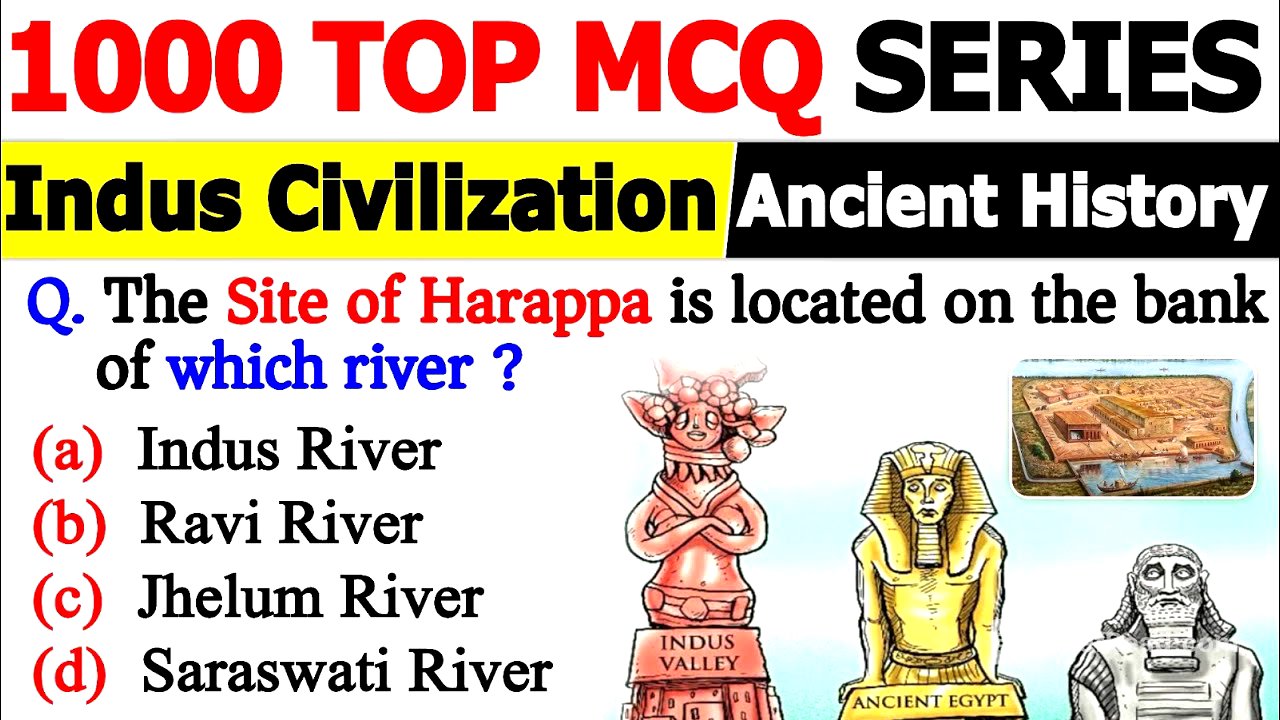
The first question asks about the riverbank on which the Harappa site is located. The correct answer is the Ravi River. The presenter explains that Harappa was discovered in 1921 and is situated in the West Punjab province of Pakistan, near the Ravi River, a left bank tributary of the Indus.
Nomenclature: Harappan Civilization [3:10]
The next question asks which civilization is also known as Harappa Civilization. The answer is Indus Valley Civilization. Initially named IVC because most sites were near the Indus River, the name changed to Harappa Civilization after the first discovered site in 1921.
Animal Representation in Harappan Culture [4:26]
The video then discusses which animal was not represented on seals and terracotta art of the Harappa culture. The answer is the cow. While elephants, rhinoceroses, tigers, deer, and sheep were depicted, cows, camels, horses, and lions were not. The most commonly represented animal was the unicorn (bull).
Sites Located in India [6:19]
The presenter asks which IVC site is not located in India. The answer is Amri, which is in the Sindh province of Pakistan. Alamgirpur is in Uttar Pradesh, Dholavira and Lothal are in Gujarat. A map is shown to illustrate the locations.
Mohenjo-daro's Location [8:25]
The video discusses the location of Mohenjo-daro, which is situated in the Sindh province of Pakistan, near the Indus River. It is the largest settlement of the Indus Valley Civilization. In India, the largest site is Rakhigarhi in Haryana.
Lothal's River [10:03]
The presenter asks about the river near which Lothal is situated. The answer is the Bhogva River, a right tributary of the Sabarmati River in Gujarat. Lothal is known as a dockyard.
Port City of IVC [11:06]
The video revisits the question of which was a port city of the Indus Valley Civilization. The answer is Lothal, located in Gujarat near the Bhogva River.
Largest Harappan Site in India [11:43]
The largest Harappan site in India is Rakhigarhi, located in Haryana. It was excavated by Amarendra Nath.
Honed Deity on Terracotta Cake [12:22]
A terracotta cake with a horned deity was recovered from Kalibangan. The presenter asks the viewers to comment on the location of Kalibangan.
IVC's Age [13:08]
The video discusses the age in which the Indus Valley Civilization existed, classifying it as Protohistoric. Prehistoric means no evidence, Protohistoric means evidence exists but is undecipherable, and Historic means evidence is decipherable.
Evidence of Harbor (Godi Wada) [15:04]
Evidence of a harbor (Godi Wada) has been received from Lothal. The site has yielded vertical walls, inlets, and outlet channels.
Sources of Knowledge about Harappa Culture [15:38]
The sources of knowledge about the Harappa culture are rock edicts, terracotta seals, and archaeological excavations. A special stone seal with a unicorn and writings provided information about the site.
Terracotta of Plougher [16:55]
A terracotta of a plougher was found at Banawali, located in Haryana's Fatehabad district.
Matching List [17:40]
The presenter matches items from List 1 with List 2: Harappa with Cemetery R37, Lothal with Dockyard, Dancing Girl Statue with Mohenjo-daro, and Furrowed Land with Kalibangan.
Water Harvesting and Management System [18:39]
Dholavira is well known for its elaborate system of water harvesting and management, featuring dams and reservoirs.
Great Bath [19:05]
The Great Bath was found at the archaeological site of Mohenjo-daro, which is 55 meters long and 33 meters wide.
Incorrectly Matched Site [19:42]
The presenter identifies the incorrectly matched site: Kalibangan is in Rajasthan, not Haryana.
Incorrectly Matched Site and Position [20:23]
The presenter identifies the incorrectly matched site and its position: Rakhigarhi is in Haryana, not Rajasthan.
Sites Located in Sindh [20:54]
The sites located in Sindh are Mohenjo-daro and Chanhu-daro. Harappa is in Punjab, and Surkotada is in Gujarat.
Rangpur's Location [21:26]
Rangpur, a contemporary of the Harappan Civilization, is found in Saurashtra, which is in Gujarat.
Significant Feature of IVC [21:50]
The most significant feature of the Indus Valley Civilization is the use of burnt bricks in construction.
Rivers of IVC [22:24]
The Indus Valley Civilization was situated on the banks of the Indus, Chenab, and Jhelum rivers. The Ganga River was not associated with IVC.
Deities Worshipped by IVC People [22:55]
The people of the Indus Valley Civilization worshipped Shiva (Pashupatinath).
Director of Archaeological Excavation [23:43]
Sir John Marshall was the director of the archaeological excavations that led to the discovery of Harappa and Mohenjo-daro. Harappa was discovered by Mr. Shahani in 1921, and Mohenjo-daro by Mr. Rakhal Das Banerjee in 1922.
First Archaeologist to Excavate Harappa [24:29]
Alexander Cunningham was the first archaeologist to excavate Harappa but did not recognize its significance.
Remains of Wells in Houses [25:10]
Remains of wells have been found in houses belonging to the developed stages of the Indus Valley Civilization in Mohenjo-daro.
Site in the Valley of Ghaggar River [25:42]
Banawali is located in the valley of the Ghaggar River and its associated rivers.
Evidence of Rock Cut Architecture [26:09]
Evidence of rock-cut architecture related to the Harappan Civilization was found in Dholavira.
Remnants of Three Townships [26:32]
Remnants of three townships have been revealed in Dholavira, which was constructed in a rectangular form and divided into three distinct sections.
Famous Bull Seal [26:51]
The famous bull seal of the Indus Valley Civilization was found in Harappa.
Shape of Tree on IVC Seals [27:17]
The shape of the Peepal tree is found on the seals from the Indus Valley Civilization.
Cotton Grown in Harappa City [27:41]
Cotton was grown in Mehrgarh, an important Neolithic site.
Harappan Site Mandi [28:01]
The Harappan Civilization site Mandi is situated in the Muzaffarnagar district of Uttar Pradesh.
Eastern Boundary of Harappa Culture [28:15]
The eastern boundary of the Harappa culture is indicated by Alamgirpur, located in Meerut, Uttar Pradesh. The video also mentions the western boundary (Sutkagendor in Balochistan, Pakistan), the northern boundary (Manda in Jammu and Kashmir), and the southern boundary (Daimabad in Maharashtra).
Father of Indian Archaeology [28:58]
Alexander Cunningham is called the Father of Indian Archaeology.
Important Facts about IVC [29:25]
British historian A.J. Toynbee called the Indus Civilization the Indic Civilization. The most expected period of the IVC is 2500 BC to 1750 BC according to carbon-14 dating. John Marshall was the first scholar to use the term "Indus Civilization." The capital cities of the IVC were Harappa and Mohenjo-daro. The main crops were wheat and barley. The people did not know about iron and used the barter system. Lothal was an ancient port. The most commonly found figurine was that of the Mother Goddess, and the chief deity was Pashupati Mahadev. Steatite was mainly used in the manufacturing of seals. The origin of the Swastik symbol is also from the IVC. Contemporary civilizations were Mesopotamia, Egypt, and China.
Important Sites and Findings [30:41]
The presenter lists important findings from various sites, including Harappa (six rows of granaries, bronze sculpture, sandstone male torso, pottery with Indus script, terracotta figurines, Cemetery R37) and Mohenjo-daro (Great Granary, Great Bath, Assembly Hall, Pashupati Mahadev, bronze image of a woman dancer, and bearded man).
Conclusion and Homework Question [31:14]
The video concludes with a homework question: viewers are asked to comment on the river and state where the Harappan city of Lothal is situated. The presenter also provides information on purchasing PDFs and accessing classes for exam preparation.