TLDR;
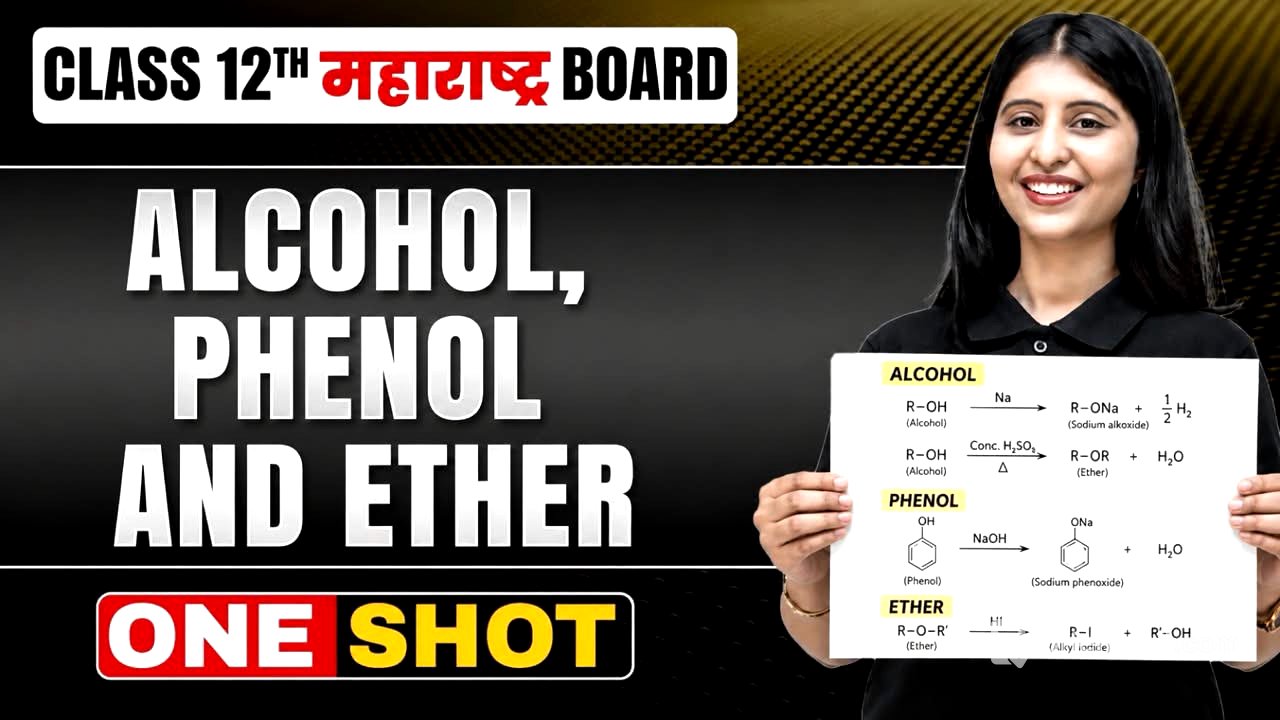
The video presents a comprehensive session on Alcohols, Phenols, and Ethers, focusing on their properties, classifications, and essential reactions. It emphasizes the importance of specific chapters and provides valuable tips for students.
- Detailed exploration of Alcohol, Phenols, and Ethers with examples.
- Discussion on previous year questions and important reactions.
Introduction and Initial Remarks
The session starts with the instructor addressing technical issues and engaging with students who are encouraged to share the session. The focus is on the importance of the Alcohol, Phenols, and Ethers chapter for clarity in organic chemistry.
Chapter Overview [1:14]
The instructor explains that understanding the concepts of Alcohol, Phenols, and Ethers is crucial, as missing these can lead to confusion in organic chemistry. Various question types, including one-mark and two-mark questions, are introduced for preparation.
Importance of Alcohols, Phenols, and Ethers [3:20]
The chapter on Alcohols, Phenols, and Ethers is significant and foundational for the students. Missing this chapter would hinder progress in organic chemistry, hence detailed notes and examples are provided.
Alcohols - Definitions and Classifications [4:10]
Alcohols are defined as compounds where a hydroxyl group (OH) replaces a hydrogen atom in an alkane. Classification includes mono-, di-, tri-, and poly-hydroxyl groups, which are significant for understanding their chemical behavior.
Phenols - Concepts and Structures [6:40]
Phenols are introduced as aromatic compounds with hydroxyl groups attached to the ring. They are further classified and discussed, focusing on their chemical behavior, which is crucial for students to grasp.
Ethers - Definition and Properties [9:15]
Ethers are explained as compounds formed by the dehydration of alcohols. The structural formula R-O-R' is highlighted, supporting the understanding of cestrence and their classifications.
Reactions and Properties of Alcohols and Phenols [11:50]
The session discusses multiple reactions involving Alcohols and Phenols, including oxidation, esterification, and reduction. Each reaction is illustrated with proper examples and detailed explanations.
Ethers - Synthesis and Reactions [14:40]
The synthesis of Ethers via Williamsons synthesis is demonstrated. The process involves reacting alkyl halides with alcohol or phenol under certain conditions, and its significance in chemistry practice is emphasized.
Key Reactions and Practical Applications [18:20]
The instructor emphasizes the practical applications of Alcohols, Phenols, and Ethers in various industries and lecture examples are derived from prior examinations.
Final Remarks and Revisiting Key Concepts [20:20]
As the session nears its conclusion, important key reactions and structural formulas are reiterated for better retention. The importance of understanding the chemical reactions involving these compounds is stressed again.
Suggestions for the Next Session [23:00]
Towards the end, the instructor asks for student feedback regarding the next chapter they would like to cover, suggesting Coordination Compounds as an option. Comments and engagement from students about their understanding and suggestions for future sessions are encouraged.