TLDR;
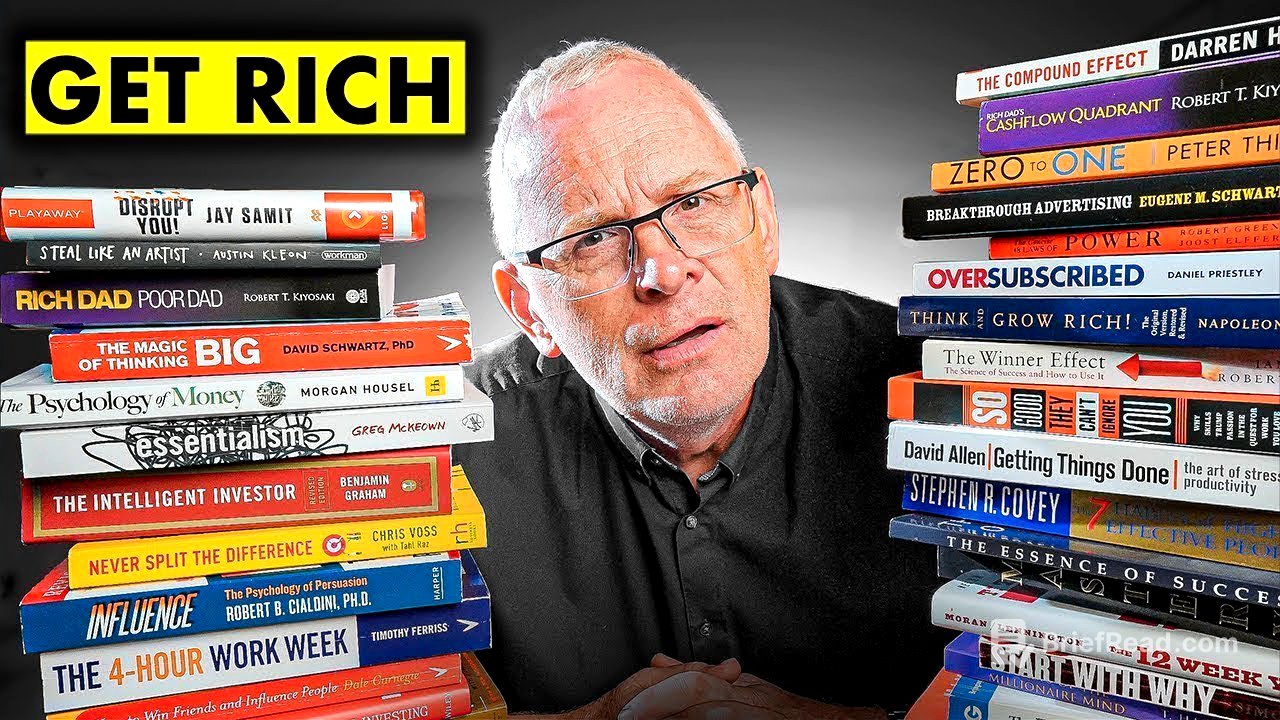
This video condenses the core lessons from 40 money-making books, providing a roadmap to go from zero to tens of millions. It emphasizes mastering your mindset, building high-value skills, understanding personal finance, and leveraging business strategies. The books are categorized into three levels: $0 to $100,000, $100,000 to $1 million, and $1 million to $10 million+, offering actionable insights for each stage of wealth creation.
- Master your mindset and rid yourself of negative beliefs about money.
- Build high-value skills and create a unique stack that is hard to replicate.
- Understand personal finance and invest wisely.
- Leverage business strategies to generate more value than you can from just selling your time.
Intro [0:00]
The video is about condensing the lessons from 40 money-making books into actionable advice to help viewers become rich. The speaker shares his experience of going from zero to making tens of millions through real businesses, not just YouTube, and promises that the shared insights can take viewers from $0 to $100,000, $100,000 to a million, and a million to $10 million if applied correctly.
Level One: $0 to $100,000 [0:43]
The initial step to making your first $100,000 involves mastering your mindset. It's important to get rid of negative beliefs about money, often ingrained from a young age. Understanding the true purpose of money, which is freedom and control, is crucial. Also, it's important to believe in your potential for wealth and set ambitious goals.
40. Secrets of the Millionaire Mind [0:58]
"Secrets of the Millionaire Mind" explains how phrases and beliefs programmed from youth can negatively impact one's ability to make money. It highlights the importance of overcoming these negative feelings associated with wealth to achieve financial success.
39. The Psychology of Money [1:22]
"The Psychology of Money" emphasizes that money is about freedom and control, highlighting the difference between being rich (visible assets) and wealthy (unseen assets). It underscores the importance of saving, investing, and postponing consumption to build true wealth.
38. The Magic of Thinking Big [1:56]
"The Magic of Thinking Big" explains that people often limit their potential by setting their finish line too soon. While thinking big alone won't guarantee success, it's a necessary first step toward achieving significant goals.
37. The Winner Effect [2:23]
"The Winner Effect" discusses studies showing a correlation between success and factors like testosterone levels. Winning increases testosterone receptors in the brain, leading to more wins. Setting achievable goals and getting small wins every day is important for building momentum.
36. Think and Grow Rich [2:55]
"Think and Grow Rich" tells a story about a commander who burned his army's ships to force them to fight with everything they had, leading to victory. This illustrates the difference between wanting to succeed and needing to succeed, highlighting that comfort and having an escape plan can be detrimental.
35. Unscripted [3:25]
"Unscripted" argues that society aims to turn people into "model citizens" (mediocre, obedient, dependent, entertained, and lifeless). Avoiding this fate depends on how well you manage stress and resist societal pressures.
34. The Essence of Success [3:44]
"The Essence of Success" provides a helpful perspective on stress, comparing it to a large amount of water that can fit into a small glass. The idea is to imagine drinking this water and using it as fuel, turning stress into a source of energy.
33. Atomic Habits [4:12]
"Atomic Habits" reveals that many people focus on the end goal, which they can't control, rather than the process, which they can. The author's habit stacking technique, pairing a new habit with an existing one, is particularly helpful for forming new habits.
32. The 7 Habits of Highly Effective People [4:44]
"The 7 Habits of Highly Effective People" stresses the importance of knowing where you're going and thinking about how you want to be remembered. This provides extra motivation and direction in life.
31. The 12 Week Year [4:58]
"The 12 Week Year" suggests treating a year as 12 weeks to create a sense of urgency. This approach can be effective for those who work best under pressure, as it helps maintain focus and drive.
30. The Art of Getting Things Done [5:14]
"The Art of Getting Things Done" emphasizes the importance of capturing all your tasks on a phone or notepad instead of relying on your brain. This allows you to organize tasks without confusion and be selective with how you spend your time.
29. Essentialism [5:31]
"Essentialism" reminds us that for every task we say yes to, we have to say no to many others. Therefore, it's important to value saying yes and not be afraid to say no to non-essential tasks.
28. So Good They Can't Ignore You [5:50]
"So Good They Can't Ignore You" argues against simply following your passion. The author found that people who love their jobs didn't necessarily start with a passion for their work; rather, their love grew as they improved their skills.
27. The Unfair Advantage [6:08]
"The Unfair Advantage" suggests that to succeed in an unfair world, you need to play to your natural strengths. Find what you're better at than most people and lean into it to gain an advantage.
26. Mastery [6:33]
"Mastery" emphasizes the importance of developing a unique stack of skills that is nearly impossible to replicate. This is crucial in a world where artificial intelligence is rapidly replacing many jobs.
25. Steal Like an Artist [6:43]
"Steal Like an Artist" echoes the point about unique skill sets, suggesting copying from multiple inspirations until you have a mix that is truly original. This helps in creating a distinctive and valuable skill set.
24. Rich Dad, Poor Dad [7:07]
"Rich Dad, Poor Dad" shares the lesson that everything we buy is either an asset or a liability. An asset puts money in your pocket, while a liability takes it away. The aim should be to buy as many assets as possible.
23. The Compound Effect [7:31]
"The Compound Effect" uses the analogy of a penny that doubles every day for 31 days to demonstrate the power of investing and gaining compound interest. This illustrates how small, consistent investments can lead to significant wealth over time.
22. The Little Book of Common Sense Investing [8:02]
"The Little Book of Common Sense Investing" states that trying to beat the market is a losing game. Instead, you should own the entire market by investing in something like the S&P 500 or a broad market index fund.
21. The Intelligent Investor [8:40]
"The Intelligent Investor" suggests imagining a person called Mr. Market who comes to your door every day offering different prices for your stock. The market is irrational, and stock prices are based on demand, not the actual real-world value.
20. One Up on Wall Street [9:10]
"One Up on Wall Street" shares the phrase, "If you love the store, chances are you'll love the stock." This means if you have a lot of experience with a company or product, you might have a bigger advantage than the pros when it comes to investing.
Level two: $100K to $1M [10:32]
To make the leap from $100,000 to $1 million, you need to generate more value than you can from just selling your time. This involves understanding different ways to earn money and moving to the right side of the cash flow quadrant.
19. Cashflow Quadrant [10:52]
"Cashflow Quadrant" outlines four distinct ways to earn money: E (employee), S (self-employed), B (business owner), and I (investor). Business owners and investors have the advantage of using other people's time and money to build their wealth.
18. The 4-Hour Work Week [11:15]
"The 4-Hour Work Week" explains that relative income trumps absolute income. It's not just about how much you earn, but how much you earn per hour and the freedom you have with your time.
17. Zero to One [12:04]
"Zero to One" states that the first step to starting a business is betting on a contrarian truth. This is the basis for most successful businesses, as they identify and capitalize on unconventional ideas.
16. Disrupt You [12:28]
"Disrupt You" outlines an effective method for coming up with business ideas: write down three things that annoy you every day and think about how they could be done better. This generates a large number of potential ideas to consider.
15. The Lean Startup [12:50]
"The Lean Startup" emphasizes the importance of execution and the use of the build-measure-learn feedback loop. This approach ensures that you don't create something nobody wants and allows you to pivot and adapt your idea as you go.
14. Blue Ocean Strategy [13:15]
The Blue Ocean Strategy refers to creating a market with little to no competition, while a Red Ocean is marked by fierce competition. Businesses in blue oceans tend to be more profitable and dominate their industries for longer periods.
13. Oversubscribed [13:44]
To create your own blue ocean, consider becoming oversubscribed. This means having more demand than supply, which keeps prices high and the product highly desired.
12. Breakthrough Advertising [14:09]
"Breakthrough Advertising" states that you can't manufacture desires; instead, your job is to create a product that fulfills the market's already existing desires.
Level three: $1M to $10M+ [14:24]
To go from $1 million to $10 million+, you need the ability to inspire others and lead effectively. This involves understanding the psychology of persuasion and building strong relationships.
11. Influence: The Psychology of Persuasion [14:35]
"Influence: The Psychology of Persuasion" is one of the best books on persuasion. Giving value and helping others often leads to reciprocity and greater success in the long run.
10. Never Split the Difference [15:05]
"Never Split the Difference" suggests using tactical empathy to negotiate effectively. Empathizing with someone's situation can get them to empathize with yours, leading to better outcomes.
9. How to Win Friends and Influence People [15:16]
"How to Win Friends and Influence People" emphasizes that people want to be heard and don't want to be told they're wrong. Understanding and validating others' perspectives is crucial for building strong relationships.
8. Pitch Anything [15:30]
"Pitch Anything" explains that humans are emotional creatures who make decisions with emotion and then justify them with logic. To sell something, you need to appeal to the emotional brain first by making your offer simple and emotionally compelling.
7. Start With Why [15:58]
"Start With Why" shares the Golden Circle concept: why is at the center, how is in the middle, and what is in the outer ring. Great leaders start with why, inspiring action rather than just telling people what to do.
6. The 48 Laws of Power [16:41]
"The 48 Laws of Power" reveals that leaders are often calculated. One key law is to keep people dependent on you, as this ensures you can't be easily replaced and maintain power.
5. The E Myth [17:10]
"The E Myth" outlines how most people who start businesses are not entrepreneurs but rather good at a certain skill. To succeed, you need to build systems and processes that don't rely solely on your individual skills.
4. Profit First [17:39]
"Profit First" proposes that entrepreneurs should run their business with the calculation: sales minus profit equals expenses. This ensures that they are always profitable by prioritizing profit allocation.
3. Good to Great [18:04]
"Good to Great" describes the hedgehog mentality, which involves specializing in one specific niche and becoming the best in that field. Being extremely good in one area makes you rich in the long run.
2. The Fourth Turning [18:33]
"The Fourth Turning" suggests that every century consists of four 25-year historical blocks: the high, awakening, unraveling, and crisis. Understanding these cycles can provide perspective on world events.
1. The changing world order [18:48]
"The Changing World Order" discusses the idea that every major superpower has its time and eventually declines. This can provide a perspective on how events and trends may impact the economy and society.