TLDR;
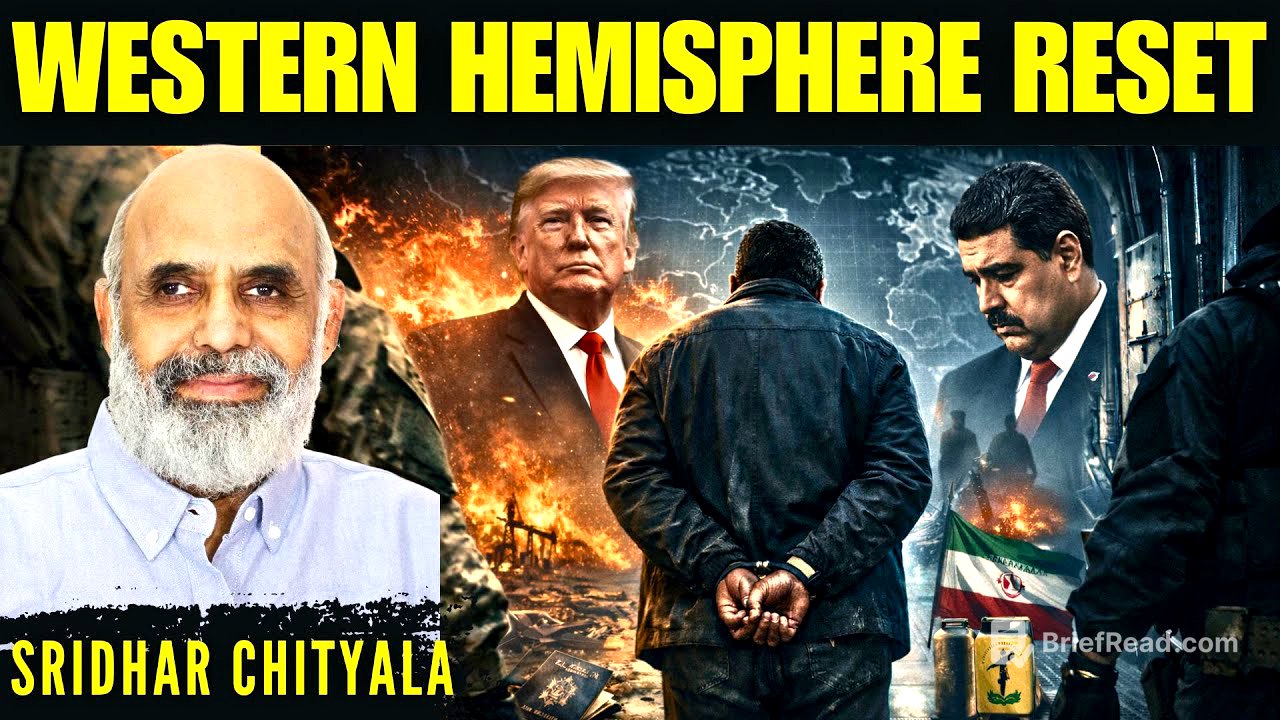
This video discusses the capture of Nicolas Maduro and the events leading up to it, presenting both the US perspective and the reactions from other countries. It covers the US operation, the charges against Maduro, the involvement of Iran and Hezbollah in Venezuela, and the political fallout. The video also touches on the historical context, the potential impact on the oil market, and the broader implications for US foreign policy in the Western Hemisphere.
- US forces raided Venezuelan palace and captured Nicolas Maduro.
- Maduro faces drug charges and narco-terrorism charges in the US.
- Iran and Hezbollah have a significant presence in Venezuela, using it as a trafficking hub.
- The US is sending a warning to other rogue nations and shifting its policy to focus on threats closer to home.
Introduction [0:03]
The video introduces the topic of Nicolas Maduro's capture and the various factors that contributed to it. It promises exclusive details and insights not covered elsewhere, inviting viewers to like the video and welcoming Sridar Chaiti to present the analysis.
The US Perspective [0:57]
The presentation begins by acknowledging the two sides of the story: the US and Western version, and the reactions from other parts of the world. It focuses on the US rationale behind the capture of Maduro, highlighting a press conference featuring President Trump and Marco Rubio, and a picture taken on the ship that transported Maduro to the United States.
The Capture of Maduro [1:59]
US forces, in collaboration with the FBI and CIA, conducted a raid on the Venezuelan palace, capturing Nicolas Maduro. The operation involved attacks on multiple locations in Karakas, with the Delta Force landing at the palace to apprehend Maduro before he could reach his fortified safe room. Maduro was then transported to the United States, where he was received by the FBI, Drug Enforcement Directorate, and the Department of Justice.
Trump's Assertions and Warnings [3:18]
President Trump asserted that the US will oversee Venezuela until a proper transition is in place, warning other countries with "rogue regimes" that similar actions could be taken. Marco Rubio specifically targeted Cuba, suggesting that they could be next if they do not change. Trump also stated that US firms will invest in rebuilding Venezuelan oil fields, and both Cecilia and Nicolas Maduro will face the full force of the court. The operation was conducted in complete secrecy, without briefing the "gang of eight" intelligence committee.
Legal Justification and Indictment [5:49]
Senator Tom Cotton stated that Maduro is a criminal running a drug racket, and the 2024 election was illegal, justifying the lack of formal briefing to the "gang of eight". US Attorney General Pam Bondi announced that Nicolas Maduro and his wife were indicted in 2020 on drug charges, which have been superseded by new narco-terrorism charges. The case will be filed in the Manhattan court, utilising the US judicial system to enforce the indictment. The charges are based on evidence of fentanyl-laced drugs from Venezuela entering the United States, which is considered an act of narco-terrorism.
Iran and Venezuela Connection [8:52]
The video shifts to the historical connection between Iran and Venezuela, noting that this relationship has suffered a blow due to recent events. Venezuela has been used by Hezbollah as a trafficking hub to collect money through illegal arms, oil trade, and other criminal activities to fund its operations. Maduro is accused of providing diplomatic passports and immunities to terror proxies, and Iran has supplied Venezuela with operational drones, posing a threat to US interests.
Tariq El Aissami and Hezbollah Training Camps [11:06]
Tariq El Aissami, a former Venezuelan vice president, is accused of corruption, money laundering, and having links to Hezbollah. During his tenure, four to six terror training camps began operating in Venezuela, particularly around Margarita Islands. El Aissami is on the US Immigration and Customs Enforcement's (USIC) most wanted list since 2019.
Hezbollah's Presence in Venezuela [13:07]
Evidence suggests Hezbollah has had a longstanding presence in Venezuela, with Margarita Island being a main training location since the 1990s. Government cover facilitates Hezbollah's covert activities, including providing Venezuelan passports. This presence has become a growing threat to US interests in the Western Hemisphere. Marco Rubio has emphasised the importance of addressing these nearshore threats rather than focusing solely on the Middle East or South China Sea.
Obama's National Security Threat Declaration [14:54]
Going back to 2015, President Obama declared Nicolas Maduro a national security threat to the United States, highlighting the longstanding concerns regarding Venezuela.
Hezbollah-Venezuela Axis and Funding [15:16]
Intelligence confirms the Hezbollah-Venezuela axis extends from Argentina to Colombia, with support from Venezuela, Russia, and Iran. The annual budget spent by Iran on Hezbollah ranges from $400 to $700 million, funded by oil smuggling, drugs, and crime. This funding supports operations in Yemen, Syria, Lebanon, and Gaza. Evidence also suggests fentanyl is mixed with cocaine in US drug supplies, leading to the narco-terrorism indictment.
The Axis Beneath Venezuela [17:17]
The extent of Iran, Russia, China, and Maduro's nexus is explored. While Venezuela has the largest oil reserves, their usability is limited due to the lack of refineries for light sweet crude. The role of China extends beyond oil and resources to rare earth minerals. Russia and Iran are suspected of arming the regime to sustain power and shield the illegal oil and narcotics trade. Hezbollah may have been trained to launch soft attacks against the United States or Israeli targets in Latin America. Benjamin Netanyahu's recent visit to the White House suggests consultations on this matter, with intelligence inputs from Mossad and the CIA operating in Venezuela.
The Maduro Family's Involvement [19:18]
Fourteen members of the Maduro family have been identified as operating and managing the drug narcotics ring, controlling the finances and key positions in defence, intelligence, and the army. This is why the opposition leader does not recognise Maduro as president, claiming he stole the 2024 elections, which were allegedly won by Gonzalez, who is now in exile in Spain.
New US Doctrine [20:47]
The US policy has shifted to focus on the Western Hemisphere, as confirmed by Marco Rubio. The emphasis is on addressing looming threats near home, such as drones from Iran and the strong Hezbollah-Iranian footprint in Venezuela. This nearshore threat to US security is a primary concern. The US is sending a warning to other rogue nations that it is prepared to act. Benjamin Netanyahu's visit to the US may have been to brief Trump on Hezbollah in the region.
Left-Wing Reactions and Protests [22:42]
Left-wing groups in the United States have swiftly organised protests against the US action in Venezuela, calling for an end to the intervention and the release of Maduro. These groups, often involved in rallies related to events like 9/11 and Israeli raids on Gaza, mobilised with remarkable speed. Prominent figures like Mamani, Kamala Harris, AOC, Ilhan, Bernie Sanders, and Senate leader Schumer have condemned the US action, while Tom Cotton defended it as the enforcement of an indictment within US law, referencing the case of Daniel Noriega in 1989.
Key Figures and Ecosystem [24:48]
The presentation identifies key figures and groups involved in the protests and reactions to Maduro's capture, highlighting their rapid response and organised efforts. Figures like Vijay Prashad and Neville Roy Singum are mentioned, linking them to broader networks.
Who is Running Venezuela Now? [26:28]
Currently, Venezuela is being run by Vice President Rodriguez, as ordered by the Supreme Court. Conversations have occurred between Marco Rubio and Rodriguez, but the truth of their statements remains uncertain. The Maduro gang is still active in Venezuela, and Rodriguez is likely protecting herself. The situation's evolution will become clearer in the coming days.
International Reactions and Support [27:31]
There is unanimous support from Europe and some members of the Democratic Party, as well as some people in Venezuela, who view Maduro's removal as a positive development. However, countries like Russia, China, Iran, and North Korea have expressed concern and deemed the operation illegal, without fully understanding the nuances of dealing with drug lords in the United States.
Conclusion [28:12]
The video concludes by emphasising that the information presented is based on available data and the indictment. It suggests that this is just the beginning, with more developments to come. The discussion also touches on the strategic importance of locations like Cologne near the Panama Canal, used by China as a distribution warehouse for Latin America, facilitating the potential mixing of drugs with legitimate merchandise. The presenters highlight the long-term investment in these operations, referencing a 2017 incident where President Trump considered arresting Maduro. The situation may also impact the crude market and potentially challenge Russia's actions in Ukraine. The presenters encourage viewers to digest the information and stay tuned for further updates.