TLDR;
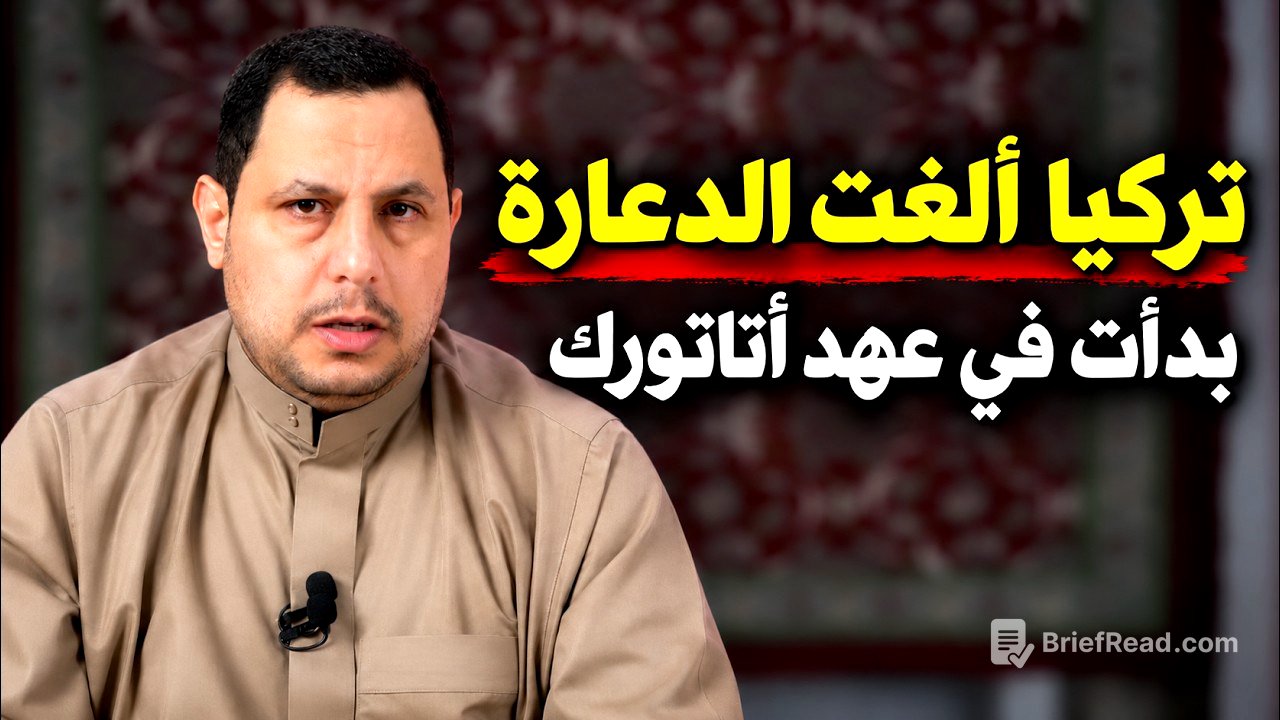
The video presents Turkey’s Constitutional Court decision to invalidate a 1930 law regulating brothels as a milestone in protecting women’s dignity. It links prostitution to poverty, social isolation and the loss of tribal support, while arguing that Turkish governments have acted gradually because of foreign pressure. The speaker contrasts secular legal systems with his interpretation of Islamic law and history, and proposes restoring tribes as a means of providing social protection, political independence and what he regards as genuine democracy.
- The speaker says the Court found the brothel law degrading to women and identified poverty and family breakdown as reasons some women enter prostitution.
- He argues that Turkey’s earlier closure of brothels and the Court’s ruling form part of a gradual change, constrained by external political and economic pressure.
- He presents tribes as a source of financial, social and security support, and calls for their restoration.
- His account combines historical and religious arguments with criticism of modern secular governments and liberal democracy.
The Constitutional Court’s ruling and the history of brothels in Turkey [0:00]
The speaker says Turkey’s Constitutional Court has invalidated a law introduced in 1930 that required the Interior and Health Ministries to supervise and regulate brothels. He describes the ruling as finding the law degrading to women and says it identifies poverty, the loss of a family breadwinner, divorce, family breakdown and limited job opportunities as circumstances that can lead women into prostitution. He gives an estimated figure of 3,000 licensed women today, contrasting it with a claimed 100,000 in 1980.
The ruling is presented as the culmination of a longer process of closing brothels. The speaker says that in 2010 the government demolished a large brothel building in the Ulus district of Ankara and that Interior Minister Ali Yerlikaya had recently closed brothels in the area near Hacı Bayram Mosque. He argues that these actions had already weakened the brothel system before the Court’s decision. He also notes that the case reached the Constitutional Court after brothels sued the Interior Minister and administrative judges referred the matter over concerns that the law violated constitutional protections for women’s dignity.
Erdogan’s political constraints and foreign influence [5:20]
The speaker questions why President Erdoğan did not abolish prostitution earlier, given his long time in office. He argues that Erdoğan only gained effective control over the state after the attempted coup in July 2016, claiming that before then the military, police and judiciary were affected by foreign influence and by the Gülen movement. He describes the years before 2016 as a period in which Erdoğan had limited power to reshape the state.
He places Turkey’s situation within a broader history of Muslim countries losing sovereignty after the First World War, citing European occupations of Egypt, Tunisia, Algeria, Morocco, Baghdad and Istanbul. He claims that foreign occupation helped spread brothels and that secular governments subsequently maintained systems that exploited women. He further argues that Turkey faces continuing external pressure, particularly from the European Union, and that its government therefore makes changes gradually to avoid sanctions or economic retaliation.
Poverty, women’s welfare and the speaker’s case for tribal support [8:13]
The Court’s findings are used to argue that women who enter prostitution are victims of social and economic circumstances. The speaker says the government should provide them with financial support, and presents this as consistent with his understanding of Islamic social obligations: a woman should be supported by her husband or family, and if those sources are absent, by the state. He distinguishes this from work he considers suitable or necessary for women, such as midwifery and teaching girls.
He traces women’s vulnerability to the loss of extended family and tribal networks. In his account, tribes provide material aid, care for widows and children, help with medical costs, mediate disputes and offer protection from crime or state abuse. He argues that removing these networks leaves individuals isolated, making women particularly vulnerable to poverty, divorce and exploitation. He also links the decline of tribal structures to the destruction of traditional communities and to the growth of prostitution.
Tribes, political independence and criticism of modern democracy [12:21]
The speaker claims that tribes are essential to a functioning democracy and that countries without them cannot be genuinely democratic. He argues that Turkish and Kurdish tribes helped establish modern Turkey by supplying soldiers, money and community support during the War of Independence. In his view, tribes also offer local security and dispute resolution, reducing reliance on police, courts, insurance systems and heavy taxation.
He criticises both authoritarian governments and liberal Western democracies, arguing that elected politicians often serve powerful interests rather than citizens. He claims that international economic pressure can force governments to enact laws they would not otherwise choose, and describes governments around the world as administrative rather than truly sovereign. He also argues that political and economic power influences laws governing families, education, clothing and social life. His proposed alternative is a state rooted in tribal communities, which he says would restore sovereignty and provide practical protection for people.
Pre-Islamic Mecca, prostitution and the Qur’anic argument [22:00]
The speaker turns to pre-Islamic Mecca and argues that even the Quraysh leader Abu Jahl did not permit free women of his tribe to enter prostitution, although enslaved women could be forced into it. He cites Hind bint Utbah’s question to the Prophet Muhammad about whether free women committed adultery as evidence, in his interpretation, that elite women were protected while women without tribal status were exploited. He connects this to the Qur’anic prohibition on forcing enslaved women into prostitution, arguing that Islam extended protection to women who had previously been treated as socially inferior.
He describes Mecca as having tribal leaders, councils and agreements that regulated political and commercial life, while presenting the Prophet’s opposition as a challenge to who had authority to set the law. He interprets the opening verses of Surah An-Nas—“the Lord of mankind”, “the King of mankind” and “the God of mankind”—as asserting that ultimate authority to establish law belongs to God. In this account, Islamic government administers divine law rather than claiming sovereignty to create it. The speaker contrasts this with rulers who, he says, change laws to serve those holding political power.
Islamic government, legal authority and historical claims [29:33]
The speaker characterises the Prophet’s role as interpreting and implementing the Qur’an and Sunnah, while the law itself comes from God. He argues that rulers in Islamic history, including the Umayyads, Seljuks, Ayyubids, Mamluks and Ottomans, were constrained by Islamic law and could not simply confiscate property, force women to work or impose arbitrary punishments. He presents these governments as administrative rather than sovereign in the sense that they did not have unlimited authority to make law.
He makes an exception for a period of Abbasid rule, which he associates with the Mu‘tazila, a theological movement, and criticises the way Islamic history is taught in schools. He disputes the portrayal of some Muslim rulers as uniquely oppressive, arguing that secular governments also committed violence while still being credited with building civilisation. To explain how law operates in practice, he cites Egyptian jurist Abd al-Razzaq al-Sanhuri’s statement that law is power, arguing that the force behind a state determines what laws it imposes.
Social protection, taxation and the consequences of exploitation [33:57]
The speaker returns to the exploitation of women, contrasting the protection afforded to powerful tribal women with the treatment of enslaved women and captives. He argues that Islam’s prohibition on coercing women into prostitution rejected this unequal division and held those responsible for coercion accountable. The Turkish Court’s recognition of women as victims is presented as resembling this principle.
He criticises modern European countries for taxing women who engage in prostitution, describing this as making vulnerable women financially support the state. He contrasts this with his account of early Muslim conquests, in which women, children, older people and clergy were exempt from taxation, and cites rates of about five per cent on some trade and ten per cent on certain goods. He uses these comparisons to argue that contemporary governments exploit people while claiming to protect them, and says written constitutions often fail to reflect the will of citizens.
Restoring tribes as the proposed solution [38:59]
The speaker argues that social isolation, divorce and limited family support make women more vulnerable to prostitution. He claims that extended families and tribes could provide assistance and prevent women from being left without income or a home. He also rejects population-control arguments based on resource scarcity, comparing human reproduction with the natural reproduction of animals.
He presents tribes as the foundation that can survive the collapse of a central government and help rebuild a state. In support, he refers to early Islamic cities such as Fustat, Kufa, Basra and Kairouan, saying that neighbourhoods were organised around particular tribes. He also claims that tribal networks helped preserve political communities during periods of conflict and supplied military strength and social support. The video concludes that restoring tribes would protect women’s dignity, reduce prostitution, recover political independence and replace what the speaker regards as superficial democracy with genuine self-government.