TLDR;
Habits can become powerful, automatic behaviours that continue even when they no longer bring rewards or cause harm. Dr Jeffrey Schwartz explains how the brain’s striatum builds and runs these habitual “chunks” of action, while mindfulness and deliberate attention help people recognise and change their responses.
- The brain supplies thoughts, urges and information, but the mind can choose how to respond.
- Repetition can make habits independent of goals and rewards, and old habits may return after a trigger.
- Self-affirmation, reflection on personal values and mindfulness can help people pay attention, assess their habits and make different choices.
The brain, the mind and habit [1:01]
Schwartz defines the mind as the choices and decisions people make about information supplied by the brain. Habits challenge this distinction because repeated behaviours can become almost automatic, leaving less room for deliberate decision-making. He argues that people are not simply their brains, but resisting habitual responses takes effort and attention.
Citing psychologist William James, Schwartz notes that people are largely shaped by habits and repeat patterns from their past. Yet James also emphasised that voluntary effort is closely connected to attention. Mindfulness, in this sense, involves deliberately noticing whether a habit is helpful or harmful and choosing how to respond.
How the striatum turns actions into habits [7:35]
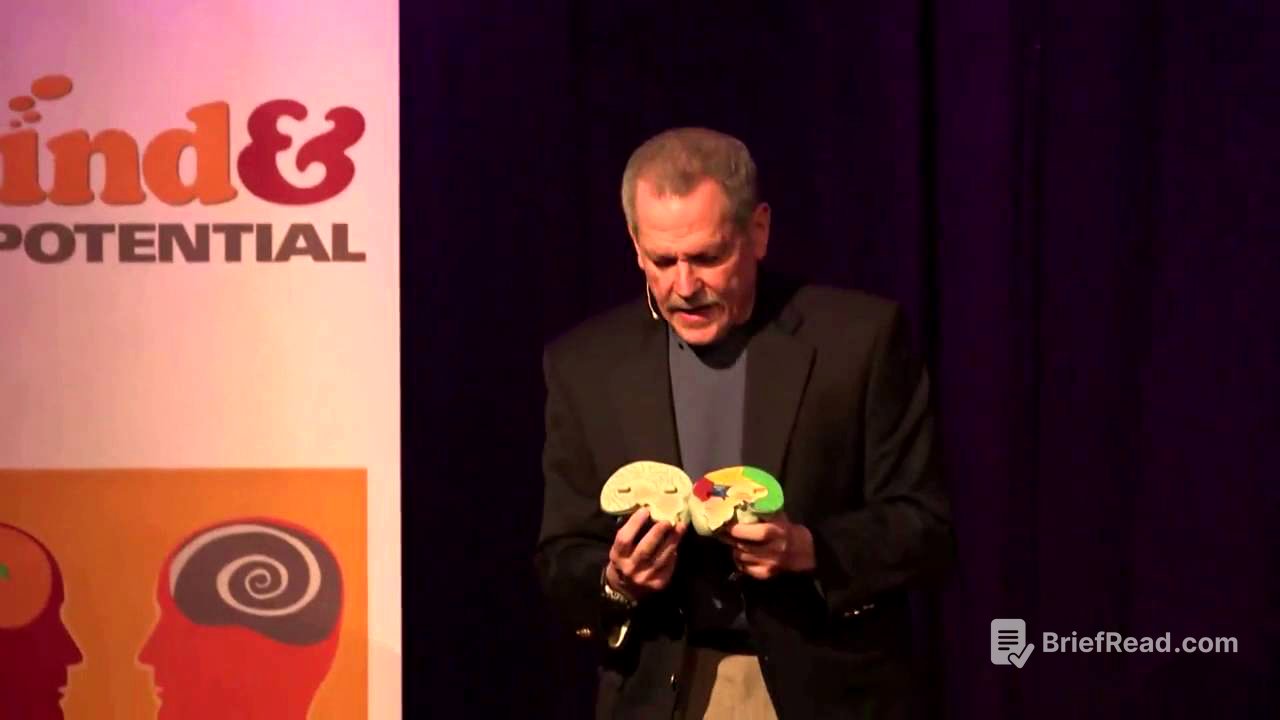
Schwartz describes the brain’s striatum, a deep structure made up of the caudate and putamen, as a key part of habit formation. It interacts with the cortex, including the orbitofrontal cortex, which contributes to noticing that something is wrong and assessing value. The striatum can act like an automatic transmission: it takes over the execution of learned behaviours, producing useful habits when the behaviour is adaptive, but problematic patterns when it is not.
The striatum includes circuitry involved in habits, goal-directed behaviour and reward. Dopamine is an important neurotransmitter in reward signalling; it is associated with pleasure and also plays a role in the effects of addictive drugs such as cocaine. Rewards can support learning, but they can also reinforce behaviours that become harmful. As habits become more firmly established, they can become less connected to conscious goals and decision-making.
Schwartz illustrates this with smoking: taking out a cigarette, lighting it and smoking can become a sequence performed without conscious awareness. The brain treats this sequence as a single behavioural “chunk”. Researchers call the pattern “task bracketing”: striatal activity marks the beginning and end of the sequence, while the actions between those points run automatically.
Experiments show how habits become automatic [19:18]
Experiments led by Kyle Smith in Ann Graybiel’s laboratory at MIT examined habit formation in rats. A tone taught each rat to turn left for chocolate milk or right for sugar water. At first, the rats learned through goal-directed behaviour: they responded to the signal, sought the appropriate reward and received dopamine-related reward signals.
After extensive training, the researchers paired one reward with a drug that caused nausea. Even when that reward became unpleasant, the rats continued running towards it when they heard the associated tone. Their behaviour had become a habit, no longer guided by the reward or by whether the outcome was good for them.
Brain recordings showed that, as the habit developed, activity shifted towards circuitry involved in automatic action, with the striatum marking the start and end of the behavioural sequence. The behaviour became less dependent on decision-making and more closely linked to sensory and motor systems.
The researchers also temporarily inactivated a small area of the ventromedial prefrontal cortex, a region associated with personal relevance and value. This immediately disrupted the rats’ established habit. However, the original habit remained stored: when the same brain area was inactivated again about a week later, the rats returned to the old behaviour. Schwartz relates this to people who have stopped smoking, drinking or overeating but relapse after stress, social pressure or exposure to familiar cues.
Personal values can support behaviour change [32:06]
Schwartz connects research on habits with research into subjective value: the sense that something matters to oneself. Studies reviewed in a meta-analysis found that thoughts about things people consider valuable or personally relevant engage the ventromedial prefrontal cortex and dopamine-related areas.
A 2015 study examined whether self-affirmation could help people respond to health advice. Health messages alone often fail to change the behaviour of people who are sedentary. In the study, participants first reflected on core values such as creativity, family, friendship, faith or other personally meaningful qualities, then listened to health messages.
Self-affirmation activated the ventromedial prefrontal cortex and helped participants regard the advice as personally important. They paid more attention to messages encouraging exercise, and over the following month they became more active and less sedentary. Schwartz’s takeaway is that reflecting on genuine personal values can help make behaviour change feel relevant.
Mindfulness, discernment and choosing a response [38:53]
Schwartz describes mindfulness as taking an outside perspective on inner experience. He also calls this the “impartial spectator”, drawing on the philosopher Adam Smith: an inner perspective that can observe thoughts and impulses clearly and fairly. He uses related terms such as “wise advocate”, inner helper, counsellor and encourager to describe this capacity.
Mindfulness requires honest, non-judgemental observation: thoughts, urges and preferences should be noticed rather than edited or denied. But non-judgemental observation does not mean approving of everything that arises. Schwartz stresses the need for discernment and good judgement: people can acknowledge that a thought or impulse is theirs while still deciding that acting on it would not be helpful.
With practice, people can notice automatic behaviours that would otherwise pass without awareness and assess whether they support their goals. Schwartz refers to a four-step method—label, reframe, refocus and revalue—and summarises the relationship between brain and mind as follows: the brain produces the impulse, while the mind decides whether to follow it. His closing message is that people can use mindful attention and deliberate choices to become less controlled by habits and more active in shaping their responses.