TLDR;
The video examines how design choices, software restrictions and corporate control can make smartphones and other products difficult or expensive to repair. It traces the issue from Apple’s battery-throttling controversy and the experiences of independent repairers to lobbying over right-to-repair laws in the US and Europe.
- Apple said it slowed some iPhones to prevent unexpected shutdowns, but the controversy raised concerns about ownership, repair access and the incentive to upgrade.
- Parts pairing, restricted repair tools, high repair prices, unusual screws, adhesives and soldered components can obstruct independent repairs.
- Right-to-repair legislation has faced lobbying and exemptions, though EU rules have introduced new repair requirements that may influence products worldwide.
The iPhone, BatteryGate and the Repair Business [2:42]
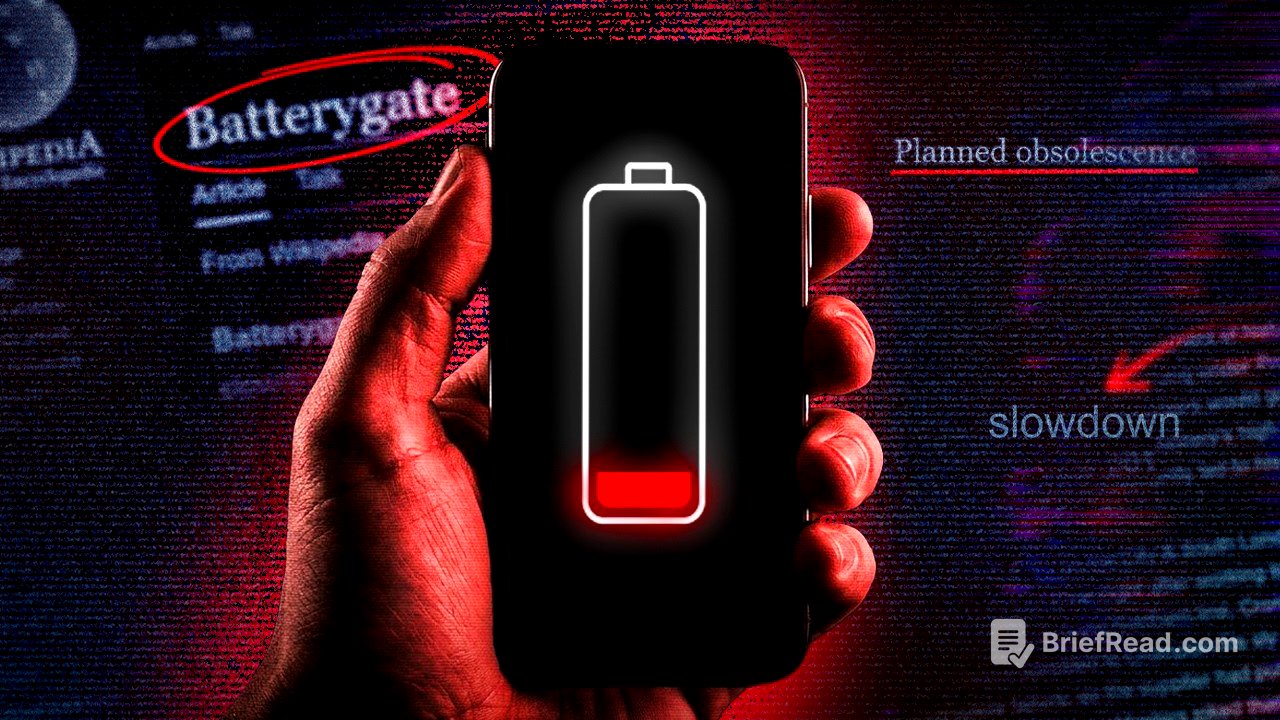
The iPhone’s early success helped establish a cycle of annual launches and regular upgrades. In 2017, Tennessee teenager Tyler Barney noticed that his iPhone 6s became slower after an iOS update. Replacing its ageing battery made it faster, and his post helped expose Apple’s practice of slowing some phones when their batteries could no longer reliably provide peak power. Apple said this was intended to prevent unexpected shutdowns, not to push customers towards new phones, but the controversy became known as “BatteryGate”.
Apple apologised, reduced out-of-warranty battery replacement prices by $50 for a year, and added battery-health information to iOS. According to information attributed to a leaked staff meeting, the scheme led to 11 million battery replacements, though Apple did not verify that figure. iPhone revenue later fell by 15%; Tim Cook said battery replacements had hurt profits, and Apple cut its projected quarterly revenue. The company ultimately agreed to settlements of up to $500 million in the US and $113 million for cases brought by 34 state attorneys general, without admitting liability or wrongdoing.
The controversy also showed that consumers might repair phones rather than replace them if repairs were affordable and straightforward. Jessa Jones discovered this first-hand after her children damaged her iPhone. She taught herself board-level repair and micro-soldering, eventually opening a repair business with other local mothers. Their work became increasingly difficult as access to parts, software and repair information grew more restricted.
The Barriers Facing Independent Repairers [8:31]
One major obstacle is parts pairing: software associates certain components, such as batteries, displays and cameras, with a specific device. A replacement part may trigger persistent warnings or disable features unless Apple’s systems authorise it. Apple says pairing supports calibration, performance, transparency, privacy and security, and introduced its Repair Assistant in 2024. Repair advocate Lewis Rossmann argues that repairers should not have to ask the manufacturer’s permission to maintain devices. The number of serialized iPhone parts reportedly rose from two in 2015 to nine in 2020, although Apple began relaxing some rules for certain models in 2024.
Independent repair shops also face difficulties accessing diagnostic tools, manuals and genuine parts. Before 2019, Apple did not provide these to unauthorised shops. Its Apple Authorized Service Provider programme offered access to official resources, but Rossmann said its rules often required shops to send devices back to Apple rather than carry out repairs themselves. A later Independent Repair Provider programme allowed more repair work, but a contract reported by Vice allegedly gave Apple broad audit powers, access to customer information and the ability to impose substantial fines. Apple did not dispute the reported contract terms, while describing its programmes as an expansion of repair options.
Repair costs can also be much higher through official channels. A 2018 MacBook Pro owner was quoted $1,200 by Apple to fix a black screen, while independent repairer Louis Rossmann found a bent pin and offered a free fix or a cable repair costing $75–$150. Similar differences were reported by a Wall Street Journal journalist in 2021. Apple said repairs performed by trained technicians using genuine parts were safest and most reliable. It also told a congressional subcommittee that it lost money on repairs, but did not provide figures to support the claim.
Product Design, E-waste and the Right to Repair [21:05]
Other design choices can make repairs harder. Apple began using pentalobe screws in its laptops in 2009 and later added them to other products. iFixit reported that some iPhone 4s returned for service had their ordinary screws replaced with pentalobes, making them difficult to open with common screwdrivers. Third-party toolmakers reverse-engineered the screws, so they became more of a temporary obstacle than a lasting lock.
Adhesives can be more hazardous: batteries and screens are often glued into place, and prying out a lithium-ion battery can puncture it and cause a fire. Apple introduced a battery adhesive in the iPhone 16 that releases when a low-voltage current is applied. Soldering chips, memory and storage directly to a logic board also prevents straightforward component swaps. Together, these barriers can leave consumers dependent on manufacturers and make repairs more expensive.
The same conflict appears in other industries. John Deere and Taylor, which makes McFlurry machines, have used software locks or copyright rules to restrict independent repairs. During the COVID-19 ventilator shortage, iFixit published repair guides and its chief executive later said the manufacturer Steris threatened legal action. In 2024, the US Copyright Office approved an exemption to Section 1201 of the Digital Millennium Copyright Act, helping McDonald’s stores repair their own ice-cream machines. These issues also contribute to growing electronic waste: the world produces about 62 million tonnes each year, equivalent to more than 6,000 Eiffel Towers.
Lobbying and the Fight for Repair Laws [27:24]
Nebraska farmer Kyle Schwarting’s $250,000 Case IH tractor repeatedly sounded an alarm over a faulty hydraulic connector he did not use. Software encryption prevented him from silencing it himself, although Case IH said customers could access diagnostic and repair resources and buy an electronic service tool. John Deere has similarly argued that buyers own the tractor but not necessarily its software. Schwarting joined other farmers campaigning for change, and Nebraska lawmakers proposed a right-to-repair bill.
The proposal failed after Apple representative Steve Kester reportedly warned state senator Lydia Brasch that the law could make Nebraska a haven for hackers, offering to back off if phones were exempt. Brasch said she had never experienced lobbying like it. Right-to-repair bills have been introduced hundreds of times across US states, but only ten states had enacted them at the time described. New York passed its Digital Fair Repair Act by 145 votes to 10, but amendments made before it became law narrowed its reach. According to Grist, TechNet, a lobby group representing Apple, Samsung, Google and others, proposed changes that were incorporated almost word for word. TechNet said its recommendations addressed consumer privacy and safety risks; Apple said it supports repair policies balanced with performance and safety.
The European Union adopted battery and smartphone rules requiring batteries to be replaceable with commercially available tools, with free specialised tools where needed, and spare batteries to remain available for years. However, an exemption for batteries retaining at least 80% of their capacity after 1,000 cycles covered iPhone 15 and later models, as well as some other phones. Digital Europe denied improperly influencing EU institutions, saying it had raised potential regulatory overlap. Further exemptions later removed products such as smartwatches, fitness trackers and electric toys from some requirements.
Despite those limits, EU rules have encouraged manufacturers to consider replaceable batteries, and require access to certain spare parts and repair tools. They also restrict the use of software pairing as an arbitrary barrier, without banning parts pairing altogether. The EU’s right-to-repair directive requires manufacturers to repair certain products for five to ten years, with parts and tools offered at prices that do not deter repair. Through the Brussels Effect—the tendency for EU rules to influence global product standards—these requirements could benefit consumers beyond Europe as manufacturers adopt common designs for multiple markets.