TLDR;
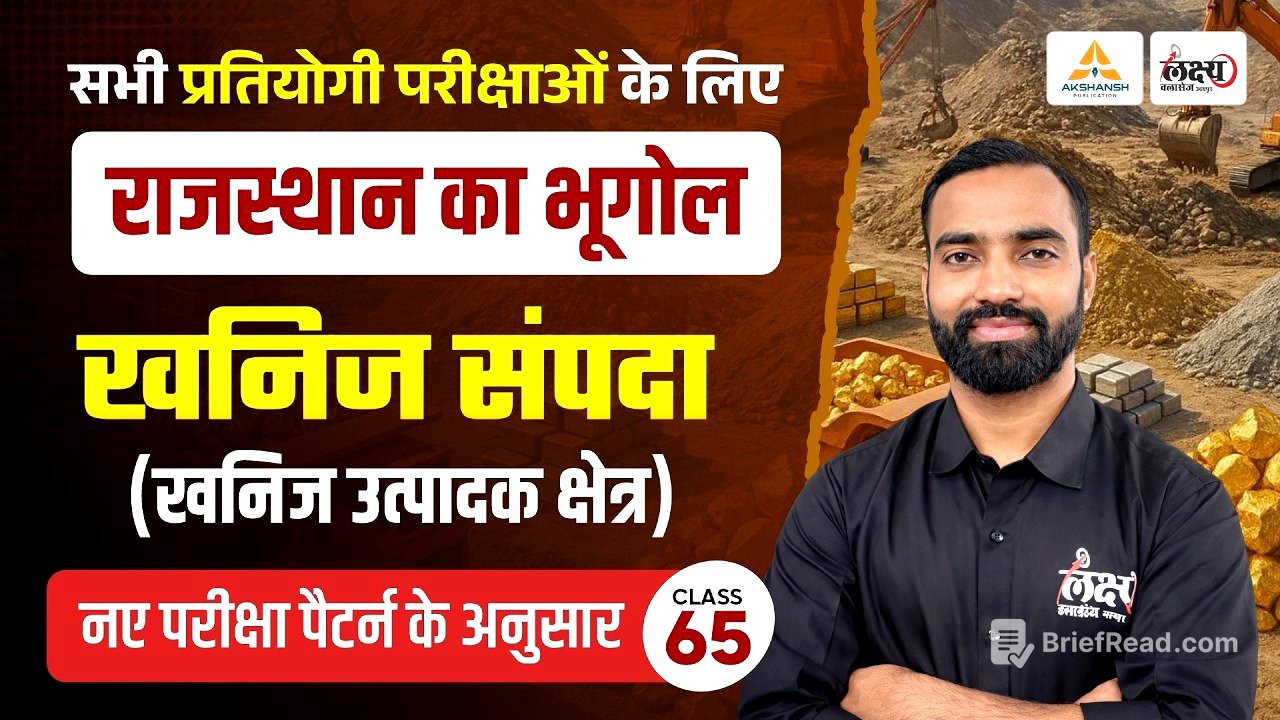
This video provides an in-depth look at Rajasthan's mineral resources, focusing on specific regions and their key mineral outputs. It covers the Aravalli belt, southern Rajasthan, and their associated minerals like copper, iron, lead, zinc, silver, tungsten, fluorite, diamond, gold, and manganese. The lecture includes memory aids and mapping techniques to help viewers remember the locations and types of minerals found in each area.
- Covers Rajasthan's mineral resources, focusing on specific regions and their key mineral outputs.
- Uses memory aids and mapping techniques to help viewers remember the locations and types of minerals.
- Focuses on the Aravalli belt and southern Rajasthan.
Introduction [0:03]
The presenter introduces the topic of Rajasthan's mineral resources, which will be discussed in seven points. The previous lesson covered mining methods, including open-cast mining for shallow minerals and coke mining. Also discussed were the different perspectives of minerals, including diversity, storage, production, and income, as well as three types of rocks: sedimentary, Vindhyan, and Dharwar. The presenter then mentions the classification of minerals into metallic and non-metallic types. The current lesson will focus on mineral production areas, which the presenter emphasises as very important.
Aravalli Belt Minerals: An Overview [2:20]
The discussion begins with the Aravalli belt minerals, dividing the Aravalli range into three sections: northern, central, and southern. The northern Aravalli is primarily known for copper, the central Aravalli for iron, and the southern Aravalli for lead, zinc, silver, manganese, gold, and tungsten. The presenter notes that the Aravalli belt is crucial for mineral production in Rajasthan.
Copper Production Areas and Uses [4:28]
The presenter discusses copper, noting its uses in electrical components, wiring, utensils, automobiles, machinery, and equipment. The focus shifts to copper production areas within Rajasthan, primarily in the Aravalli belt. Key districts include Jhunjhunu, Alwar, Churu, Ajmer, Udaipur, Chittorgarh, Bhilwara, Sikar and Sirohi. Specific locations mentioned are Khetri, Chandmari, Kolhan, Madan Kudan and Akawali in Jhunjhunu; Bannu Wali Dhani in Sikar; Khodriba in Alwar; Bidasar in Churu; Hanotia and Sawar in Ajmer; Pur Dariba and Devtalai in Bhilwara; Bhagel and Bari in Chittorgarh; Anjani Salumber in Udaipur; and Basantgarh in Sirohi. The presenter uses a mnemonic to remember the Jhunjhunu locations: "Khetri mein Chand Mari, kaun ki madad ki?"
Iron Ore: Types, Characteristics and Production [15:09]
The presenter introduces iron ore, calling it the "foundation stone" and "backbone" of industries due to its widespread use. Iron ore has four types: magnetite, hematite, limonite and siderite. Magnetite has over 72% iron content and is known as "black iron", hematite has 60-70% iron content and is called "gerua iron", limonite has 40-60% iron content and is known as "yellow iron", and siderite has less than 40% iron content and is called "brown iron". Rajasthan primarily produces magnetite and hematite. Iron ore is used in building construction, road and bridge construction, the motor vehicle industry, and railway tracks. Key production districts include Jaipur, Dausa, Karauli, Sikar, Jhunjhunu, Udaipur and Bhilwara. Specific locations mentioned are Morija Banela in Jaipur; Neemla Raisela in Dausa; Daidoli, Todpura, Liloti and Khora in Karauli; Davra in Sikar and Singhana in Jhunjhunu; Nathra ki Pal and Thur Hunder in Udaipur; and Pur Banera, Hamirgarh and Tiranga Kshetra in Bhilwara.
Lead, Zinc and Silver: Twin Minerals and Production Areas [29:57]
The presenter discusses lead, zinc and silver, noting that their primary ore is galena. These minerals are often found together and are known as "twin minerals". Rajasthan has a monopoly on the production of lead and zinc in India. Storage areas include Guda Kishori Daspura in Alwar and Chauth ka Barwara in Sawai Madhopur. Production areas are primarily in the southern Aravalli region, including Rajsamand, Bhilwara and Udaipur. Specific locations mentioned are Rajpura Dariba, Sinser Khurd and Sinser Kala in Rajsamand; Jawar ki Khan and Devri in Udaipur; and Rampura Agucha and Gulabpura Agucha in Bhilwara.
Tungsten: Ore, Uses and Production Areas [37:20]
The presenter introduces tungsten, noting that its ores are wolframite and scheelite. Tungsten is used in making cartridges, electrical equipment and motor vehicles. The primary production areas are in Nagaur, Pali and Sirohi. Specific locations mentioned are Degana in Nagaur, Nana Karab in Pali, and Balda and Abu Rewdar in Sirohi. The Degana mine, located on Revat hill, is the largest tungsten mine in India but is currently closed.
Southern Rajasthan Minerals: Fluorite, Diamond, Gold and Manganese [42:23]
The presenter shifts focus to the minerals of southern Rajasthan, specifically in Dungarpur, Banswara and Pratapgarh districts. Fluorite (also known as fluorospar) is found in Dungarpur at Mando ki Pal. Diamonds are found in Pratapgarh at Kesarpura. Gold and manganese are found in Banswara. Gold locations include Jagatpura Bhukia, Anandpura Bhukia, Ghotia Amba, Delwara and Kakria. Manganese locations include Leelwani, Talwara, Kala Khunt, Tamresha, Timoria, Intala and Kansala. Manganese is also found in Rajsamand at Negadia.
Summary and Revision [54:44]
The presenter provides a recap of the minerals discussed, including their locations and uses. The Aravalli belt minerals (copper, iron, lead, zinc, silver and tungsten) and southern Rajasthan minerals (fluorite, diamond, gold and manganese) are reviewed. The presenter encourages viewers to revise the material and use the hints and mnemonics provided to aid memory. The next lesson will cover minerals found in the "fortress" areas.




![Unang Balita sa Unang Hirit: (Part 2) MARCH 9, 2026 [HD]](https://wm-img.halpindev.com/p-briefread_c-10_b-10/urlb/aHR0cDovL2ltZy55b3V0dWJlLmNvbS92aS9XSllWMVhyeU03TS9ocWRlZmF1bHQuanBn.jpg)