TLDR;
This module introduces quantitative analysis in human movement science, contrasting it with qualitative analysis. It covers the measurement of biomechanical parameters, the instrumentation used, and the environmental factors affecting data collection (laboratory vs. field). The module also discusses various tools for measuring kinematics (timing devices, velocity systems, optical imaging, accelerometers, IMUs, motion capture) and kinetics (force transducers, pressure sensors, force platforms, electromyography), as well as computer simulation and modelling. Finally, it reviews instrumented gait analysis systems, highlighting their advantages, disadvantages, and manufacturers.
- Quantitative analysis involves the numerical measurement of human movement, contrasting with qualitative analysis, which is descriptive.
- Data collection can occur in controlled laboratory settings or uncontrolled field environments, each with its own considerations for cost, accessibility, and participant comfort.
- Tools for measuring kinematics include timing devices, velocity measuring systems (radar guns, lasers), accelerometers, inertial measurement units (IMUs), and optical imaging systems (video cameras with manual or automatic digitising).
- Kinetics are measured using force transducers, pressure sensors, force platforms, and electromyography (EMG), which assesses the electrical activity of muscles.
- Computer simulation and modelling are used to design, create, and evaluate complex systems, predict joint forces, and explore "what if" scenarios.
Introduction to Quantitative Analysis [0:00]
Quantitative analysis involves the actual measurement of human movement, typically expressed in numbers. It contrasts with qualitative analysis, which is descriptive and relies on senses and feelings. Quantitative data can be discrete or continuous and is factual, while qualitative data is subjective. Quantitative analysis is often used at elite or professional levels to monitor training changes, technique improvements, and rehabilitation progress, as well as to provide data for biomechanical research. Key considerations include the expense and time involved, and the ability to distinguish biomechanical parameters using specialised instruments.
Environmental Factors in Data Collection [3:00]
Data collection in sports can occur in a controlled laboratory setting or in the field, where environmental variables are harder to manage. Selecting the right instrumentation depends on these environmental considerations. Laboratory setups are costly due to expensive specialised instruments, which may not be accessible to all practitioners. The artificial environment of a lab may not accurately reflect real-world conditions, potentially affecting an athlete's performance or movement patterns. Participant comfort and the ability to control variables like lighting and temperature are also key factors when choosing between lab and field data collection.
Tools for Measuring Kinematics [5:32]
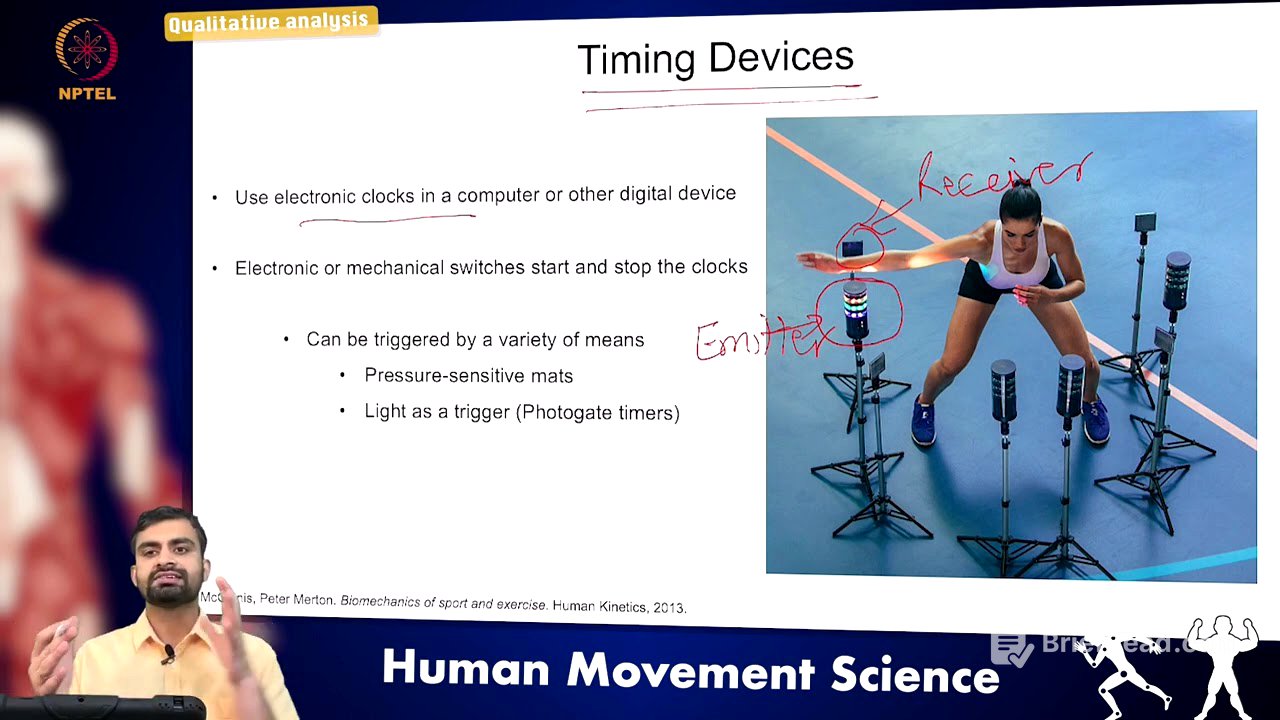
Kinematics involves analysing motion without considering the forces that cause it. Tools for measuring kinematics include timing devices, which are fundamental for measuring time in mechanics. Simple stopwatches are effective for longer events, but automatic timing devices using electronic or mechanical switches are needed for accuracy in shorter events. Velocity measuring systems, such as radar guns and lasers, determine speed using microwave radio signals and laser light reflection, respectively. Accelerometers, which are small and lightweight, measure acceleration in one (uniaxial) or three (triaxial) directions and can be used in both field and lab settings. Inertial measurement units (IMUs) combine accelerometers and gyroscopes to measure acceleration and angular properties and are found in smartphones and other devices.
Optical Imaging Systems and Motion Capture [13:39]
Optical imaging systems, particularly video cameras, are widely used in biomechanics to record visual images of performance. Single cameras provide two-dimensional images, while multiple cameras offer three-dimensional data. Digitisation can be manual, which is time-consuming and prone to errors, or automatic, which requires specialised software and markers. Markers can be active (LEDs), passive (reflective), or electromagnetic, each with its own advantages for tracking anatomical points. Motion capture systems, considered the gold standard for measuring kinematics, use multiple cameras to capture three-dimensional movements. These systems are accurate but expensive, require specific environments and specialised training for data collection, processing, and reporting.
Kinetic Measurement Tools: Force Transducers [21:29]
Kinetic parameters involve analysing motion with consideration of the forces that produce it. Force transducers measure forces applied to implements or equipment and are available in various shapes and sizes. Types of force transducers include strain gauge-based load cells, pneumatic load cells (dependent on air pressure), hydraulic load cells (using fluids), and piezoelectric load cells (using natural crystals that generate electric signals when deformed). These transducers help understand the effect of forces on body parts and the mechanics of movement.
Force Platforms and Pressure Sensors [24:43]
Force platforms are commonly used devices for measuring kinetic variables, utilising multiple force transducers to measure reaction forces, point of application, and direction of resultant force. They measure multi-dimensional forces, such as vertical ground reaction force and forces in anterior-posterior and medial-lateral directions. Pressure sensors, often in the form of thin mats with embedded sensors, provide detailed information on pressure between the foot and the ground. In-sole pressure measuring devices also exist, providing pressure mapping on the sole of the feet.
Electromyography (EMG) [28:41]
Electromyography (EMG) measures the electrical activity of muscles using surface or indwelling electrodes. It provides information on muscle activation and deactivation during an event. Researchers also explore the correlation between muscle activity and force production. EMG analysis can reveal whether muscles are active when they should be, helping to adjust techniques for optimal muscle force utilisation and enhanced performance.
Computer Simulation and Modelling [31:51]
Computer simulation and modelling are tools for processing existing information, aiding in the design, creation, and evaluation of complex systems that cannot be directly measured. These models predict joint forces and moments without invasive sensors. Designers and analysts use these tools to explore "what if" scenarios by changing parameters in mathematical models. Benefits include better process understanding, identifying problem areas, assessing the impact of changes on performance, and evaluating the effects of implementation changes.
Instrumented Gait Analysis Systems [34:19]
Instrumented gait analysis systems use specialised equipment to record both kinematics and kinetics. Pressure mats are easy to operate but costly and non-portable, while pressure insoles are portable and cost-effective but less accurate. Motion capture systems are accurate for complex tasks but expensive, non-portable, and require specialised training. Wearable sensors like IMUs are low in cost and can be used indoors and outdoors, but require special algorithms to combine data from multiple sensors. Manufacturers mentioned include Tekscan, Novel Electronics, Northern Digital (Opto-Trak), Qualisys, Vicon, Motion Analysis Corporation, BTS, Xsens, Shimmer, and Gaitup.