TLDR;
This module introduces qualitative analysis as a method for studying movement, focusing on its systematic observation and interpretation of movement quality. It covers data collection techniques, software tools, and the advantages and disadvantages of this approach compared to quantitative methods. Key aspects include identifying errors, understanding movement patterns, addressing functional discrepancies, optimising performance, and reducing injury risk.
- Qualitative analysis involves systematic observation and interpretation of movement quality.
- Key considerations for data collection include camera setup, positioning, and lighting.
- Advantages include ease of setup, cost-effectiveness, adaptability, and timely insights.
Introduction to Qualitative Analysis [0:00]
The module introduces qualitative analysis as a tool for studying movement, contrasting it with quantitative analysis and computer simulation modelling. Qualitative analysis involves the systematic observation and study of movement quality through introspective judgment. It focuses on examining and interpreting underlying movement patterns and mechanics without using numeric data, providing an overall understanding of movement quality, efficiency, and effectiveness.
Qualitative Interpretation [2:41]
Qualitative interpretation in movement analysis involves identifying errors, underlying patterns, and functional discrepancies to optimise performance and reduce injury risk. It highlights areas where movement is sub-optimal or inefficient and includes regular reassessment and feedback to monitor an athlete's progress. This approach ensures that interventions produce the desired outcomes by continuously monitoring and adjusting techniques.
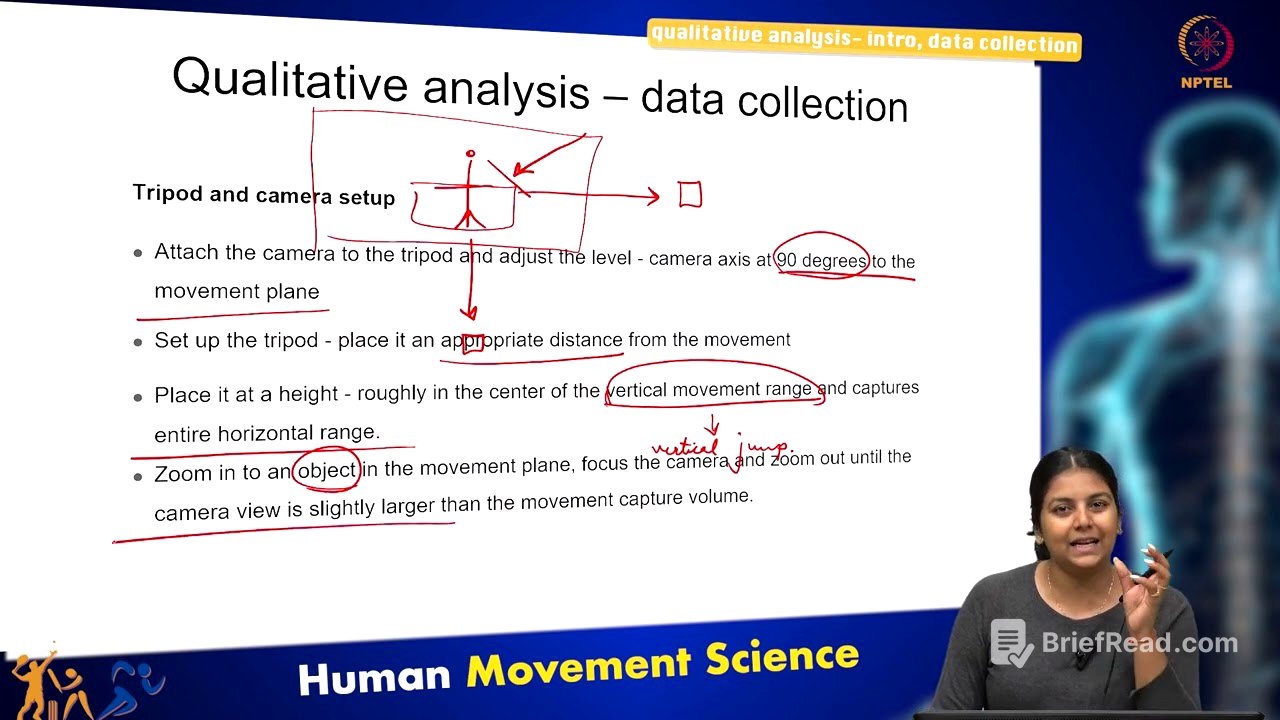
Data Collection Considerations: Tripod and Camera Setup [5:08]
Effective qualitative analysis requires careful data collection using video cameras. The camera should be attached to a tripod and adjusted to ensure it is level and balanced. The camera axis should be at 90 degrees to the movement plane to optimally capture movements. The tripod should be positioned at an appropriate distance and height to capture the full vertical and horizontal range of movement, with the camera zoomed in to focus on the athlete.
Camera Settings: Frame Rate, Aperture and Shutter Speed [9:40]
Key camera settings include frame rate, aperture, and shutter speed. A higher frame rate (over 100 frames per second) is needed to accurately capture rapid movements, preventing blur. The aperture affects image brightness and depth of field; a smaller aperture provides greater depth of field, ensuring all body segments are in focus while minimising background distractions. Shutter speed, the time the camera shutter is open, needs to be optimised to avoid motion blur and maintain optimal exposure, alongside adjusting the white balance for accurate colour representation.
Camera Position and Alignment [13:24]
Camera position and alignment are crucial for capturing accurate movement data. Cameras should be mounted at a sufficient distance to capture the entire movement without distortion. They should be aligned parallel or perpendicular to the movement, with options for suspending cameras from above to capture rotational movements. Using varied camera angles (frontal, sagittal, posterior, and top views) provides multiple perspectives, and cameras should focus on specific body segments relevant to the analysis.
Lighting Considerations [17:06]
Consistent and adequate lighting is essential to minimise shadows and ensure clear visibility of body segments. Diffused and uniform lighting facilitates accurate observation and prevents distortions, which is particularly important if the video is used as input for software analysis. Proper lighting enhances the quality of the captured data, leading to more reliable qualitative assessments.
Advantages of Qualitative Analysis [18:20]
Qualitative analysis is easy to set up and execute, requiring only video cameras and tripods, making it cost-effective compared to quantitative analysis. Its simplicity and mobility allow for quick implementation and adaptability to various environments, benefiting research, sports, rehabilitation, and clinical settings. It provides timely insights through immediate visual feedback and quick interpretation of movement errors and patterns, aiding researchers and coaches in readily observing and interpreting data without time-consuming computations.
Tools for Qualitative Analysis [22:02]
Various software tools facilitate the systematic processing, interpretation, and visualisation of movement in qualitative analysis. Commonly used software includes Dartfish, Silicon Coach, Kinovea, Qualisys Track Manager, and SimiMotion. The selection of software depends on factors such as compatibility with existing hardware, specific functionalities required, analytical complexity, and workflow preferences.
Summary of Qualitative Analysis [23:34]
Qualitative analysis is a systematic observation and introspective judgment of human movement quality. Regular assessment and feedback are essential for monitoring progress and ensuring interventions achieve desired outcomes. Successful qualitative analysis requires appropriate camera positions, settings, lighting, and alignment. The advantages include ease of setup, cost-effectiveness, mobility, adaptability, and timely insights, with software options like Dartfish, Silicon Coach, Kinovea, Qualisys, and SIMI motion available to enhance the analysis.