TLDR;
This module provides an overview of qualitative analysis in human movement science, focusing on its methodology and application in injury prevention and rehabilitation. It covers the stages of qualitative analysis (preparation, observation, evaluation, and intervention), key principles, and a practical example using tuck jumps to illustrate how to identify critical movement features and provide feedback for performance enhancement and injury prevention.
- Qualitative analysis involves systematic observation and judgement of human movement quality.
- The process includes preparation, observation, evaluation, and intervention stages.
- Principles of movement, including universal, general, and specific principles, guide the analysis.
- Qualitative analysis can be applied to injury prevention and rehabilitation, as demonstrated by the tuck jump assessment.
Introduction to Qualitative Analysis [0:00]
Qualitative analysis is a descriptive and subjective process that uses human senses to assess the quality of human movement. It involves systematic observation and judgement, considering temporal (time-related) and spatial aspects of movement. The analysis focuses on identifying critical features that contribute to successful performance and detecting errors in movement patterns.
Stages of Qualitative Analysis [2:35]
The qualitative analysis process consists of four main stages: preparation, observation, evaluation, and intervention. The preparation stage involves understanding the purpose of the analysis, gathering knowledge about the activity and performance environment, and identifying critical movement features. The observation stage focuses on systematically collecting data using human senses or video recordings, defining the focus of observation, and determining appropriate vantage points. The evaluation stage involves assessing strengths and weaknesses, analysing movement patterns, and considering data validity and reliability. The intervention stage focuses on providing feedback to performers, addressing issues related to technique, skills, or training, and using motor control models to individualise interventions.
Preparation Stage: Subcomponents [4:03]
The preparation stage includes ascertaining the need for the analysis, such as injury prevention, rehabilitation, or performance enhancement. It also involves gathering knowledge of the activity and performance context, considering whether the activity is indoors or outdoors, individual or team-based. Identifying critical movement features like range of motion and spatio-temporal parameters is crucial, alongside understanding the characteristics of the movement (e.g., distance versus time) and the performer's skill level.
Observation Stage: Subcomponents [5:49]
The observation stage involves developing a systematic observation strategy, determining who will observe and what they will observe. Data collection methods include using human senses, video recordings, paper-based evaluation sheets, or performance rating scales. Defining the focus of observation, whether it's a specific phase or the entire movement, and selecting appropriate vantage points (multiple planes or single plane) are essential for reliable data collection.
Evaluation and Diagnostic Stage: Subcomponents [7:22]
The evaluation and diagnostic stage focuses on identifying strengths and weaknesses in performance, such as inadequate joint range of motion. It involves analysing movement patterns using video recordings to understand movement mechanics. Assessing the validity and reliability of the data is crucial, depending on the analyst's training and knowledge. Variability in movement errors and potential analyst bias are also considered, addressing issues like annotation errors or human tendencies that might influence the analysis.
Intervention Stage: Subcomponents [9:17]
The intervention stage centres on providing feedback to performers, tailored to specific techniques or general performance. Key considerations include how, when, and where to provide feedback, such as visual or verbal methods, during or after performance. Interventions are based on individualised sessions using motor control models, addressing issues related to technique, skills, or training. The number of observations helps determine movement variability, guiding appropriate feedback delivery.
Example of Qualitative Analysis: Single Leg Hopping [10:44]
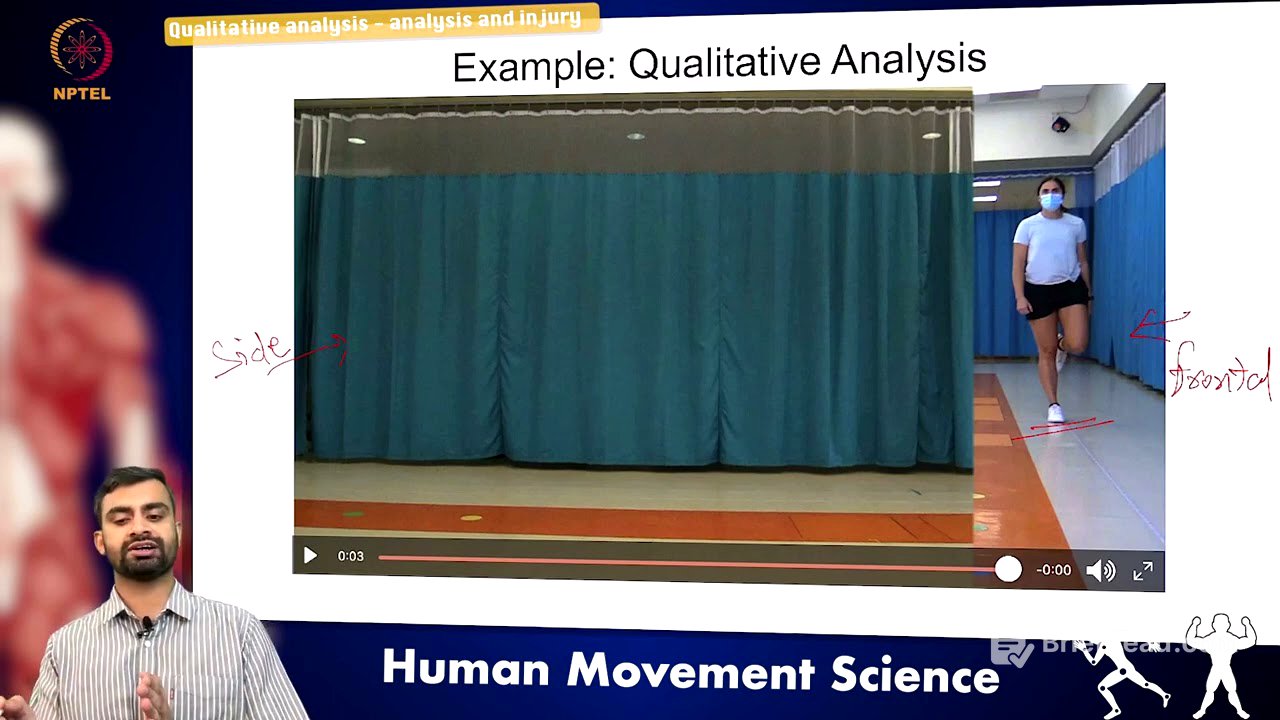
In single leg hopping, the analysis involves observing the athlete from sagittal and frontal views. The preparation phase includes ensuring appropriate video recording setup, considering space requirements and background. The observation phase focuses on movement from different perspectives, while the evaluation phase identifies issues like hip joint tilt. The intervention phase provides feedback to the athlete based on these observations.
Principles Involved in Qualitative Movement Analysis [13:10]
Qualitative movement analysis is guided by universal, general, and specific principles. Universal principles include the stretch-shortening cycle, energy minimisation, and control of degrees of freedom. General principles involve sequential muscle action, energy minimisation or acceleration, impulse generation or absorption, and stability. Specific principles are task-dependent, such as the focus on takeoff, flight, and landing distances in long jump, differing from the considerations in sprinting.
Qualitative Analysis in Injury Prevention: Tuck Jumps [15:14]
Tuck jumps, where the knees are brought in front of the body, are used in plyometric training and have been shown to be useful in injury prevention and rehabilitation for ACL injuries. Critical factors to observe include knee joint valgus at landing, thigh parallelism at peak jump, equal side-to-side thigh position during flight, shoulder-width foot placement, parallel foot placement, and foot contact timing.
Tuck Jump Assessment: Key Factors [16:22]
The tuck jump assessment involves observing specific factors to identify potential issues. Knee valgus at landing is assessed by observing the knee joint alignment. Thigh position at the peak of the jump is evaluated from the sagittal plane to ensure thighs are parallel. Side-to-side thigh equality during flight is checked for deviations. Foot placement is assessed for shoulder-width distance and parallel alignment. Foot contact timing is observed to ensure simultaneous landing.
Additional Factors in Tuck Jump Analysis [20:18]
Additional factors in tuck jump analysis include excessive landing contact noise, pauses between jumps, technique decline during the test, and landing at the same footprint. Excessive noise indicates high ground impact forces. Pauses between jumps disrupt the plyometric nature of the exercise. Technique decline during the 10-second test indicates fatigue or improper form. Landing at the same footprint ensures balance and control.


![Download NetFlix Enola Holmes (2020) Dual Audio {Hindi-English} WeB-DL 480p [350MB] || 720p [1GB] || 1080p [3.3GB] - MoviesMod | Movies Mod 2025, MoviesMod Official, MoviesMod.blue](https://wm-img.halpindev.com/p-briefread_c-10_b-10/urlb/aHR0cHM6Ly9tb3ZpZXNtb2QuYmx1ZS93cC1jb250ZW50L3VwbG9hZHMvMjAyMC8wOS9Eb3dubG9hZC1OZXRGbGl4LUVub2xhLUhvbG1lcy0yMDIwLUR1YWwtQXVkaW8tSGluZGktRW5nbGlzaC1XZUItREwtNDgwcC1NQi03MjBwLTkwME1CLTEwODBwLTEuOEdCLnBuZw==.jpg)