TLDR;
This video provides a comprehensive guide to prescriptions in pharmacy, covering their definition, components, handling, and potential errors. It emphasises the importance of understanding prescriptions for pharmacy students, as it's a common exam topic.
- Definition and Parts of a Prescription
- Handling of Prescriptions
- Sources of Error in Prescriptions
Introduction [0:00]
The video introduces the topic of prescriptions, highlighting its significance as a frequently asked question in pharmacy exams. The discussion will cover the definition of a prescription, its various parts, how to handle prescriptions, and potential sources of errors within them. The presenter stresses the importance of watching the entire video to gain a complete understanding of the topic.
Introduction of Prescription [2:19]
The presenter defines a prescription as a written order from a doctor to a pharmacist for medication to be dispensed to a patient. It serves as a direct link between the physician, pharmacist, and patient. The doctor assesses the patient, writes the prescription, which the pharmacist then uses to dispense the correct medication, providing counselling on its use.
Part of Prescription [6:52]
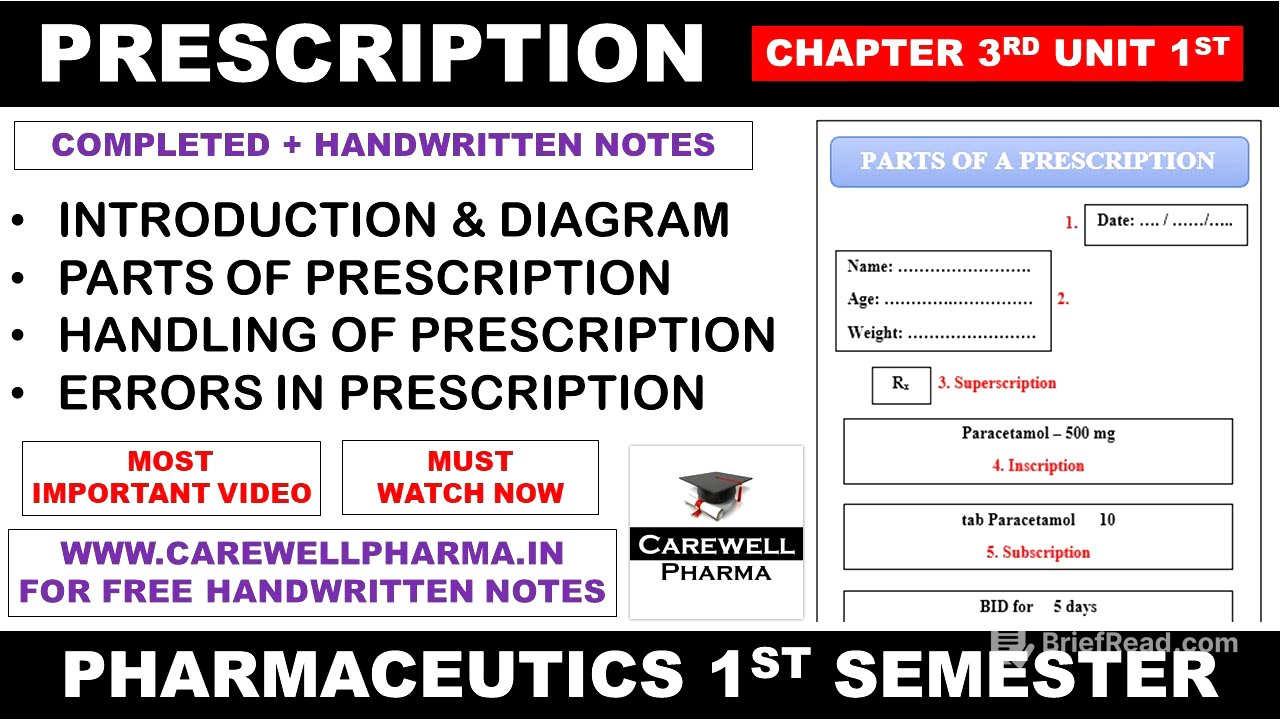
This section details the eight essential parts of a prescription:
- Date: Recorded at the top, helping track when the medication was prescribed and aiding in renewals.
- Patient Information: Includes the patient's name, age, gender, and address for identification and to prevent mix-ups. Age and gender help determine the correct dosage.
- Superscription: The "Rx" symbol, representing a prayer for the patient's quick recovery.
- Inscription: The main part, listing the names and quantities of drugs, divided into the base (active medicine), adjuvant (to enhance action and palatability), and vehicle (carrier).
- Subscription: Directions from the doctor to the pharmacist on how to prepare the medication.
- Signature: Instructions for the patient on how to take the medication, including quantity, route, timing, and special instructions.
- Renewal Instructions: Indicates if and when the prescription should be renewed.
- Doctor's Information: Includes the doctor's signature, registration number, and address for verification.
Handling Of Prescription [20:04]
This part explains the process a pharmacist should follow when handling a prescription:
- Receiving: The pharmacist should personally receive the prescription and maintain a normal facial expression to avoid alarming the patient.
- Reading and Checking: The pharmacist must carefully read the prescription at least twice, checking for any doubts or unclear information, and consulting the doctor if needed.
- Collecting and Weighing: The pharmacist gathers all necessary materials and weighs them according to the prescription.
- Compounding, Labelling, and Packaging: The pharmacist prepares the medication, ensuring the work area is clean, using only one prescription at a time, and following the doctor's directions. The medication is then placed in a suitable container, labelled with clear instructions, and packaged for the patient.
Errors in Prescription [27:17]
This section discusses potential sources of errors in prescriptions:
- Abbreviations: Misinterpretation of abbreviated terms used by doctors.
- Drug Names: Confusion due to similar-sounding or looking drug names.
- Strength of Preparation: Errors in dispensing the correct strength or potency of a drug.
- Dosage Form: Incorrect selection of the drug's form (e.g., tablet vs. syrup).
- Instructions for the Patient: Incomplete or unclear instructions for the patient.
- Dose: Incorrect dosage specified, especially concerning paediatric doses.
- Incompatibility: Potential harmful interactions between prescribed drugs.