TLDR;
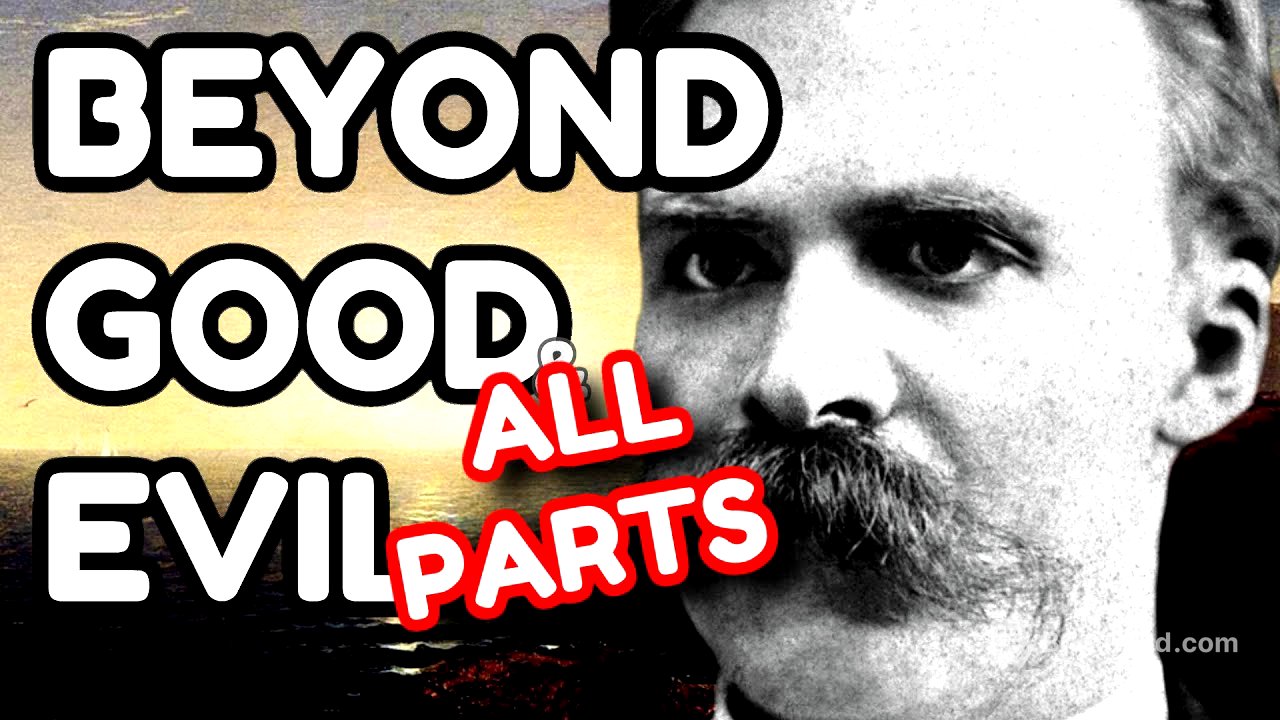
This series explores Friedrich Nietzsche's "Beyond Good and Evil," a complex and influential philosophical work. The series aims to provide a solid understanding of the book's main ideas and Nietzsche's unique perspective on the world. It examines the meaning of the title, Nietzsche's critique of philosophical prejudices, his concept of the will to power, and his views on slave morality and Christianity.
- Nietzsche challenges traditional philosophical assumptions and invites readers to move beyond binary thinking.
- He critiques the notion of objective truth, arguing that philosophers are often driven by a will to power.
- Nietzsche examines the psychological underpinnings of Christian morality, viewing it as a "slave revolt" against natural values.
Part 1: The Title [1:20]
The full title, "Beyond Good and Evil: Prelude to a Philosophy of the Future," reveals Nietzsche's intentions. "Beyond Good and Evil" encourages readers to transcend the conventional dichotomy of good versus evil, and other pairs of opposites like appearance and reality, will and reason, and true and false. Nietzsche challenges the very idea of contradiction. The subtitle indicates that the book is a starting point, not a finished philosophical system. Nietzsche aims to inspire a new philosophical movement, inviting "free spirits" to continue his work and develop a philosophy of the future.
Part 2: Philosophical Prejudices [5:11]
Nietzsche exposes the prejudices of philosophers who believe they are objectively searching for truth. He argues that philosophers, like surgeons using "dirty knives," operate with unnoticed biases. He critiques René Descartes' "I think, therefore I am," identifying hidden assumptions such as the existence of an "I" that thinks. Nietzsche attacks the "atomistic need" of philosophers to find singular entities like one self or one world, arguing that language tricks us into thinking of things as undivided wholes. He asserts that the "mother of all assumptions" is that truth is preferable to falsehood, questioning why and suggesting that the search for truth is often a front for something else, like gaining power.
Part 3: The Will to Power [15:12]
Nietzsche introduces the concept of the "will to power," which is not merely political or military power, but a fundamental drive of organisms. He contrasts this with the "will to life," arguing that living things primarily seek to discharge their strength. Philosophers seek spiritual power over knowledge and truth, with truth being a means to power. Nietzsche proposes a thought experiment: viewing the world solely as will to power. He illustrates this with the example of digestion, where the desire for nourishment triumphs over the food's resistance, representing a battle of wills. Nietzsche suggests that the entire world can be seen as a struggle for power, and that philosophers often prefer explanations that suit their personalities, increasing their power, over objective truth. This leads to perspectivism, the idea that there is no objective truth, only different perspectives.
Part 4: Slave Morality [28:14]
Nietzsche extends his critique to Christianity, examining the psychological constitution of Christians. He views Christianity as "anti-life," stemming from a "slave revolt in morals." He argues that oppressed people, like early Christians, made a virtue out of their lack of power, denouncing earthly power and embracing self-denial. This led to a reversal of values, where Christian virtues like humility and poverty opposed Roman values like military might and wealth. Nietzsche sees this as a morality of the weak, contrasting it with the natural state of the world. He claims that Christians, despite preaching humility, still desire power, but seek it through deceptive means. Nietzsche challenges "free spirits" to create new values and rise above the nihilistic future, urging them to build and invent rather than discover truth. He acknowledges that "Beyond Good and Evil" is a prelude, encouraging readers to fill in the blanks and continue his work.