TLDR;
This unit explores the neuromuscular system, its structure, functions, and role in movement. It covers motor units, neuron types, and how the system senses and responds to stimuli via reflex actions. The unit also explains neuromuscular recruitment strategies, including the role of different muscle fibre types and motor unit size in force generation.
- Neuromuscular system comprises skeletal muscle fibres and neural circuits.
- Motor units consist of motor neurons and the muscle fibres they innervate.
- Muscle spindles and Golgi tendon organs provide sensory feedback to the central nervous system.
- Neuromuscular recruitment involves adjusting motor unit size and firing rate based on the desired outcome.
Introduction to the Neuromuscular System [0:00]
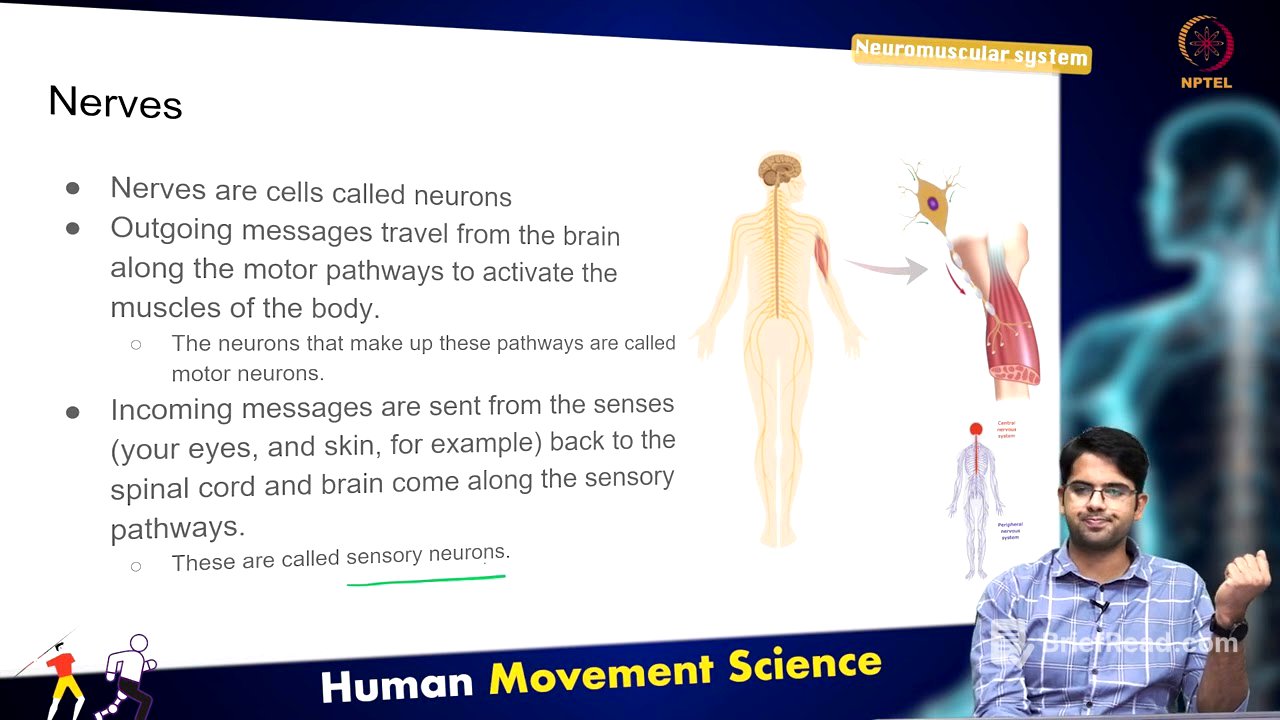
The neuromuscular system, composed of skeletal muscle fibres and neural circuits, is explored. The key components include motor neurons (efferent) that transmit signals from the brain or spinal cord to the muscles, and sensory neurons (afferent) that relay signals from muscles and sensory organs back to the brain for processing. Golgi tendon organs, which innervate tendons, sense tension when the tendon is loaded.
Sensory Neurons and Muscle Spindles [3:44]
Afferent neurons, along with Golgi tendon organs, enable the neuromuscular system to sense specific characteristics at their attachment points. Sensory neurons form muscle spindles located within muscle fibres, wrapping around them and extending to the central nervous system. These muscle spindles detect the state and amount of stretch in the muscle, transmitting this information to the central nervous system.
Neurons and Motor Neurons [5:29]
The nervous system consists of nerves made up of cells called neurons. Motor neurons transmit outgoing messages from the brain along pathways in the spinal cord to various organs, facilitating movement. Incoming messages from sensory organs are conveyed via sensory neurons, providing feedback such as touch, heat, visual, olfactory, and auditory information.
Motor Units: Definition and Function [7:18]
A motor unit comprises a motor neuron and the muscle fibres it innervates. Each muscle consists of multiple motor units. Motor neurons convey decisions from the brain to the muscle to perform actions. Understanding motor units is crucial for optimising muscle recruitment, training, and behavioural patterns.
Neuromuscular Junction [8:51]
The neuron attaches to the muscle fibre with a small gap in between. Chemicals released from the neuron are transferred across this gap into the muscle fibre, triggering a contractile action. The innervation ratio, which is the ratio of motor neurons, can vary from three for eyelid muscles to approximately 100 for limb muscles, indicating that one neuron can control multiple muscles.
Reflex Actions: Stretch Reflex and Golgi Tendon Reflex [11:43]
Reflex actions demonstrate how components of the neuromuscular system work together. Muscle spindles detect the state of stretch and the speed of stretch within muscle fibres. If a muscle stretches beyond a certain range, a signal is sent to the central nervous system, which then signals the motor unit to contract, protecting the muscle from physical damage via the stretch reflex. Golgi tendon organs protect the muscle's innervation by detecting excessive tension, triggering a shutdown signal to prevent detachment from the bones, similar to a circuit breaker.
Neuromuscular Recruitment [16:36]
Muscles require activation from nerves to function, forming the neuromuscular system. The body employs strategies to recruit muscles based on the desired outcome. Increasing muscle force can be achieved by recruiting larger motor units or increasing the firing rate of motor units. Fast-twitch fibres excel in explosive movements, while slow-twitch fibres are better suited for endurance activities. The neuromuscular system adapts through training to optimise motor unit recruitment and apply appropriate strategies.