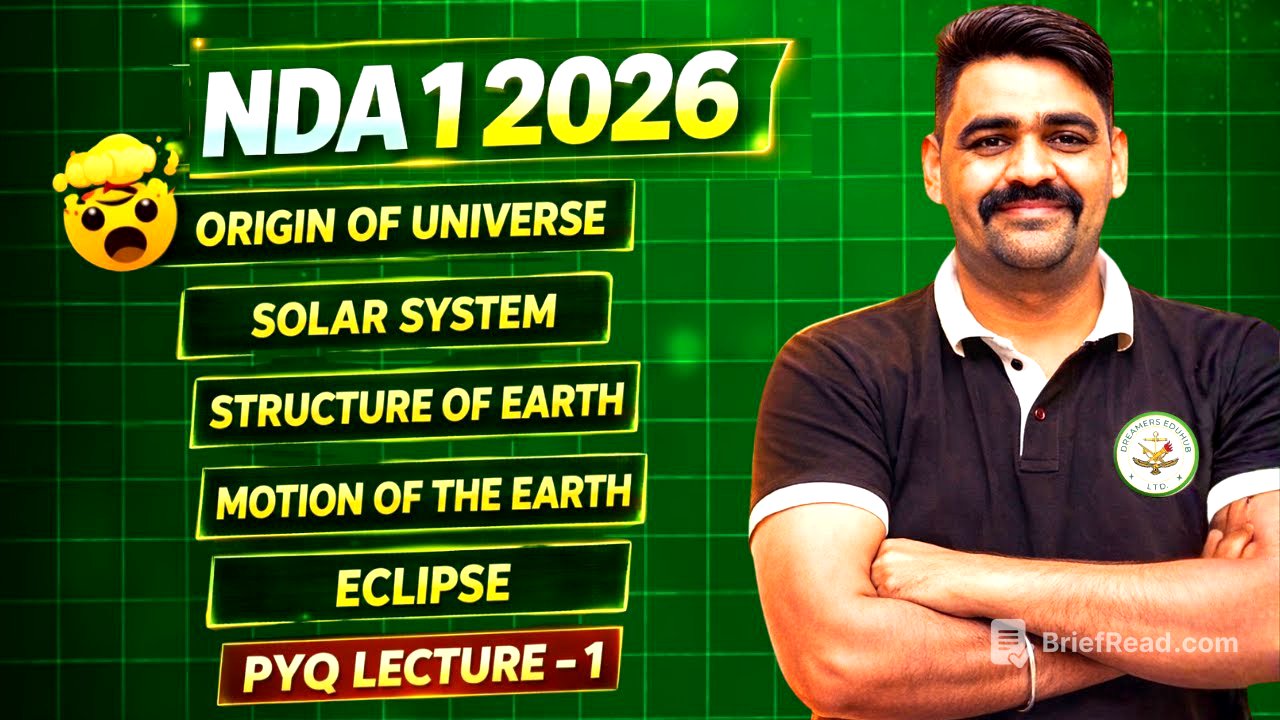
TLDR;
The video covers various questions related to the National Defence Academy (NDA) examination, focusing on topics regarding the origin of the universe, celestial theories, and geological concepts. Key questions discussed include theories explaining the origin of the universe, characteristics of the "Goldilocks zone," seismic waves, Earth's layers, and astronomical events like eclipses.
- Discusses various theories on the universe's origin, including the Big Bang Theory and Nebular Hypothesis.
- Explains the concept and importance of the "Goldilocks zone" in relation to liquid water.
- Examines seismic waves and key geological terms like "Mohorovičić discontinuity."
- Introduces fundamental concepts of Earth’s structure, including the inner and outer core.
- Explains solar and lunar eclipses and their conditions, including the formation of black holes.
Understanding Theories of Origin [0:00]
The session starts with a question regarding the origin of the universe, relating to theories like the Nebular Hypothesis, Big Bang Theory, Planetesimal Theory, and Tidal Hypothesis. It discusses how the Big Bang Theory, proposed by Georges Lemaître, is widely accepted and explains that it describes the universe's expansion and origin.
Goldilocks Zone and Celestial Bodies [4:00]
The next question involves defining the Goldilocks Zone, which is the region around a star where conditions may be suitable for liquid water to exist on a planet. The speaker elaborates on how this zone enables water to exist in all three states: solid, liquid, and gas, hence supporting life.
Seismic Waves and Discontinuities [8:00]
The discussion then shifts to seismic waves, specifically Mohorovičić discontinuity—commonly known as "Moho." It highlights how seismic waves are used to study the Earth's internal layers, particularly focusing on how these waves behave when transitioning between different materials.
Earth's Core and Its Layers [15:00]
The speaker explains the internal structure of the Earth, detailing the crust, outer core, inner core, and their characteristics. Emphasis is placed on the density and nature of these layers, specifically noting that the innermost layer experiences high pressure and is primarily made up of iron and nickel.
Eclipses: Solar and Lunar [21:00]
Eclipses are explored next, addressing the conditions necessary for both solar and lunar eclipses to occur. The speaker clarifies that a solar eclipse takes place when the Moon passes between the Earth and the Sun, and a lunar eclipse occurs when the Earth sits between the Sun and the Moon.
Black Holes and Supernovae [25:00]
The concept of black holes is introduced, explaining how they form from the remnants of massive stars after they undergo a supernova explosion. The discussion explains the gravitational pull of black holes and their impact on surrounding celestial bodies.
Geological and Astronomical Measurement [30:00]
The session also highlights significant geological terms such as lithosphere, asthenosphere, and the difference between oceanic and continental crust. It discusses Light Year as a measurement of astronomical distances and how sunlight is refracted, impacting the visible appearance of the Sun.
Geographic Grids: Latitude and Longitude [36:00]
The video concludes with the definitions of latitude and longitude, including how they are represented on the globe. The speaker mentions the Prime Meridian and how different countries are affected by its passage, clarifying common misconceptions about geographic coordinate systems.





!["This is a civilisational failure!" – World's Strictest Headmistress Katharine Birbalsingh [ARC26]](https://wm-img.halpindev.com/p-briefread_c-10_b-10/urlb/aHR0cDovL2ltZy55b3V0dWJlLmNvbS92aS9FcWpfU25USWhOWS9ocWRlZmF1bHQuanBn.jpg)