TLDR;
This module provides an overview of muscle function and movement, covering muscle roles, contraction types, and health. It begins by recapping muscle anatomy and the sliding filament theory, before discussing how muscles facilitate movement at synovial joints through origin and insertion points. The module also explains the roles of agonist, antagonist, and synergist muscles in coordinated movements. Different types of muscle contractions—isometric, isotonic (concentric and eccentric), and isokinetic—are examined with sport-specific examples. Finally, the importance of muscle health and common injuries are addressed.
- Muscles are contractile tissues essential for movement and posture.
- Agonist, antagonist, and synergist muscles coordinate joint actions.
- Isometric, isotonic (concentric/eccentric), and isokinetic contractions enable various movements.
- Maintaining muscle health requires good nutrition, exercise, and hormone regulation.
Introduction to Muscles and Movement [0:00]
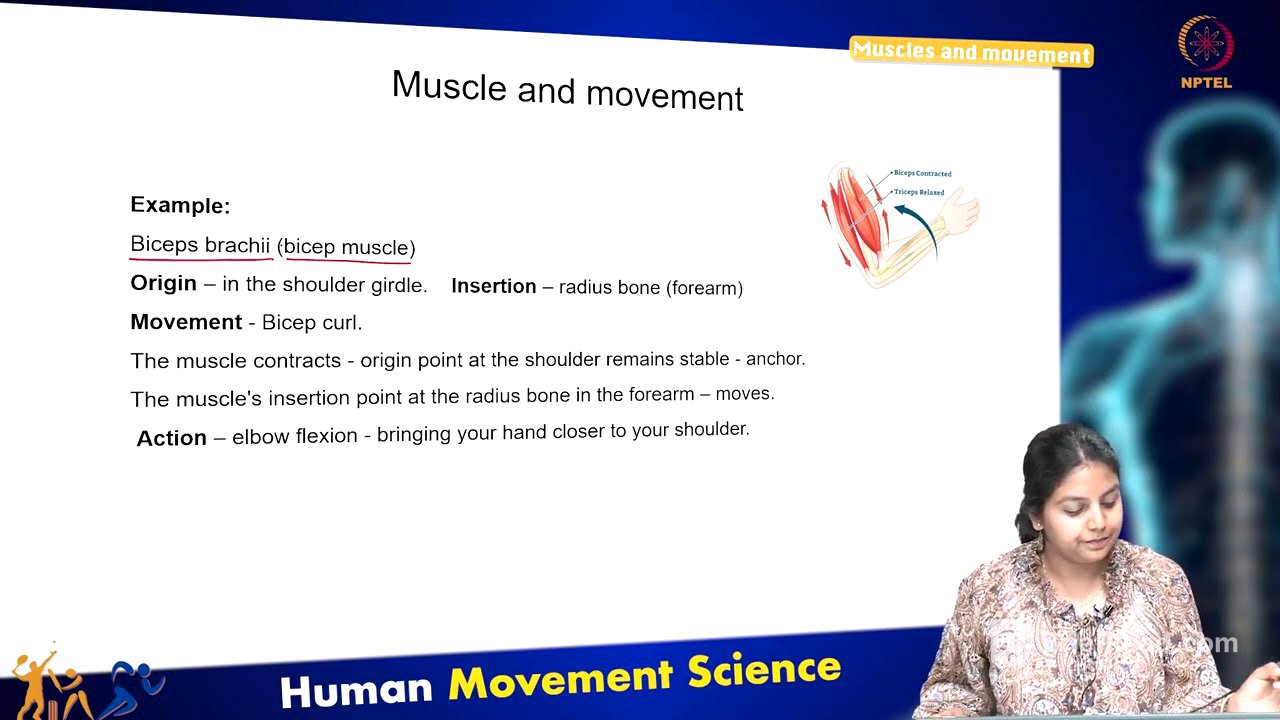
The module begins with a recap of muscle anatomy, highlighting their role as contractile tissues that produce movement and maintain body posture. Muscles are stimulated by nerve impulses, leading to the contraction of sarcomeres within muscle fibres. The sliding filament theory, involving actin and myosin filaments, is key to understanding muscle contraction. To facilitate movement at synovial joints, skeletal muscles modify joint angles. The origin (fixed attachment) and insertion (movable attachment) of muscles are crucial for understanding how muscles pull on bones to cause movement. For example, the biceps brachii originates in the shoulder girdle and inserts on the radius bone, enabling elbow flexion.
Agonist, Antagonist, and Synergist Muscles [6:04]
To understand how muscles coordinate complex movements, the concepts of agonist, antagonist, and synergist muscles are explained. The agonist, or prime mover, is the main muscle involved in a joint action. The synergist assists the agonist in performing the movement. The antagonist has the opposite action to the agonist. For example, during elbow flexion, the biceps brachii is the agonist, the brachioradialis in the forearm acts as a synergist, and the triceps brachii is the antagonist. In a lower body example, during knee extension, the rectus femoris (a quadriceps muscle) is the agonist, the hamstrings are the antagonist, and the other quadriceps muscles act as synergists.
Types of Muscle Contractions [11:00]
The module examines different types of muscle contractions: isometric, isotonic (concentric and eccentric), and isokinetic. These classifications are crucial for understanding movement mechanics and optimising training. Isometric contractions involve the muscle maintaining its length with no external movement or change in joint angle, such as core muscles during a plank or quadriceps during a wall sit. Isotonic contractions involve the muscle changing length while maintaining tension, divided into concentric (muscle shortening) and eccentric (muscle lengthening) contractions. Isokinetic contractions involve maintaining a constant velocity throughout the range of movement, often achieved with specialised equipment.
Isometric Contractions [14:10]
Isometric contractions occur when the muscle maintains its length, with the force generated being equal to the opposing force. These contractions are crucial for movements requiring static strength, such as maintaining balance, holding a position (like in a plank or wall sit), and providing stability. In sports like gymnastics and rock climbing, core muscles undergo isometric contractions to hold static positions. In wrestling, isometric contractions in core muscles help maintain balance.
Concentric Contractions [17:26]
Concentric contractions occur when the muscle shortens while generating force against resistance, such as the biceps during a bicep curl or calf muscles during a calf raise. These contractions are crucial for generating power in activities like pushing, pulling, lifting, jumping, and running. In basketball, leg muscles concentrically contract to generate the force needed to jump. Weightlifting, boxing, and sprinting also rely on concentric contractions for explosive strength.
Eccentric Contractions [19:50]
Eccentric contractions occur when the muscle lengthens under tension while controlling a resistance, such as the biceps during the lowering phase of a bicep curl or quadriceps while walking down stairs. These contractions are crucial for controlling movements and maintaining stability, particularly in activities like sprinting downhill or skiing, where controlled deceleration is required. During running, quadriceps eccentrically contract during the leg descent phase.
Isokinetic Contractions [21:47]
Isokinetic contractions involve muscle contraction at a constant velocity throughout the entire range of movement, often achieved with specialised equipment like a dynamometer. These contractions are essential for injury rehabilitation, providing controlled and adjustable resistance to reduce the risk of further damage. Isokinetic training also helps in assessing and improving muscular imbalances and weaknesses, aiding in injury prevention.
Muscle Health and Common Injuries [23:13]
Maintaining good muscle health is crucial for effective and efficient human movement. This requires good nutrition, an active lifestyle, and proper bone health and hormone regulation. Common muscle injuries include bruises, strains (e.g., ankle sprains), tears (varying degrees affecting recovery), lacerations (often from accidents with open wounds), and contusions (common in contact sports like football). The module concludes by summarising the key roles of muscles in movement, the importance of understanding muscle function, and the significance of maintaining muscle health to prevent injuries.





![[타로]🌹갓 신내림 받은 것처럼 잘맞는🔥현재 그 사람, 100% 이런 감정 느낍니다🔮상대방의 진짜 속마음](https://wm-img.halpindev.com/p-briefread_c-10_b-10/urlb/aHR0cDovL2ltZy55b3V0dWJlLmNvbS92aS9UWVVVQmZEdUNXOC9ocWRlZmF1bHQuanBn.jpg)