TLDR;
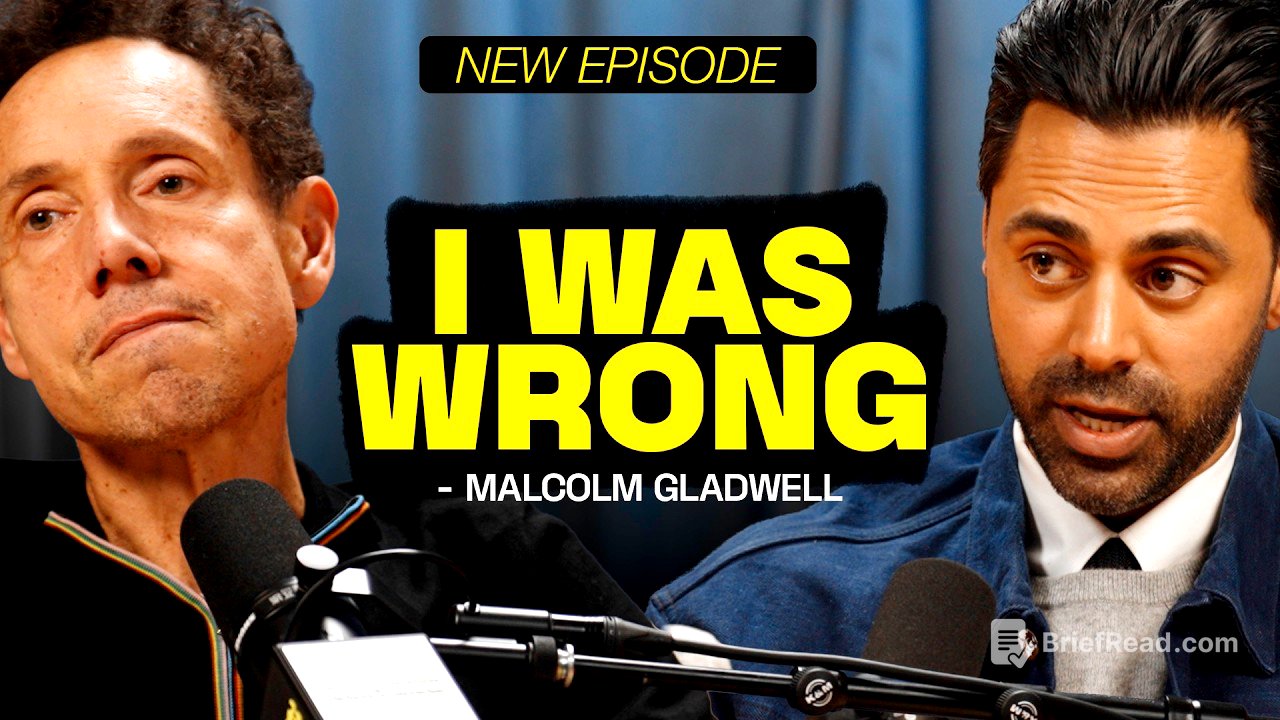
Hasan Minhaj interviews Malcolm Gladwell, discussing Gladwell's career, his approach to storytelling, and his "Revisionist History" podcast. They discuss the nature of popular non-fiction, the importance of accessible ideas, and the willingness to admit when one is wrong. They also touch on Gladwell's takes on working from home and university choices, and his deep dive into the complexities of capital punishment and the legacy of slavery in Alabama.
- Malcolm Gladwell discusses his approach to storytelling and the importance of making ideas accessible.
- They discuss the Alabama murders and capital punishment.
- Gladwell shares his views on working from home and university choices.
A Blurb by Malcolm Gladwell… (Cold Open/Opening Monologue) [0:00]
Hasan Minhaj starts the interview by asking Malcolm Gladwell to provide a blurb for the interview, defining a blurb as a short endorsement for a book. Gladwell jokingly provides a blurb, praising Minhaj's ability to make his guests cry and recommending the podcast to listeners.
The world of ideas [2:55]
Minhaj and Gladwell discuss Gladwell's popularity as a non-fiction writer and the criticism he receives. Gladwell explains that his books aim to provide people with an opportunity to engage with the world of ideas, which they may not have in their daily lives due to work and family responsibilities. He sees his role as finding and arranging interesting ideas for readers to explore and consider. Gladwell acknowledges that some view his work as "infotainment" rather than deep expertise, but he believes he serves as a "gateway drug" to intellectual exploration, encouraging people to discover new ideas on their own.
Hot 97 [7:39]
Minhaj asks Gladwell how he makes mundane topics interesting, referencing the possibility of a "Revisionist History" episode about W2s and W9s. Gladwell shares his current project on American gun violence, where he avoids discussing guns directly and instead focuses on the peculiarities of American attitudes towards gun violence. He mentions a chapter on the Second Amendment that delves into 18th-century grammar to highlight the Supreme Court's flawed interpretations of the amendment. Gladwell argues that the court's rulings on gun rights are based on a misunderstanding of historical linguistics, akin to a college paper receiving a C minus.
Testostergone [10:59]
The conversation shifts to Gladwell's ability to coin catchy terms, such as "Tipping Point." Gladwell explains that he doesn't know what makes a term catch on, but he believes a good title should be an oxymoron, creating tension between two operative words. He uses "Silent Spring" as an example. Minhaj asks Gladwell to help him coin a term for the urge men over 40 have to engage with history. Gladwell suggests it's linked to a longing for a lost version of themselves and a connection to a time when masculinity and physical force mattered more, describing it as "testostergone."
My bad! [16:18]
Minhaj praises Gladwell's willingness to admit when he's wrong, referencing his TED Talk on the "broken windows theory." Gladwell explains that he finds personal delight in discovering that something he thought was one way is actually another. He believes that people are generally accepting of authors changing their minds, as it reflects the common experience of adapting to a changing world. Gladwell contrasts this with the perception that public figures must deny and defend their positions at all costs, which he attributes to the influence of powerful, unapologetic figures like Elon Musk and Donald Trump. He shares a story about two Air Force officials who took responsibility for a mistake that led to a mass shooting, highlighting their empathy and willingness to admit fault.
Broken windows [23:04]
Gladwell revisits his endorsement of the "broken windows theory" in his 2000 book, where he argued that cracking down on minor signs of disorder could reduce crime. He acknowledges that this theory was used to justify the NYPD's stop-and-frisk program, which disproportionately targeted young black men. However, after a court deemed stop-and-frisk unconstitutional and crime continued to fall, Gladwell realised he was wrong. He gave a TED Talk to take ownership of his mistake.
Boy in blue [27:55]
Minhaj asks Gladwell how he felt about the NYPD using his book as intellectual justification to stop and frisk young black men. Gladwell admits he was initially flattered, but later realised the negative consequences of his theory. He states that he now tempers his certainty and makes it clear that ideas are based on evidence that can change.
Malcolm Gladwell Doesn’t Know [29:02]
Gladwell discusses how his approach to his work has changed over the course of his career. He emphasises the importance of tempering certainty and acknowledging that knowledge is a moving target. He also defends comedians' right to use a "distorted lens" for comedic effect, arguing that fact-checking their stories undermines the very basis of their art.
Go to UCLA! [33:26]
Minhaj brings up Gladwell's "spicy takes," including his argument that people should not always attend the best university they get into. Gladwell clarifies that he believes students should avoid being in the bottom half of their class and should choose a university where they can thrive. Minhaj disagrees, arguing that students should take their shot at the best universities. He shares his regret about not attending UCLA, which he was admitted to, because he was scared.
Go to the office! [37:04]
Minhaj questions Gladwell's take that it's not in one's best interest to work from home. Gladwell clarifies that his view applies primarily to young people entering a new field, who benefit from learning from others in an office setting. He acknowledges that experienced workers with families may be more productive at home. Minhaj disagrees, stating that people should do whatever they can to protect their own interests and take care of their families. Gladwell concedes that Minhaj's position is more evolved, but reiterates the value of social learning in mastering complex skills.
Season 11 of Revisionist History [42:07]
The conversation turns to Gladwell's podcast, "Revisionist History," specifically Season 11, which focuses on the Alabama murders. Gladwell explains that the season was inspired by a conversation with a trauma expert named Kate Porterfield, who worked on the case of Kenny Smith, a man convicted of murder in 1988 and sentenced to death. The season explores the case and its implications for capital punishment in Alabama.
The legacy of slavery lingers in Alabama [45:08]
Minhaj and Gladwell discuss the details of the Alabama murders case, which involves a murder-for-hire plot and the subsequent sentencing of two men to death. Gladwell explains that the season is not just a true crime story, but also an analysis of the Alabama judicial system. He describes Alabama as a state still struggling under the weight of the legacy of slavery, which manifests in a brutal and unfeeling system of punishment.
Capital punishment [47:15]
Minhaj and Gladwell discuss the history of capital punishment in America. Gladwell explains that America was slow to dial back capital punishment compared to its Western European peers. The Supreme Court put a pause on the death penalty due to racial bias and arbitrariness. Alabama does this thing to ensure that they will retain their right to execute whoever they choose. They give the judges what is called override.
The mechanics of lethal injection [50:37]
Gladwell explains the mechanics of lethal injection, which involves three drugs: a sedative, a paralytic, and potassium chloride. He notes that the protocol was dreamt up by a doctor in Oklahoma and has never been subjected to scientific analysis. Gladwell shares that autopsies of executed individuals have revealed that the drugs cause the lungs to fill with blood, resulting in a painful death. He argues that no one involved in the death penalty is interested in proving that it is a humane method of punishment.
The petty police [56:41]
Gladwell discusses the philosophical divide between those who believe there must be a more humane way to have justice and those who support the death penalty. He finds the latter sentiment peculiarly American and medieval. He compares the American focus on the severity of punishment to the European focus on the certainty of punishment, arguing that the European approach is superior.
There are only good people left [59:25]
Gladwell shares an anecdote about his brother, an elementary school principal, who believed that you cannot fire your way to a better school. He connects this to the obsession with killing off murderers, arguing that it doesn't address the underlying conditions that create crime.
Silence [1:01:07]
Minhaj points out a powerful moment at the end of Season 11 where Gladwell is silent and choked up after speaking to the therapist of the man sentenced to death. Gladwell explains that doing the show shook him emotionally and that he wanted to communicate the fact that it tore him apart. He describes the series as being about people who see humanity in those whom society has written off and invest in them.
Empathy injection [1:06:33]
Minhaj commends Gladwell for exploring the complexity of human beings, even those who have done horrible things. He asks if Gladwell hopes the podcast will make society more empathetic. Gladwell responds that he hopes to join the chorus of people who are insisting that we be more human. The interview concludes with Minhaj thanking Gladwell for his insights and encouraging listeners to listen to Season 11 of "Revisionist History."