TLDR;
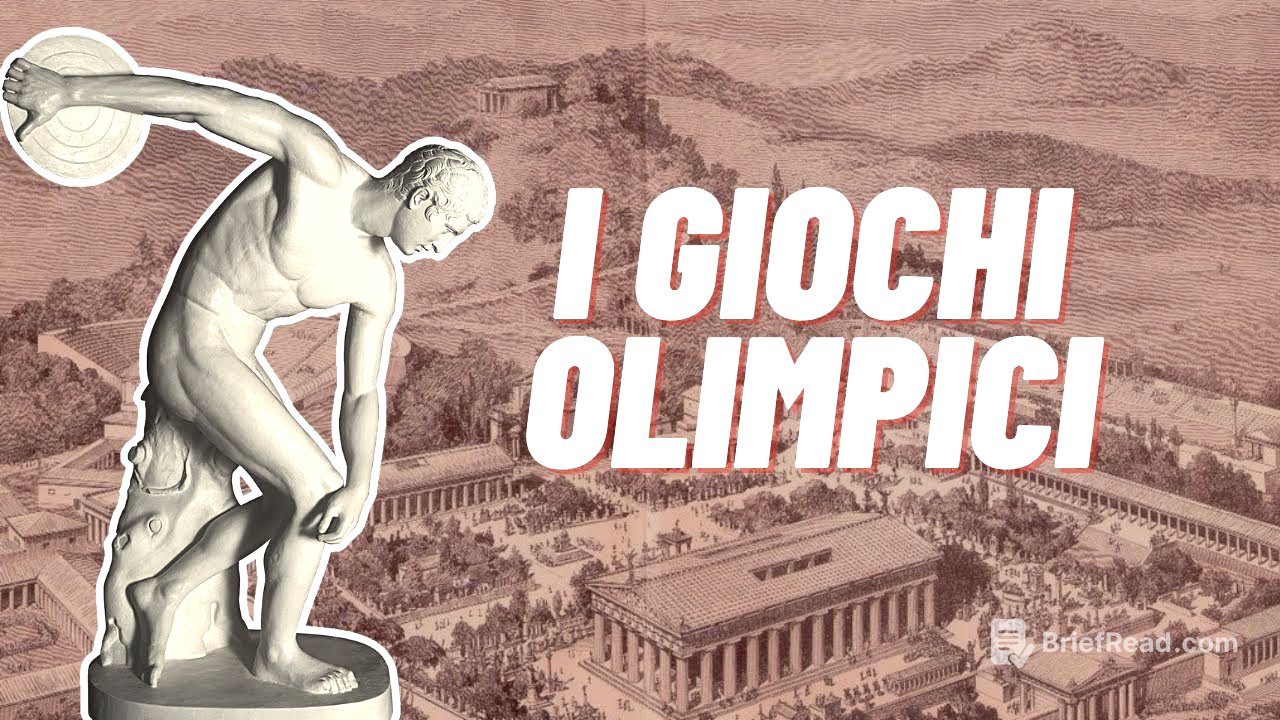
This video explores the origins of the Olympic Games in ancient Greece, tracing their evolution from religious ceremonies to a symbol of peace and athletic competition. It covers the mythological and historical accounts of the Games' founding, the significance of Olympia as a sacred site, and the traditions and rituals associated with the event. The video also discusses the values and ideals promoted by the Games, the role of athletes, and the gradual expansion of the Games to include various sports and participants.
- The Olympic Games originated in ancient Greece over 2700 years ago.
- They evolved from religious ceremonies to a symbol of peace and athletic competition.
- Olympia was a sacred site dedicated to Zeus and the central location for the Games.
- The Games promoted values such as physical excellence, agonism, and the pursuit of glory.
- The event expanded over time to include various sports and participants from across the Greek world.
Introduction [0:00]
The video introduces a journey through time to explore the origins of the Olympic Games, one of history's most iconic sporting events. It highlights how a small sanctuary dedicated to Zeus in Olympia, over 2700 years ago, became the centre of an event that united people and celebrated human excellence. The video aims to uncover how these games, which began as religious manifestations, transformed into a symbol of peace and fair competition, directly inspiring the modern Olympics.
Sport in Ancient Greece [0:55]
Sport in Greece has ancient origins, with archaeological evidence from the Minoan age indicating practices such as running, boxing, and bull-leaping. While their existence is confirmed in artistic forms, their role in Minoan society is debated. It seems their function was not only entertainment but also linked to sacred ceremonies and religious rites. Later, descriptions of athletic competitions appear, such as the games organised by Achilles for Patroclus' funeral, narrated in the 23rd book of the Iliad. These contests had a symbolic meaning, restoring vitality to the deceased through displays of strength and athletic prowess.
The Significance of Agonism and Aristocratic Ideals [1:56]
The competitions included boxing, chariot races, horse races, wrestling, running, javelin and weight throwing, archery, and armed combat, all linked to warfare. There were no professional athletes; the warriors themselves competed. This highlights the origins and value of sport in ancient Greece, particularly its connection to funeral rites and heroic cults. The extreme level of agonism among participants was notable, as Greek society valued winning to assert one's worth in the community. Greek athleticism was tied to aristocratic ideology, with aristocratic men and athletes sharing values like physical superiority, the desire for primacy and glory, and disdain for losers.
The Role of Sport in Forming Citizens [2:47]
The Greeks cultivated the athletic ideal deeply, using gymnastic and sports activities to form citizens physically and characteristically. The education of young people aimed to balance the care of the spirit with that of the body, achieving moral and physical perfection. The heroes were the reference points for this ideal, and athletic competitions were associated with their cults. The origin of the games is deeply linked to sacredness, with city-states organising local sports competitions during religious festivals at important sanctuaries.
The Panhellenic Games [3:37]
The games were marked by complex rituals, including sacrifices that allowed men to connect with the divine world. The most prestigious contests in ancient Greece were the Pythian, Nemean, Isthmian, and Olympic Games. The Olympic Games, held at the sanctuary of Zeus in Olympia, became the greatest sporting event in the Greek world. They took place every four years in July and August, coinciding with the most important religious festival in ancient Greece, honouring Zeus.
The Establishment of the Olympic Calendar [4:15]
The year of the first Olympic Games, 776 BC, became the basis of the first Greek calendar, considered year zero. The Olympic Games became a crucial reference point in the common Greek calendar, with historical events dated based on the four-year cycle of the games. The games were held in Olympia due to its sacred nature as the site of a cult dedicated to Zeus. Additionally, political reasons influenced the choice, as Olympia remained a sanctuary, avoiding competition for supremacy. Its location in the Peloponnese made it easily accessible by land and sea, central to the Greek world.
Mythical Origins of the Olympic Games [5:27]
The origins of the Olympics are rooted in myth, with multiple traditions considered valid. One story involves King Oenomaus of Pisa in Elis, who, fearing a prophecy that he would be killed by his son-in-law, prevented his daughter Hippodamia's marriage. He challenged suitors to a chariot race, killing them when they lost, thanks to his divine horses. Pelops bribed Oenomaus's charioteer, Myrtilus, to sabotage the king's chariot, leading to Oenomaus's death. Pelops then married Hippodamia and organised the first Olympic Games in honour of Zeus to appease the gods for his deceit.
Alternative Accounts of the Founding [6:53]
Another version, from Pindar's "First Olympian Ode," attributes the Olympics' origin to funeral games for the hero Pelops, again linking it to heroic cults and funerary rites. Other sources, also cited by Pindar, credit Heracles with founding the games. Heracles diverted the Alpheus River to clean the Augean stables, built a sacred enclosure around Pelops' tomb, erected twelve altars for the Olympian gods, consecrated the area to Zeus, and planted a sacred grove of wild olive trees, from which victors' crowns were made.
The Political and Military Treaty [7:41]
Historians offer a different account, with Pausanias stating that the Olympic Games originated from a political-military treaty between Iphitus, king of Elis, and Lycurgus, king of Sparta. This treaty aimed to end the conflicts plaguing Elis, the region where Olympia was located. It established the sanctity and inviolability of Olympia and Elis, along with a military truce that eventually lasted three months. This peace allowed athletes and delegations to safely reach the sanctuary of Zeus, where Iphitus instituted the Olympic Games to celebrate the peace.
The Sacred Truce and Early Olympic Practices [8:30]
The sanctuary became one of Greece's most sacred sites, and the Olympic Games symbolised the political-military truce. Violators of the pact were fined and banned from competition. This truce, known as "echecheria," allowed the Olympic Games to evolve from a local event into the most prestigious of the Panhellenic Games. Without this sacred truce, few would have risked travelling to Olympia during wartime. A bronze disc, kept in the temple of Hera at Olympia, recorded the truce agreement.
The Evolution of the Games [9:25]
The first Olympics in 776 BC was a local sporting event with only Greek athletes participating. The sole event was the "stadion," a foot race held inside the stadium of Olympia. Victory was paramount; there were no silver or bronze medals. The motto was "Crown or death," reflecting the true spirit of the Olympic Games. Coroebus, a runner from Elis, won the first Olympic Games, becoming the first Olympic champion. Participants were not professionals; professionalism emerged later in the post-classical era.
The Significance of Victory and Early Traditions [10:23]
In the early centuries, athletes did not make a living from sports. For example, Coroebus was a baker. The stadion winner had the privilege of lighting the fire on the sacrificial altar, possibly the origin of the Olympic torch tradition. Winning the Olympic Games was the greatest distinction for an athlete. The prize was an olive wreath, of great symbolic and sacred value. Victory consecrated the winners, granting them privileges upon their return home, including political careers, statues, and songs of glory, leading to eternal fame.
Expansion and Changes Over Time [11:33]
The champion was considered a hero, almost a demigod, like modern athletes who become myths or legends. Initially, the Olympic Games lasted only one day with a single race. Over the years, various sports were gradually added, extending the duration to the canonical five days. Participation was originally limited to free Greek men who had never been convicted of legal offences, excluding women, slaves, foreigners, and the sacrilegious.
Nudity in the Games [12:04]
After the expansion during Alexander the Great's reign and the Roman conquest of Greece, the games opened to the entire Mediterranean. Athletes competed naked, though the origin of this practice is uncertain. Even the Greeks of the time were unclear about the exact reasons and start date. Thucydides claimed the Spartans introduced the custom, while Pausanias attributed it to the 15th Olympiad in 720 BC, when a runner named Orsippus of Megara discarded his loincloth during the race, improving his speed.
Archaeological Evidence and Conclusion [13:13]
Archaeological evidence, such as vase paintings, shows athletes depicted nude from at least 650 BC. There is much disagreement among sources, making it difficult to determine a precise date. The video concludes with this anecdote about the origin of the Olympic Games, inviting viewers to explore further information on the development of the Olympics and the sports included in antiquity.






![[아라비아 ep.03] 1,200년 전 아라비아인이 본 신라인의 모습은? | 고대 아랍 문헌에 기록된 한국인의 ‘웃긴 해석’](https://wm-img.halpindev.com/p-briefread_c-10_b-10/urlb/aHR0cDovL2ltZy55b3V0dWJlLmNvbS92aS9PYUhtVFpQXzdSay9ocWRlZmF1bHQuanBn.jpg)