TLDR;
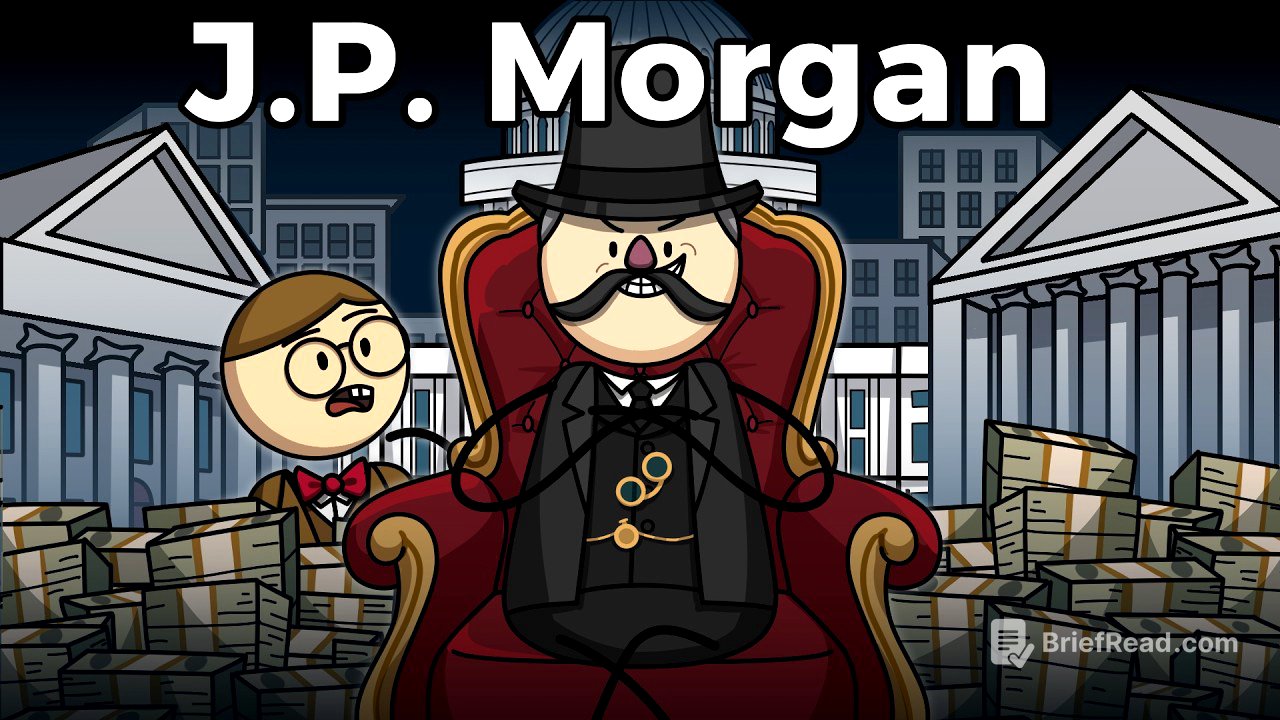
J.P. Morgan rose from a privileged but emotionally strict upbringing to become one of the most influential financiers in America. He reorganised railways and steel, accumulated power across major companies and twice helped the government deal with financial crises. The Panic of 1907 exposed the danger of relying on one banker to stabilise the economy, helping lead to the creation of the Federal Reserve in 1913.
- Morgan’s financial influence came from taking control of struggling businesses and reshaping them.
- His rescue efforts demonstrated both the value and the risks of concentrated private power.
- The Federal Reserve was established so America would have a central bank to respond to future crises.
Morgan’s Early Life and First Financial Deals [0:23]
John Pierpont Morgan was born in Connecticut in 1837 to a wealthy family. His father, Junius Spencer Morgan, was severe and demanding, and Morgan grew up with little affection from him. Morgan was strong at mathematics and studied it in Germany before joining a New York banking firm connected to his father in 1857. There he learnt to assess financial records, shipping deals and loans, and how to connect people with money to those who needed it.
During the American Civil War, Morgan paid another man to take his place in the draft, a practice that was legal at the time. He then financed a deal involving 5,000 discarded rifles: the weapons were bought for $3.50 each, repaired and resold to another army department for $22 apiece. Although the transaction drew anger and accusations that he had profited from selling dangerous weapons to his own country, no criminal charges were filed because Morgan had financed the deal rather than personally inspected the rifles. His father warned him that a profitable deal could still be a bad one if it attracted public outrage. Morgan took the lesson to heart: he wanted not only to make money, but also to gain control.
Morganization and the Control of Railways [3:42]
By the 1880s, railway companies were competing over the same routes and customers, driving prices so low that many struggled to make a profit. Morgan brought railway bosses together and pushed them to stop competing destructively, divide up territory and agree on prices. He also sought positions on their boards so he could oversee the arrangement.
This approach became known as “Morganization”. Morgan bought control of struggling companies, stopped them fighting their rivals, replaced managers and placed his own representatives in charge. Investors saw him as rescuing failing businesses, but the consolidation also reduced competition. By the mid-1890s, he controlled around one-sixth of the railway tracks in the United States and sat on 48 company boards. The railways taught him that disorder could be profitable if he was the person paid to impose order.
The Creation of US Steel [6:40]
Morgan turned his attention to steel, an essential material for railways, bridges, buildings, factories and ships. The leading company belonged to Andrew Carnegie, who had built it himself and did not answer to outside investors. Morgan sought Carnegie’s trusted associate Charles Schwab, president of Carnegie Steel, after Schwab argued that America needed one enormous steel company.
Schwab approached Carnegie, who was considering retirement, and Carnegie wrote a price of $480 million on a piece of paper—about $17 billion in today’s money. Morgan bought Carnegie Steel and combined it with nine other companies to create US Steel, the first company valued at more than $1 billion. By 1901, Morgan was not merely lending to businesses: he was influencing which companies survived, who managed them and how whole industries were organised.
Roosevelt Challenges Morgan’s Power [8:43]
Morgan and another financier placed several major north-western railways under one new company, giving it control of nearly all major rail traffic in the region. President Theodore Roosevelt intervened, arguing that the arrangement violated laws against one company controlling an entire market. Morgan initially expected the matter to be settled through negotiation, but Roosevelt demanded that he stop.
The government broke up the railway company because it had become too powerful. For the first time, the government had directly told Morgan no. Soon, however, it would turn to him for help when a financial panic threatened the country.
The Panic of 1907 and Morgan’s Rescue [9:29]
In October 1907, rumours that Knickerbocker Trust was in trouble triggered a rush by customers to withdraw their money. The company lost $8 million by noon and ran out of money by 2 pm. Panic spread to other financial institutions, the stock market crashed, and banks stopped lending to one another. Because banks lend out much of their deposits, even a healthy bank can fail if too many customers demand their cash at once. Businesses then struggled to buy supplies and pay workers.
America had no central bank to lend money during the crisis, so government officials and President Roosevelt sought Morgan’s help. This was not the first time the government had depended on him. In 1895, when the Treasury was running out of gold—then needed to maintain confidence in the dollar—Morgan had organised bankers to buy government bonds at a discounted price. The bankers paid the government in gold and later sold the bonds to investors at the normal price, earning a profit while securing the Treasury’s gold supply.
In 1907, the 70-year-old Morgan returned to New York from a church conference and gathered leading bankers in his library. He needed them to raise $25 million by morning to save the Trust Company of America. After hours of argument, Morgan locked the library door and told the bankers they could leave once they agreed to save the company. By 4:45 am, they had pledged the full amount. The trust company survived, and the panic began to ease.
The Money Trust Investigation and the Federal Reserve [13:16]
In 1912, Congress investigated what it called the “money trust”: the possibility that a small group of bankers controlled America’s finances. Morgan’s allies held seats on 341 boards across 112 companies, whose combined value was $22 billion. The New York Stock Exchange’s companies together were worth about $26.5 billion, meaning Morgan and his associates had influence over businesses worth more than four-fifths of the market.
At 75, Morgan travelled to Washington to testify despite warnings about his health. Under questioning by lawyer Samuel Untermyer, Morgan said that character mattered more than money or property when deciding whether to lend. When asked who judged a person’s character, he answered, “I do.” His confidence reflected the system’s reliance on his personal judgement, but also its central weakness: one person could become ill, make a mistake or die, leaving the economy exposed.
Congress’s investigation confirmed that a small group of bankers controlled a huge share of American finance, with Morgan at its centre. The Panic of 1907 and the inquiry helped build support for a permanent solution. In December 1913, Congress created the Federal Reserve, America’s central bank, so the government would have its own emergency financial system rather than having to rely on a single banker.
Morgan’s Death and His Legacy [15:23]
Morgan died in his sleep at a hotel in Rome, just months after testifying before Congress, and did not live to see the Federal Reserve’s creation. When his will was opened, his estate was valued at around $68 million—an enormous sum, though less than many people expected. His defining achievement was not simply the wealth he accumulated, but the control he built over companies, industries and finance.
Morgan’s rise took him from a sickly boy in Connecticut to the man America called when its financial system was in danger. His career showed how much a private financier could accomplish in the absence of a central bank, while also demonstrating why that much power should not rest with one person.