TLDR;
This video explores the extreme gender conflict in South Korea, tracing its roots from economic crisis and escalating into online warfare. It highlights how radical feminist movements and their tactics led to a counter-movement by Korean men, who adopted similar logic to undermine feminist goals. The video concludes by drawing parallels to gender dynamics in the West, noting a global trend of men withdrawing from social and romantic engagement due to perceived hostility and unequal treatment.
- South Korea's gender conflict is among the most extreme globally, marked by radical feminist actions and male counter-movements.
- Economic downturns and hyper-competition exacerbated gender tensions, leading to aggressive verbal combat and online battles.
- Korean men strategically used feminist logic against itself, resulting in unexpected consequences like decreased social engagement and declining birth rates.
- The dynamic mirrors trends in the West, where a culture of hostility and moral competition leads to male withdrawal.
- The core issue is the transformation of equality into a weapon, hindering genuine progress and shared responsibility.
Introduction: The State of Gender Relations [0:00]
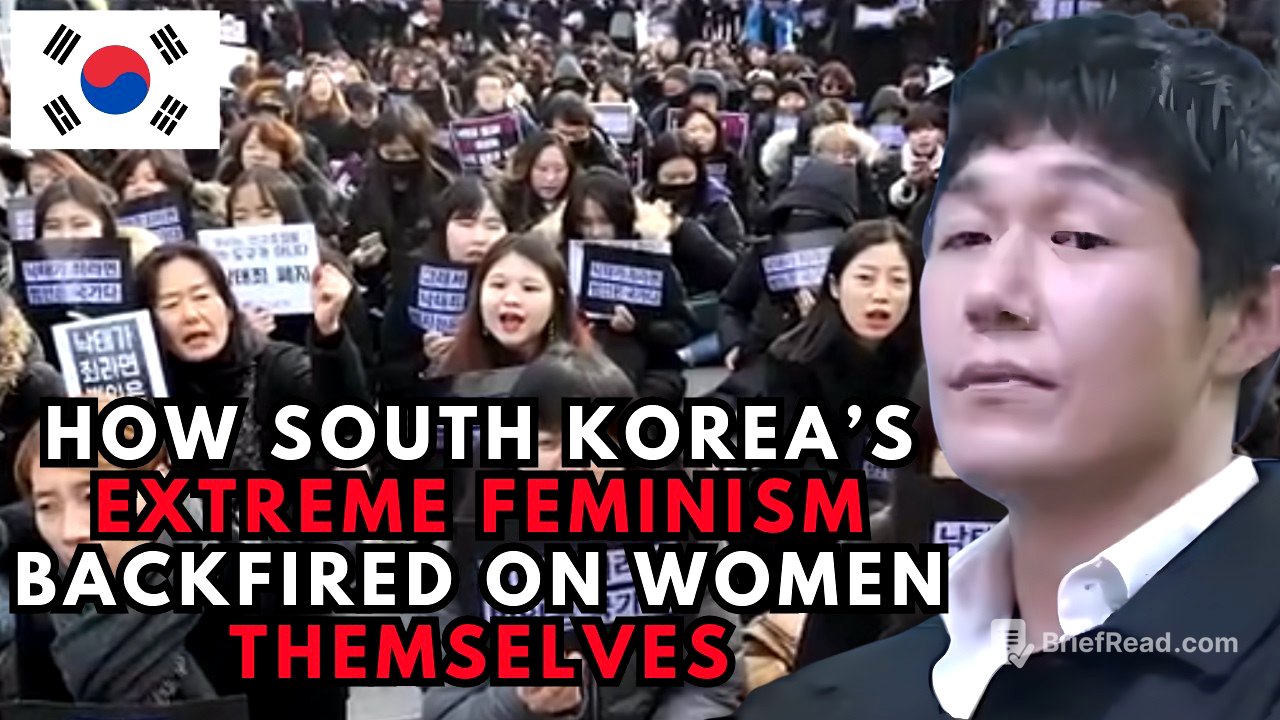
The video begins by posing the question of why men are increasingly hesitant to pursue women, particularly in South Korea, where a strict "three attempts rule" exists, legally defining excessive romantic interest as harassment. This regulation highlights the severity of gender conflict in South Korea, with some radical feminist groups advocating for the elimination of Korean men. The video aims to explore how feminism in South Korea became so extreme, contrasting it with similar developments in Japan.
The Rise of Feminism in Korea [1:14]
From 1960 to 1990, South Korea experienced rapid economic growth, leading to urbanisation, fashion trends, progressiveness, and free love. This captivated the younger generation, with Korean women initially seeking independence from old traditions. This movement was widely supported by both men and women. However, economic downturns and increased competition exacerbated the conflict between men and women, mirroring Japan's experience during the 1997 Asian financial crisis.
Escalation of Conflict and the Role of the Internet [2:13]
In 1999, Korean feminists filed a lawsuit against military veterans to remove the 5% hiring bonus for men who completed mandatory service, claiming it was unconstitutional and discriminatory. This demand was approved in 2000, marking a turning point. The entry of China into the WTO in 2001 and the 2008 financial crisis further worsened the job market, leading to intense internal competition. In 2009, an all-out confrontation erupted after a TV show comment about men under 1.8m being "losers" sparked outrage. The internet then fuelled the gender war, with extreme feminist groups like Megalia emerging, promoting radical ideas such as selective abortion of male babies and online harassment of men.
The Counter-Offensive: Men Using Feminist Logic [5:51]
Korean men responded to radical feminism by adopting its own logic. When feminists criticised companies with fewer women, masculinists openly admitted to discriminating to maximise benefits for men. The "three attempts rule" was met with men ceasing to message women altogether. This strategy involved turning feminist arguments back on themselves, such as agreeing with the idea that marriage and childbirth oppress women, leading to men choosing not to marry or have children.
Consequences and Internal Splits [7:17]
Initially, feminists thought they had won as men complied with their demands. However, variety shows became dull, and women felt bored. Men openly discriminated in the job market, making it harder for women to find employment. The "three attempts rule" contributed to Korea's declining population. This led to internal divisions among women, with grassroots feminists wanting to revoke the rule while elite radical feminists wanted to keep it. The masculinists supported not harassing women, creating a curious situation where they aligned with some feminist goals.
The End of Radical Feminism in Korea [9:31]
Feminists realised they couldn't outperform men in the job market or beat their strategies. Korean men, like Japanese men, chose not to marry, date, or have children, leading individual lives. The feminist movement's punches started hitting the air, and the game of radical feminism in Korea began to end. The conflict also involved Korean politics, but the video avoids going too deep into that aspect.
Global Parallels and the Real Lesson [10:17]
South Korea's situation reveals the consequences of pursuing advantage instead of equality. Korean men, tired of being treated as villains, simply stopped engaging. This dynamic is not exclusive to Korea, with the West following a similar script of hostility, moral competition, and a cold war between genders. Men are withdrawing emotionally, economically, and familially. The core issue is that equality has become a weapon, with each side seeking unilateral advantage.
Conclusion: The Tragedy of a War Where No One Wins [12:30]
The endless tug of war results in a society where everyone loses, with a generation distrustful of love, marriage, and coexistence. The solution was always simple: respect, dialogue, and shared responsibility. However, conflict generates more attention and engagement. The real lesson is that when equality becomes a weapon, it ceases to be equality and becomes another form of power. The conversation that should unite becomes a trench, and the fight for rights overshadows the importance of sharing life with others.