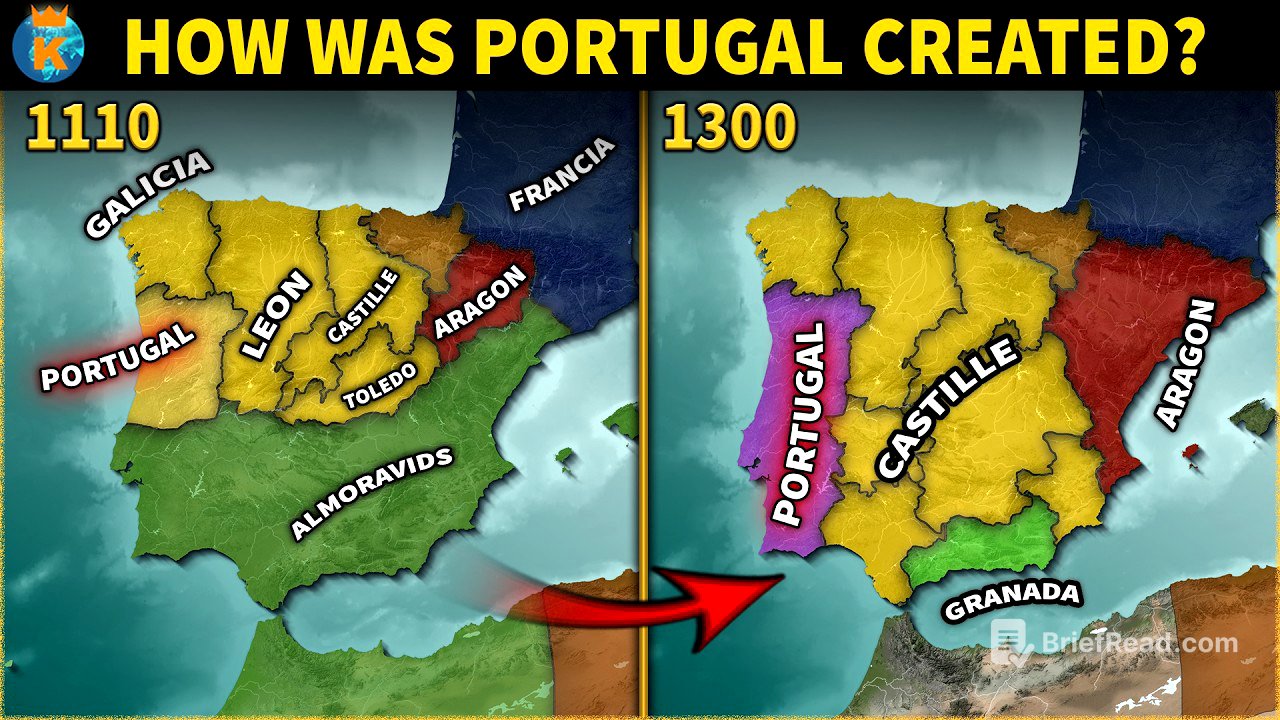
TLDR;
This video explains the historical origins and development of Portugal, from its ancient roots to the establishment of its modern borders. It highlights key events such as Roman influence, the Reconquista, the role of figures like Afonso Henriques, and the complex negotiations with Castile that shaped Portugal's territory.
- Portugal's borders were formed through centuries of conquest and diplomacy.
- Key figures like Afonso Henriques were instrumental in securing Portugal's independence.
- The Reconquista and conflicts with Castile significantly shaped Portugal's territorial boundaries.
Early History and Roman Influence [0:00]
The territory that would become Portugal lacked initial unity. The Romans, arriving in the 2nd century BC, encountered warrior tribes known as the Lucatanians. Southern Portugal and western Spain were organised into the Roman province of Lucitania, while the northwest formed part of Galacia. The Romans founded key cities like Lisbon and Porto and introduced Christianity, which later became central to Portuguese society. However, even after the Romans left in 410, there was no unified Portugal.
Visigothic and Muslim Rule [1:19]
Following the collapse of the Roman Empire, northern Portugal fell under the control of the Suebi, while the south was taken by the Visigoths, who then conquered the Suebi by 535. The Visigoths contributed to the Christianisation of the region and influenced the development of Old Portuguese through their Germanic language. Portugal remained under Visigothic rule until 711, when Muslim forces led by Tariq ibn Ziyad invaded the Iberian Peninsula, conquering most of the Visigothic kingdom. For the next 200 years, Portugal was largely under Muslim control as part of Al-Andalus.
The County of Portugal [2:15]
Galacia in the north remained under Christian control, with rulers aspiring to reclaim Iberia from the Muslims, a period known as the Reconquista. In the 8th and 9th centuries, the Kingdom of Asturias (later León), located north of Portugal, launched raids into Portuguese territory. In 868, Vimara Perez, a vassal of King Alfonso III of Asturias, seized Porto and Coimbra. By 879, this newly conquered region was granted to Vimara Perez as the County of Portugal. The Perez family ruled for centuries, establishing foundations for the future nation, including the city of Guimarães, considered the cradle of Portugal.
The Kingdom of Portugal is Created [5:33]
King Alfonso VI of León and Castile initially believed the "Portuguese issue" was resolved by incorporating Portugal and Coimbra into Galacia. However, in 1095, he divided Galacia, granting Portugal and Coimbra to Henry of Burgundy, who became Count of Condado Portucalense. Henry ruled as a loyal vassal until his death in 1112, leaving the crown to his widow Theresa and their son, Afonso. Galacia attempted to regain control by influencing Theresa, but Afonso Henriques rebelled in 1127 against his mother and the Galicians.
Afonso Henriques and Independence [6:50]
Afonso Henriques, supported by the nobility and clergy, defeated his mother's forces at the Battle of São Mamede in 1128, exiling her and declaring himself Prince of Portugal. Initially reaffirming loyalty to León-Castile, Afonso focused on the Reconquista, moving his court to Coimbra. On 25 July 1139, after a victory at the Battle of Ourique, Afonso renounced loyalty to León-Castile and declared himself King Afonso I of Portugal.
Recognition and Expansion [8:00]
Afonso I faced opposition from Alfonso VII of León-Castile, leading to a brief war that culminated in the skirmish at Valdevez in 1141, where Portuguese forces prevailed. The Treaty of Zamora in 1143 recognised Afonso's status as King of Portugal, with full papal recognition following in 1179. Afonso then turned his attention back to Muslim Al-Andalus, viewing the Reconquista as his royal duty.
The Second Crusade and the Capture of Lisbon [9:10]
Taking advantage of the Second Crusade, Afonso received crusader reinforcements. In March 1147, he captured Santarém. In June 1147, a fleet of crusaders en route to the Holy Land agreed to help Afonso capture Lisbon. After a four-month siege, Lisbon surrendered on 25 October 1147, adding a major port to the kingdom. Many crusaders settled in the area, bolstering the Christian population.
Continued Reconquista and Setbacks [10:56]
Afonso continued to push south, capturing cities like Beja and Évora, aided by the Knights Templar, who received land and privileges in return. However, in 1169, an attempt to capture Badajoz failed. The now 60-year-old king was injured and captured by forces of León, who were wary of Afonso's growing power. Although eventually released, Afonso lost control of some conquered territories, marking the eastern limit of Portugal's borders.
Later Reconquista Efforts [12:27]
Afonso retired from fighting personally, but his armies continued the war. By his death in 1185, Portugal had doubled in size. His successors continued the Reconquista. Sancho I used the Third Crusade to capture Silves in 1189, but the Almohad dynasty retook it, pushing Portugal back to the Tagus River. The Tagus became Portugal's border for the next 30 years, guarded by castles manned by military orders.
Consolidation and Further Expansion [13:50]
Portugal consolidated its conquests, settling conquered regions with Christians and developing administration. In 1211, King Afonso II convened the first Portuguese Cortes (Parliament) in Coimbra, issuing general laws that recognised royal power and protected the rights of Portuguese subjects. In 1217, Portugal resumed its southward conquests, capturing Alcácer do Sal with the help of the Fifth Crusade. King Sancho II captured most of the Alentejo region, leaving only the Algarve in Muslim hands.
Final Conquest of the Algarve [15:22]
In 1249, Afonso III completed the Reconquista by capturing Faro, the last major Muslim stronghold in the Algarve. By the end of 1249, the territory of modern Portugal was united under the crown.
Conflicts with Castile and Border Resolution [15:53]
With Muslim power reduced to the Emirate of Granada, Portugal's main concern became Castile, which saw itself as the supreme power in Iberia. Alfonso X of Castile claimed the Algarve, leading to a brief war in 1250. Castile granted Afonso III the right to hold the Algarve in their name, sealed by his marriage to Princess Beatrice of Castile. In 1267, the Treaty of Badajoz relinquished Castile's claims to the Algarve, recognising it as Portuguese territory. The Guadiana River was established as the boundary. In 1297, the Treaty of Alcanizes resolved lingering border disputes, securing Portugal's borders by the 14th century.
Final Border Security [18:08]
Even the temporary union of Portugal and Spain in 1580 had little effect on its borders. When Portugal broke away in 1668, its only mainland loss was the town of Olivenza. Portugal's borders were the result of generations of conquest and diplomacy, shaped by local political and geographic circumstances. This process led to Portugal becoming a major world power, influencing regions from India to Brazil, while maintaining its independence for centuries.
![This Crypto Crash Will NOT End Here! [Here's Why]](https://wm-img.halpindev.com/p-briefread_c-10_b-10/urlb/aHR0cDovL2ltZy55b3V0dWJlLmNvbS92aS9EbUdyNzlUemp4TS9ocWRlZmF1bHQuanBn.jpg)