TLDR;
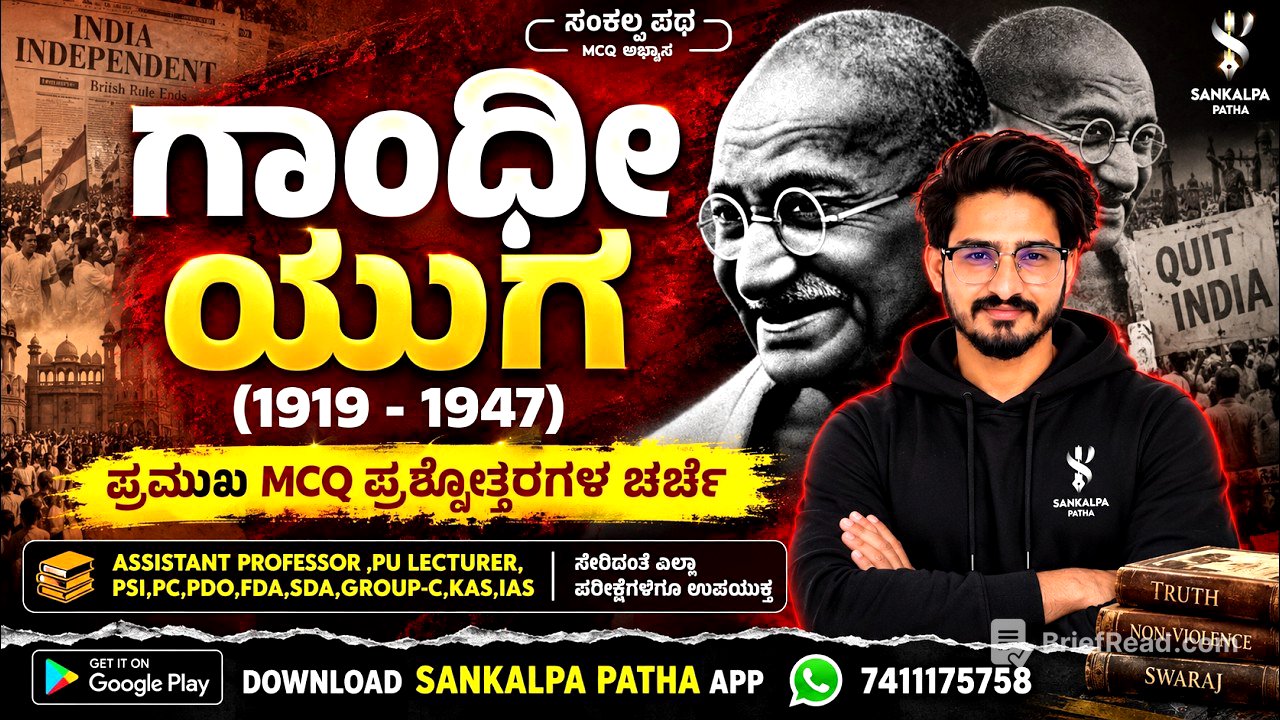
This video focuses on competitive examination preparation, primarily discussing past years' important questions and current exam patterns. The tutorial examines various publications closely associated with Mahatma Gandhi and pivotal moments in India's independence movement. It also covers the Quit India Movement, the impact of various political resolutions, and Gandhi's significant role in shaping Indian nationalism.
- Importance of competitive exams and exam patterns
- Discussion of Gandhi's publications and various movements
Introduction and Welcome [0:00]
The instructor, Shivaraj Kumar Palled, welcomes students and introduces the session, indicating a focus on previous years' competitive exam questions and significant current examination patterns.
Gandhi's Publications [0:50]
The chapter highlights the publications established by Mahatma Gandhi, including "Indian Opinion," "Navajeevan," and "Harijan." It discusses Gandhi's role in initiating "Indian Opinion" in South Africa to address Indian issues and later starting "Navajeevan" and "Harijan" to uplift the Harijan community in India. The significance of these publications in Gandhi's life and their relation to his autobiography is covered.
Congress Formation and Leadership [4:50]
This section elaborates on the foundation of the Indian National Congress and its significant leaders, noting Jawaharlal Nehru and Maulana Abul Kalam Azad's contributions. It discusses leadership tenures with emphasis on Congress' evolving role up to India's fight for independence.
Quit India Movement Overview [4:51]
Here, the video explains the Quit India Movement's instigation, Gandhi's philosophy of non-violence, and its evolution. It touches on key events, including the Dandi March and the broader significance of civil disobedience as a method of pushing for independence.
Key Events and Resolutions [12:52]
This chapter discusses important declarations and resolutions from various Congress sessions. Specific focus is given to the resolutions made during the Nagpur and Bardoli sessions, explaining their impact on the independence struggle.
Chauri Chaura Incident [13:30]
The Chauri Chaura incident, where violent clashes occurred during the Non-Cooperation Movement, is elaborated upon. The chapter highlights the event's immediate consequences on Gandhi’s strategy for non-violent protests.
Simon Commission and Its Rejection [14:51]
The Simon Commission's visit to India is discussed, detailing how all members were Europeans, causing widespread discontent among Indians. The Indian National Congress and other political factions collectively refused to accept the commission, sparking protests.
Jallianwala Bagh Massacre [21:00]
This chapter provides a detailed account of the Jallianwala Bagh massacre, where a large number of Indians were killed by British forces in 1919. The critical response to this incident and its significance in galvanising Indian nationalist sentiments are illustrated.
Independence and Gandhi's Role [38:20]
The section discusses Gandhi's return to India and his involvement in the independence movement, citing how he fully committed himself to the freedom struggle post-1915 and his major strategies employed thereafter.
Conclusion and Further Discussions [48:20]
In concluding remarks, the instructor summarises the important topics covered during the session and invites students to engage further with questions related to the independence movement and Gandhi's strategies.