TLDR;
This video focuses on the composition, classification, functions, and metabolism of fats and lipids. Key points include the significance of essential fatty acids for health, fat-related disorders, and the role of fats in energy production, hormone synthesis, and nutrient absorption.
- Overview of fats and lipids as energy sources.
- Classification into simple, compound, and derived lipids.
- Importance of essential fatty acids from diet.
- Functions of fat in energy provision, vitamin absorption, and hormone synthesis.
- Digestion, absorption mechanisms, and health implications of different types of fatty acids.
Composition and Classification of Fats [0:16]
Fats and lipids are essential components in the body, serving primarily as energy sources, providing 9 kilocalories per gram. They include fats, oils, waxes, phospholipids, and sterols. Historically, fats were viewed mainly as energy nutrients, but research later established the importance of fatty acids and cholesterol in health. Fats occur mainly as triglycerides in adipose tissue, serving as energy reserves and playing roles in membranes and nerve insulation. The classification of lipids includes simple lipids (like triglycerides), compound lipids (lipids with additional elements such as phosphorus), and derived lipids (which consist of fatty acids).
Functions of Fats [7:08]
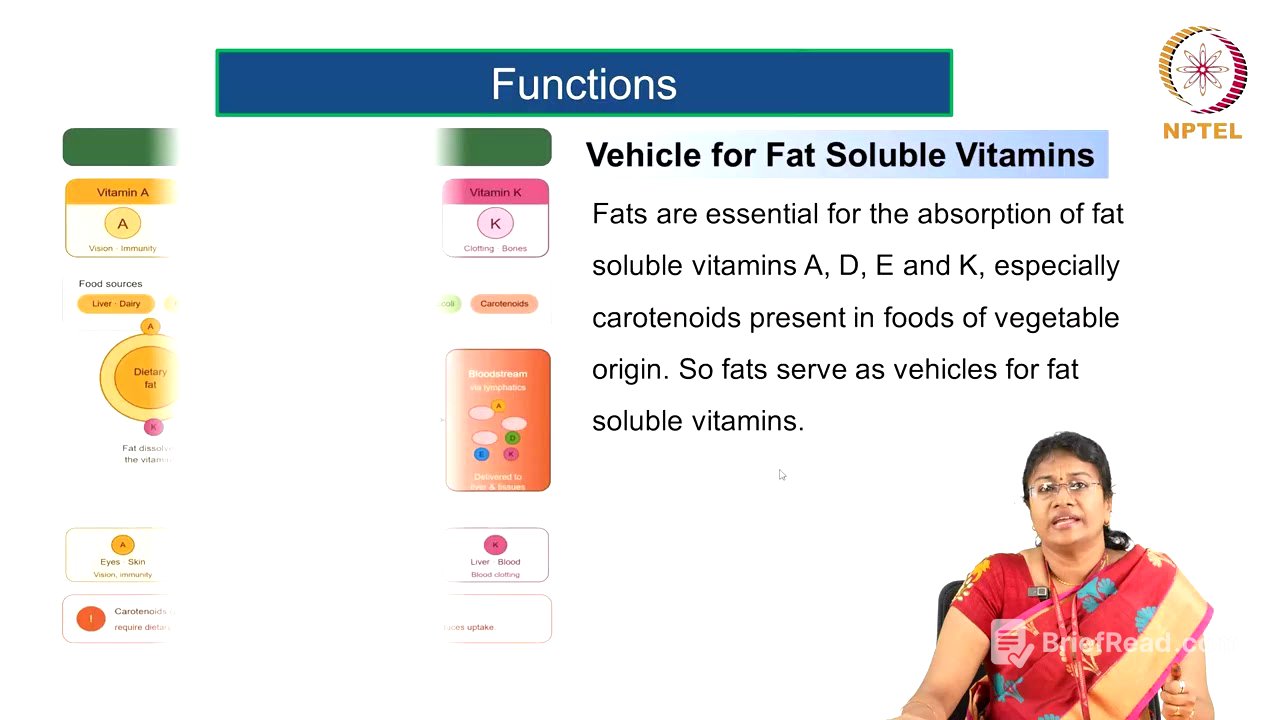
Fats serve several crucial functions in the body, notably energy provision and protein sparing. They provide substantial energy, especially during starvation when stored fats are mobilised. Adequate fat intake preserves protein for tissue repair rather than energy production. Fats also facilitate the absorption of fat-soluble vitamins A, D, E, and K and are essential for hormone synthesis, including sex hormones and bile acids, illustrating their wide-ranging role in health.
Digestion and Absorption of Fats [11:50]
The digestion of fats begins in the mouth with lingual lipase and continues in the stomach with gastric lipase. However, the majority of fat digestion occurs in the small intestine, where bile salts emulsify fats, allowing pancreatic lipase to hydrolyse triglycerides into fatty acids and glycerol. The absorption process involves forming micelles that transport these components into intestinal cells, where they are reassembled into triglycerides and packaged into chylomicrons for transport through the lymphatic system to the bloodstream.
Lipid Transportation and Cholesterol [17:20]
Lipid transportation in the body involves several lipoproteins. Chylomicrons transport dietary lipids, while very low-density lipoproteins (VLDL) carry lipids synthesized in the liver. Low-density lipoproteins (LDL) deliver cholesterol to tissues but are associated with increased atherosclerosis risk, whereas high-density lipoproteins (HDL) remove excess cholesterol from tissues, earning the label of "good cholesterol." Maintaining a balance between HDL and LDL is critical for cardiovascular health.
Essential Fatty Acids [20:48]
Essential fatty acids, such as omega-3 and omega-6, must be obtained through diet as the body cannot synthesise them. Omega-3 includes alpha-linolenic, eicosapentaenoic (EPA), and docosahexaenoic (DHA) acids, while omega-6 includes linoleic and arachidonic acids. These fatty acids play fundamental roles in membrane structure, inflammation regulation, and overall health, necessitating a balanced intake for optimal physiological results.
Fatty Acid Types and Health Implications [29:00]
The video discusses saturated and unsaturated fatty acids. Saturated fats, usually solid at room temperature and found in animal fats, can increase LDL cholesterol and the risk of cardiovascular diseases. Unsaturated fats, either monounsaturated or polyunsaturated, are generally healthier options found in plant oils and fish. They lower LDL levels and promote heart health. Trans fats, created through hydrogenation, are harmful and should be avoided due to their potential to raise LDL cholesterol and increase heart disease risk.
Properties and Mechanisms of Fat [33:50]
Fats are defined by their solubility in water and specific melting points. Their chemical properties include reactions like hydrogenation and oxidation. Hydrogenation improves shelf life and texture but may create trans fats, while rancidity is caused by oil exposure to light and moisture, leading to unpleasant flavours. Ketosis occurs when fats are broken down for energy, producing ketone bodies, while lipotropic factors can help prevent fat accumulation in the liver, aiding fat metabolism.
Cholesterol and Impacts on Health [37:40]
Cholesterol is vital for synthesising bile acids and hormones, but excess levels can lead to serious cardiovascular issues. The differential roles of LDL (bad cholesterol) and HDL (good cholesterol) are reiterated, emphasizing how LDL can lead to plaque buildup while HDL helps remove cholesterol from the bloodstream. Proper management of dietary fats is crucial for maintaining heart health, hormone production, and overall wellness. This session concludes that a balanced intake of healthy fats is essential for optimal health.
![$40,512 with 1 faceless shorts channel by stealing content [FULL COURSE]](https://wm-img.halpindev.com/p-briefread_c-10_b-10/urlb/aHR0cDovL2ltZy55b3V0dWJlLmNvbS92aS9jZ3VDNDJBUGVVWS9ocWRlZmF1bHQuanBn.jpg)