TLDR;
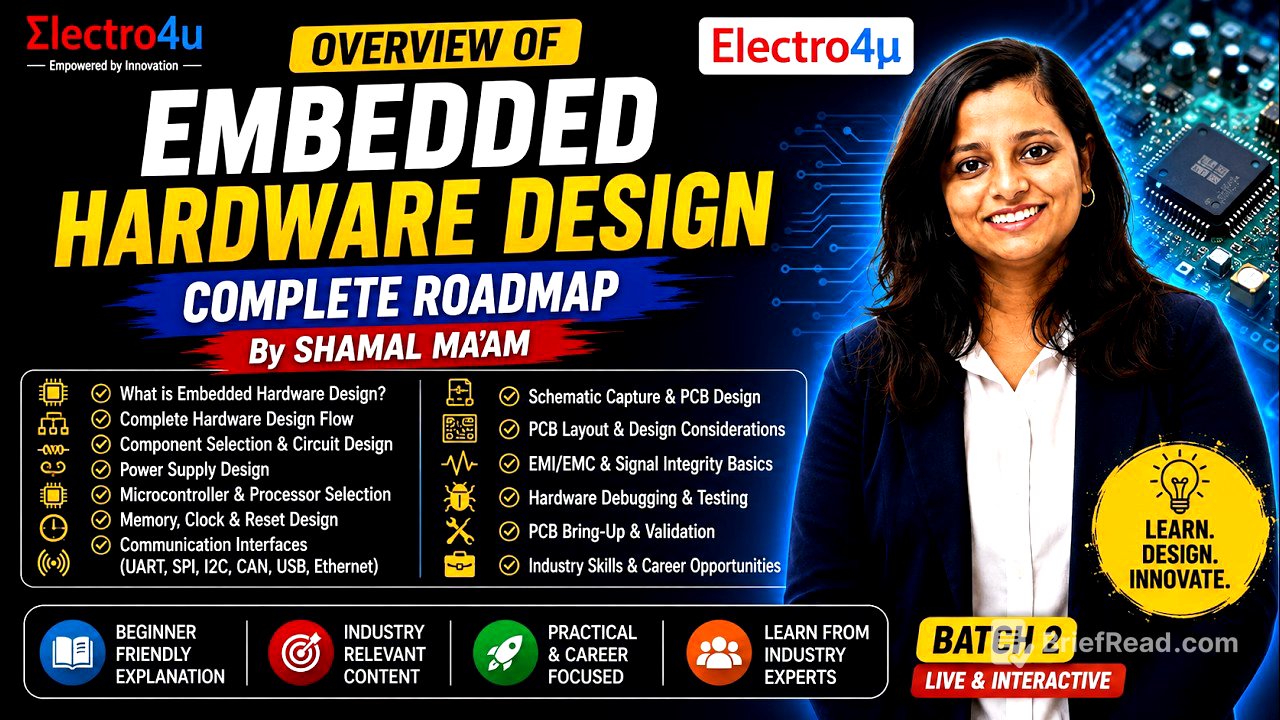
This video provides a comprehensive introduction to embedded hardware and firmware, outlining important concepts in the field of electronics. Key points covered include passive components, power supply basics, microcontroller architecture, industrial communication protocols, and practical applications such as LED resistor calculations.
- Embedded hardware and software (firmware) are crucial to electronics.
- Understanding passive components, microcontrollers, and power supply principles is essential for effective circuit design.
- The video also discusses practical applications and calculations relevant to embedded systems.
Introduction to Embedded Hardware and Firmware [0:09]
The session begins with an introduction to embedded hardware and firmware, explaining the distinction between hardware and software components in embedded systems. The speaker emphasises the significance of understanding these foundational elements, which include passive components and power supply basics.
Overview of Passive Components and Semiconductors [0:54]
This chapter provides an overview of passive components such as resistors, capacitors, and inductors, as well as semiconductors like transistors. The speaker discusses practical applications and calculations associated with these components, focusing on their roles in embedded systems.
Power Supply Basics: AC to DC and DC-to-DC Converters [1:48]
The session explains the fundamentals of power supply systems, including the conversion of AC to DC. The speaker outlines how embedded systems typically operate on DC voltages, detailing the use of DC-to-DC converters to provide the necessary power levels for microcontrollers.
Microcontroller Architecture and Interfaces (GPIO, UART, SPI, I2C) [3:12]
In this segment, the architecture of microcontrollers is explored, focusing on essential interfaces such as GPIO (General Purpose Input/Output), UART (Universal Asynchronous Receiver-Transmitter), SPI (Serial Peripheral Interface), and I2C (Inter-Integrated Circuit). The practical applications of these interfaces in communication between microcontrollers and peripheral devices are highlighted.
Industrial Communication Protocols (CAN, Modbus) [3:59]
The video discusses industrial communication protocols, particularly CAN (Controller Area Network) and Modbus. These protocols are vital for communication in industrial applications, allowing devices to exchange information over a network efficiently.
Memory Interfaces (EEPROM, SD Card) [5:44]
This chapter covers memory interfaces used in embedded systems, focusing on EEPROM (Electrically Erasable Programmable Read-Only Memory) and SD cards. The speaker explains how to interface these memory types with microcontrollers and their applications in data storage.
Practical Example: Resistor Calculation for an LED using Ohm's Law [6:58]
A practical example is presented where the calculation of a resistor required for an LED is demonstrated using Ohm's Law. The speaker walks through the steps to determine the necessary resistance based on voltage and current specifications.
Understanding Forward Voltage (V_f) [11:45]
This segment clarifies the concept of forward voltage (V_f) in diodes and LEDs, explaining how it affects circuit design. The importance of understanding forward voltage when calculating resistance and current in LED applications is emphasised.
Comparison of Series and Parallel LED Connections [12:24]
The differentiation between series and parallel LED connections is discussed in detail. The impact on voltage drop and current distribution in each configuration is covered, including how to calculate the necessary resistor values for both setups.
How to Measure Current and Voltage using a Multimeter [20:07]
The speaker explains how to measure current and voltage using a multimeter. The importance of understanding circuit connections and settings while measuring electrical parameters is highlighted for accurate readings.
Capacitors: Decoupling (nF) vs. Filtering (μF) [28:48]
An overview of capacitors is provided, focusing on the distinctions between decoupling and filtering capacitors. The speaker explains their roles in circuits and how their values (in nanofarads and microfarads) relate to frequency-dependent applications.
Diodes: Zener, Schottky, and TVS (Transient Voltage Suppressors) [30:35]
Different types of diodes, including Zener, Schottky, and TVS (Transient Voltage Suppression) diodes, are discussed. The speaker outlines their functions and applications in protecting circuits from voltage spikes and ensuring proper operation.
BJT (NPN/PNP) vs. MOSFET (N-channel/P-channel) Switching [34:11]
This chapter compares bipolar junction transistors (BJTs) with metal-oxide-semiconductor field-effect transistors (MOSFETs). The characteristics and switching capabilities of N-channel and P-channel MOSFETs versus NPN and PNP BJTs are discussed in the context of electronic design.
Linear Regulators (LDO) vs. Buck Converters (SMPS) [38:03]
The session explains the principles of linear regulators (LDOs) and buck converters (Switched-Mode Power Supplies, SMPS). The differences in their applications and efficiency are highlighted, along with considerations for choosing between them.
Embedded Hardware Design Life Cycle and Block Diagrams [39:21]
An overview of the embedded hardware design life cycle is provided, detailing the stages involved in developing hardware products. The significance of creating block diagrams for visualising components and their interconnections in a system is emphasised.
Discussion on Development Boards (Arduino, ESP32, NodeMCU) [41:30]
This chapter discusses popular development boards such as Arduino, ESP32, and NodeMCU. The speaker highlights their features, ease of use for prototyping, and applications in embedded projects.
Understanding Reset Circuits (Hardware vs. Software Reset) [44:41]
The differences between hardware and software reset circuits are explained. The speaker discusses how reset mechanisms function in embedded systems and their significance in ensuring reliable operation.
What is Firmware? (Language, Compilers, and Hex Files) [52:09]
An introduction to firmware is provided, discussing its role in programming microcontrollers. Key topics include programming languages, compiler usage, and the importance of hex files in uploading code to hardware.
Introduction to Programmers and Debuggers (ST-Link, Pickit) [54:37]
The final chapter covers programmers and debuggers such as ST-Link and Pickit. The speaker explains how these tools are used to upload firmware and debug embedded systems, enhancing development efficiency.