TLDR;
This video explains the dialysis tube lab experiment, focusing on the principles of osmosis and diffusion. The experiment demonstrates how different-sized molecules move across a semipermeable membrane, mimicking a cell. Key observations include the movement of glucose and iodine, the immobility of starch, and the overall change in the bag's weight due to water movement.
- Osmosis involves the movement of water from an area of high concentration to low concentration.
- Diffusion involves the movement of particles from an area of high concentration to low concentration.
- The dialysis tube acts as a semipermeable membrane, allowing certain molecules to pass through based on size.
Introduction to Osmosis and Diffusion [0:00]
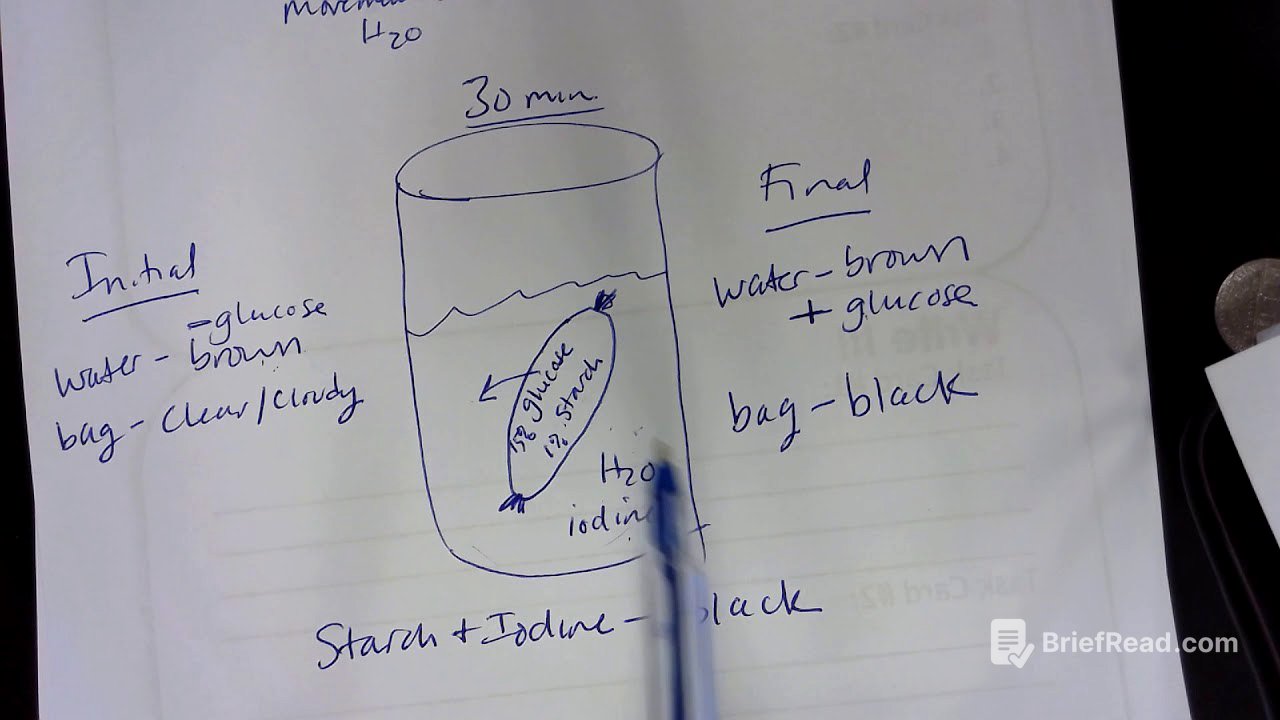
The dialysis tube lab explores osmosis, the movement of water, and diffusion, the movement of gases and particles. The experiment uses a beaker containing a dialysis tube, which acts as a semipermeable membrane. The beaker is filled with water and iodine, while the dialysis tube contains glucose (15%) and starch (1%). Initially, the water is brown due to the iodine, and the solution inside the bag is clear, possibly slightly cloudy.
Experiment Setup and Initial Observations [0:40]
The experiment involves observing changes over 30 minutes. Glucose molecules are small, whereas starch molecules are large polysaccharides. The dialysis tube, like a cell, selectively allows molecules to pass through based on size. Given this, it's expected that glucose will move out of the bag due to its smaller size.
Final Results and Glucose Diffusion [2:37]
After 30 minutes, the water outside the bag tests positive for glucose, indicating that glucose has moved out of the bag. The bag's contents turn black. This colour change occurs because iodine diffuses into the bag and reacts with the starch inside. Starch remains inside the bag because it is too large to pass through the semipermeable membrane.
Iodine Diffusion and Starch Retention [3:58]
Iodine diffuses into the bag because it is a small enough particle. The black colour inside the bag confirms the presence of both starch and iodine. This demonstrates diffusion, with glucose moving out and iodine moving in, based on their respective sizes.
Water Potential and Osmosis [4:38]
The bag's weight increases, indicating water has moved into it. Inside the bag, there's more solute (glucose and starch), meaning less water. Outside, the beaker is full of water with very little solute. Water moves from high to low concentration (outside to inside), a passive transport process. This influx of water causes the bag to swell, a condition known as hypotonic, where water moves into the cell.
Hypotonic Solutions and Passive Transport [6:07]
The solution outside the bag is hypotonic, meaning the water concentration is higher outside than inside, causing water to move in. This experiment exemplifies both osmosis and diffusion without any energy input, illustrating passive transport.