TLDR;
This video introduces the course on Human Movement Science, highlighting its interdisciplinary nature and applications. It covers the history of the field, key figures who contributed to its development, and its relevance to various areas such as sports science, robotics, clinical applications, and more. The course aims to provide a comprehensive understanding of human movement, from basic mechanics to advanced biomechanical analysis, and its impact on health, performance, and rehabilitation.
- Human Movement Science is an interdisciplinary field drawing from anatomy, physiology, psychology, engineering, and mathematics.
- The field has applications in sports science, robotics, clinical settings, animation, and digital twins.
- Key historical figures include Aristotle, Archimedes, Leonardo da Vinci, and Isaac Newton.
Introduction to Human Movement Science [0:00]
The course will cover the basics of human movement science, its history, and various applications, particularly focusing on sports sciences. Human movement science is an interdisciplinary field that integrates knowledge from anatomy, physiology, psychology, sociology, engineering, and mathematics. It is relevant from infancy to old age, helping to understand movement patterns and address musculoskeletal disorders.
The Breadth of Human Movement Science [1:43]
Human movement science is not limited to musculoskeletal disorders or elite athletes; it encompasses the entire lifespan. It begins with observing infant limb movements and identifying abnormal patterns through qualitative analysis. Advanced tests and equipment are used to understand the mechanics behind movement disorders, and the science extends to adulthood and older age, addressing conditions affecting independent movement like knee or hip pain.
Biomechanical Analysis and Applications [3:58]
Human movement science examines how humans move in different contexts and environments and is used by teachers, coaches, and therapists for biomechanical analysis. Biomechanical analysis uses principles of mechanics, engineering, and physics to understand movement patterns. It monitors changes in technique, training improvement, and progress during injury rehabilitation.
History of Human Movement Science [4:53]
The study of human movement dates back to Aristotle, who documented complex movements like walking and running in his book "On the Motion of Animals." Archimedes examined floating bodies and their movement, while Galen developed anatomical descriptions still used today. Leonardo da Vinci studied the structure and function of the human body, producing detailed anatomical drawings of the musculoskeletal system.
Key Figures in Biomechanics [6:34]
Galileo Galilee studied falling bodies and laid the foundation for mechanical analysis of movement, including human jumps and gait analysis. Giovanni Alfonso Borrelli, a student of Galileo, examined muscular movement and mechanical principles, and his work "De Motu Animalium" is considered the first biomechanical text. Borrelli is regarded as the father of biomechanics, demonstrating geometrical methods to describe complex movements.
Newtonian Mechanics and Modern Developments [7:35]
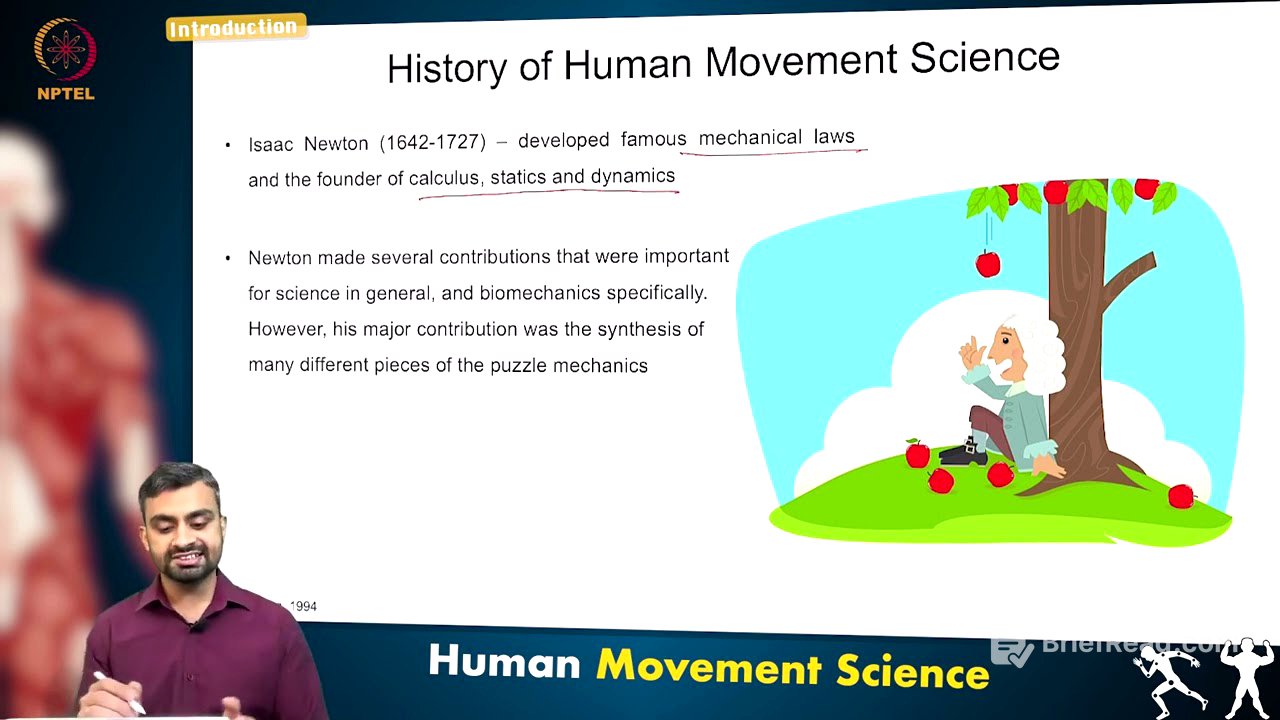
Isaac Newton developed the laws of motion and calculus, contributing significantly to biomechanics by synthesising mechanics into Newtonian mechanics. Edward Muybridge developed cinematographical serial pictures to study animal and human movement, and Etienne Jules Marey used photographic methods to examine movement. Jules Amar summarised physical and physiological aspects of industrial work, setting standards for human engineering.
The Growth of Biomechanics [9:12]
Nicholas Bernstein laid the foundation for motor control and coordination studies, while A.V. Hill explained muscle mechanics and energy efficiency in human movement. Christian Wilhelm Braune and Otto Fischer founded the scientific study of human movement, leading to the development of prostheses. The period from 1966 saw significant growth in biomechanics, with the establishment of societies, journals, and professional meetings, including the first international seminar in biomechanics in 1967 and the incorporation of the Journal of Biomechanics in 1968.
Understanding Human Movement Science [10:22]
Human movement science aims to understand and optimise the function of the human body during work, sports, and daily activities. It seeks to restore and maximise functional capacity and well-being across the lifespan by exploring the causes and consequences of human movement, including preventing and treating conditions that cause movement disorders. It involves the scientific basis of human movement, developing theories and methods for maintaining health, preventing disability, and improving movement ability.
Classifying Human Movement Science [11:36]
Human movement science is classified into kinesiology and biomechanics. Kinesiology focuses on functional anatomy, while biomechanics includes kinematics (linear and angular motion study) and kinetics (forces and torques). Kinesiology examines the kinetic chain, including the skeletal, muscular, and nervous systems, focusing on anatomical and physiological functions, including motor control. Biomechanics applies principles of physics, specifically rigid body mechanics, subdivided into statics and dynamics, which are further studied as kinematics and kinetics.
Defining Biomechanics, Kinematics, and Kinetics [13:10]
Biomechanics combines biology and mechanics to analyse forces and their effects on living systems. Herbert Hatze defined it as the study of movement using the science of mechanics. Kinematics describes motion without reference to its causes, focusing on form and technique, such as joint angles and body segment positions. Kinetics describes motion with reference to its causes, including forces (ground reaction forces, joint forces) and torques, explaining the effort and power behind movements.
Applications of Human Movement Science [15:43]
Human movement science has broad applications, including sports science, robotics, exoskeletons, computer vision, neuromechanics, animation, digital twins, and clinical applications. In robotics, it aids in designing bipedal and quadrupedal robots for realistic movements and computer-aided surgery. Exoskeletons are used for ergonomic workload management in industrial settings and for rehabilitation in clinical settings.
Computer Vision and Neuromechanics [18:29]
Computer vision is used for pose estimation, gait analysis, activity recognition, gesture recognition, and fall detection for the elderly. Neuromechanics studies the effect of neuronal control on movement, helping clinicians understand and manage neurological impairments. This knowledge also helps athletes train their minds for optimal performance.
Animation, Digital Twins and Clinical Applications [20:49]
Human movement science is applied in animation for CGI effects in movies and video games, creating more realistic human-like and animal-like movements. Digital twins, which are digital copies of human systems, help understand movement and create databases for normal and abnormal movement, reducing the need for human trials. Clinical applications are extensive in orthopaedics, neurology, physical therapy, and rehabilitation.
Sports Science Applications [23:32]
In sports science, human movement analysis enhances performance by analysing movement mechanics, helping athletes and coaches identify areas for improvement. It aids in developing targeted training programs to optimise movement and improve performance. It also helps prevent sports injuries by analysing loads and optimising technique. Finally, it supports rehabilitation by managing loads and correcting form for early recovery and better injury management.