TLDR;
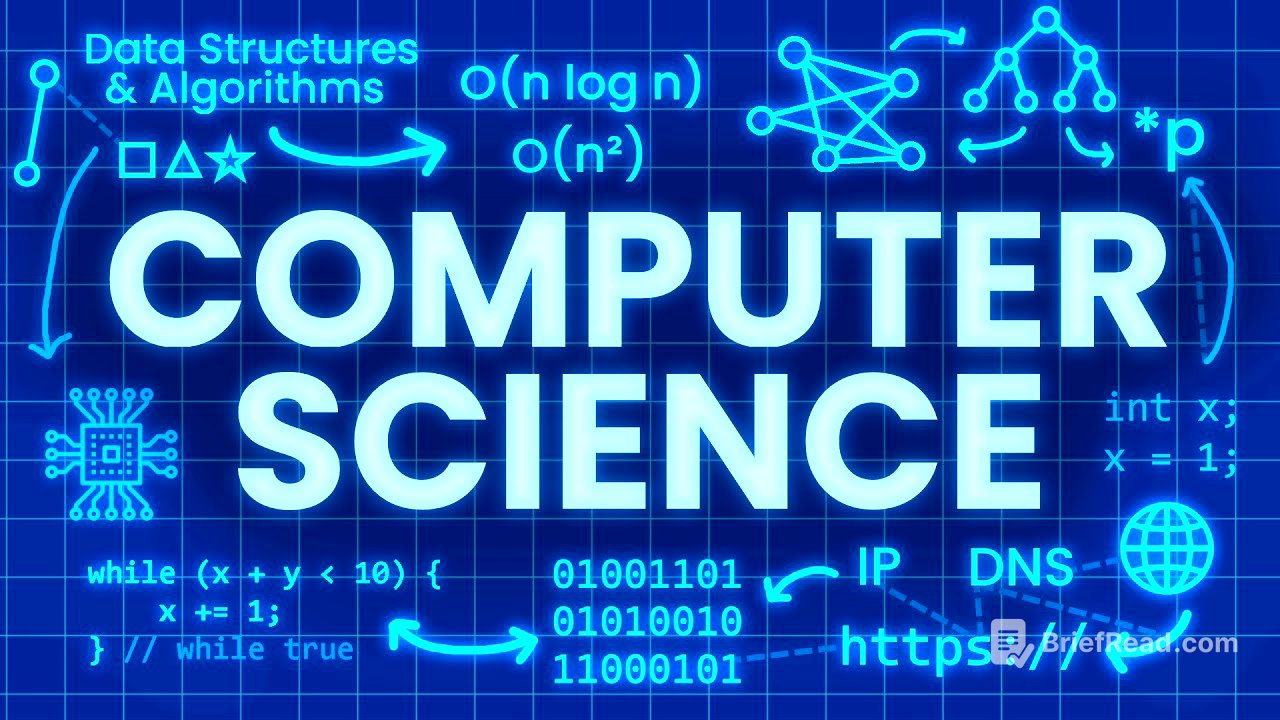
This video provides a comprehensive overview of computer science concepts, starting from the basics of binary code and logic gates, and progressing to more advanced topics such as data structures, algorithms, programming paradigms, machine learning, and internet protocols. It also touches on databases, security, and the importance of practical learning.
- Computers operate using binary code (0s and 1s) represented by transistors.
- Logic gates and Boolean algebra enable computers to perform calculations.
- Programming languages use abstraction to simplify instructions, which are then converted into machine code.
- Data structures like arrays, linked lists, stacks, queues, hash maps, graphs, and trees are used to organise data efficiently.
- Algorithms are step-by-step instructions for solving problems, and their efficiency is measured using Big O notation.
- Object-oriented programming (OOP) and machine learning are advanced paradigms for software development.
- The internet relies on protocols like IP and HTTP to facilitate communication between computers and web servers.
- Relational databases use SQL to manage and query data, but are vulnerable to SQL injection attacks.
Intro [0:00]
The video introduces the complexity of computers, questioning how simple components like metal can perform complex tasks. It sets the stage for explaining the inner workings of a computer, from its basic elements to advanced functions.
Binary [0:30]
Computers use a Central Processing Unit (CPU) made of silicon with billions of transistors that act as switches. These switches have two states, on or off, represented as 1 and 0, known as bits. Eight bits form a byte, which can have 256 different combinations, allowing computers to store information using binary code.
Hexadecimal [0:47]
Hexadecimal is a more human-readable format than binary. It represents four binary bits with a single digit, using 0-9 and a-f to represent values from 0 to 15. This makes it easier for humans to work with binary data.
Logic Gates [1:09]
Logic gates are electronic circuits made from transistors that perform logical operations. They can be thought of as light bulbs with switches that turn on only under specific conditions, such as when both switches A and B are on (AND gate).
Boolean Algebra [1:20]
By combining logic gates, circuits can perform calculations based on Boolean algebra. This system formalises mathematical operations in binary, allowing computers to perform complex calculations.
ASCII [1:28]
ASCII is a character encoding that assigns a binary number to each character, making it easier for humans to interact with computers. When you type a character, it's translated into binary code that the computer recognises and displays on the screen.
Operating System Kernel [1:46]
The operating system kernel (like Windows, Linux, or Mac) manages the interaction between computer hardware and applications. It uses device drivers to ensure everything works together smoothly.
Machine Code [1:56]
Computers understand instructions in machine code, which is binary code that tells the CPU what to do and which data to use. Input devices allow users to give instructions, which are then translated into machine code.
RAM [2:15]
The CPU can execute instructions but cannot store data, so it relies on Random Access Memory (RAM). RAM is like a grid where each box holds a byte of information (data or instructions) and has an address for the CPU to access.
Fetch-Execute Cycle [2:25]
The CPU accesses data in RAM through a four-step process: fetch (retrieve from memory), decode (interpret instructions and data), execute (perform the instruction), and store (save the result). This is known as a machine cycle.
CPU [2:38]
Modern CPUs can perform billions of machine cycles per second, coordinated by a clock generator measured in GHz. CPUs often have multiple cores that can execute different instructions in parallel, and each core can be split into multiple threads to handle multiple instructions concurrently.
Shell [3:18]
The kernel is wrapped in a shell, which is a program that exposes the kernel to the user. It allows for simple instructions to be given through a command-line interface with text inputs.
Programming Languages [3:25]
Programming languages use abstraction to simplify instructions, converting human-readable code into machine code. Some languages use an interpreter (like Python) to execute code line by line, while others use a compiler (like C or Go) to convert the entire program into machine code before execution.
Source Code to Machine Code [3:35]
The process of converting source code to machine code involves either an interpreter, which executes the code line by line, or a compiler, which converts the entire program into machine code before execution. Different languages use different approaches to this conversion.
Variables & Data Types [3:51]
Variables are used to assign values to names, which can then be reused and modified. Variables have different data types, including characters, strings, integers, and floating-point numbers. Floating-point numbers use scientific notation and can lead to rounding errors due to memory limitations.
Pointers [4:44]
Pointers are variables that store the memory address of another variable. They allow for direct manipulation of memory and are used in languages like C. Pointer arithmetic involves adding and subtracting from memory addresses to navigate through individual bytes of memory.
Memory Management [5:01]
In low-level languages like C, memory must be manually allocated and freed in the heap. Failure to do so can result in segmentation faults (accessing invalid memory) or memory leaks (unused memory that is not freed). High-level languages like Python use garbage collectors to manage memory automatically.
Arrays [5:45]
Arrays store multiple items of the same data type in a contiguous chunk of memory. Each item has a numerical index, and the address of any item can be quickly accessed using pointer arithmetic. Arrays have a fixed size, which can lead to wasted memory if not fully used.
Linked Lists [6:16]
Linked lists use nodes containing a value and a pointer to the next node, allowing them to be spread apart in memory. They can grow and shrink dynamically, but accessing the last node requires traversing every node before it.
Stacks & Queues [6:38]
A stack follows the last-in, first-out (LIFO) principle, while a queue follows the first-in, first-out (FIFO) principle. Stacks use a pointer to the last added item, while queues use two pointers for the first and last added items.
Hash Maps [7:02]
Hash maps are collections of key-value pairs that use a hash function to assign keys to indices in an array. Collisions (when two keys map to the same index) are handled using linked lists. Hash maps allow for fast retrieval of values based on their keys.
Graphs [7:30]
Graphs represent relationships between data points, with nodes connected by edges. Edges can be directed, undirected, and weighted. Graphs are used for analysing networks and finding shortest paths. Breadth-first search and depth-first search are two main ways to search a graph.
Trees [8:07]
A tree is a graph where any two nodes are connected by exactly one path, representing a hierarchy. Trees start at the root and branch out into subtrees, ending in leaf nodes. Binary trees, especially binary search trees, are commonly used for efficient searching.
Functions [8:39]
An algorithm is a set of instructions that solves a problem step by step. The simplest way to write an algorithm is in the form of a function, which takes inputs, processes them, and returns an output. Function calls are pushed onto the call stack, which is based on the stack data structure.
Booleans, Conditionals, Loops [9:03]
Algorithms often involve comparing values using operators and logical expressions (AND, OR, NOT). These expressions result in Boolean values (true or false), which are used in conditional statements (if-else) and loops (while, for) to control the flow of execution.
Recursion [9:40]
Recursion is when a function calls itself, useful for breaking down problems into smaller, identical subproblems. Recursive functions require a base condition to stop the recursion and prevent a stack overflow.
Memoization [10:09]
Memoization is a technique to minimise computations by saving past results in a cache. This way, if the same computation is needed again, the computer can retrieve the result from the cache instead of recomputing it.
Time Complexity & Big O [10:21]
Time and space complexity measure the efficiency of an algorithm. Big O notation describes the relationship between the growth of input size and the number of operations needed. It focuses on the trend as the input size approaches infinity.
Algorithms [10:57]
Common algorithmic approaches include brute force and divide and conquer. Binary search is an example of divide and conquer, where the problem is halved each time by checking the middle element of a list.
Programming Paradigms [11:15]
Programming paradigms are different ways to achieve the same result. Declarative programming describes what the code does, while imperative programming describes how the computer should achieve the result with detailed instructions.
Object Oriented Programming OOP [11:30]
Object-oriented programming (OOP) involves defining classes as blueprints for objects, which consist of data (properties) and behaviours (methods). Classes can inherit properties and behaviours from superclasses, and subclasses can extend and override them, demonstrating polymorphism.
Machine Learning [12:12]
Machine learning teaches a computer to perform a task without explicitly programming it. It involves using training data to build a model, which can then be tested and improved over time by adjusting its parameters to minimise errors.
Internet [12:52]
The internet is a network of computers connected by wires, including cables at the bottom of the ocean. Internet Service Providers (ISPs) connect users to their destinations.
Internet Protocol [13:12]
Computers communicate using the Internet Protocol Suite. Each computer has a unique IP address, and data is transferred using the Transmission Control Protocol (TCP), which breaks messages into packets and reassembles them at the receiving end. Packet loss occurs when some packets get lost along the way.
World Wide Web [13:31]
The web is the software layer on top of the internet hardware, accessed through a browser. Every page has a URL, which is translated into an IP address using the Domain Name System (DNS).
HTTP [13:47]
The Hypertext Transfer Protocol (HTTP) is used by the client (browser) to send requests to the server, which then sends a response containing the contents of the webpage.
HTML, CSS, JavaScript [13:57]
Websites consist of HTML (content), CSS (visuals), and JavaScript (functionality). HTML files contain elements like text, links, and buttons. CSS files control the appearance of the website. JavaScript adds interactivity.
HTTP Codes [14:15]
HTTP responses include a response code indicating the status of the response. For example, 200 means "OK," while codes starting with 4 indicate an error, such as "404 – page not found."
HTTP Methods [14:28]
HTTP requests use different methods like GET, POST, PUT, and DELETE to retrieve, add, update, and delete information. These methods are often used by Application Programming Interfaces (APIs).
APIs [14:35]
Application Programming Interfaces (APIs) connect two applications and allow them to interact, for example, to store and retrieve data from a database.
Relational Databases [14:44]
Relational databases use tables to store data, with columns representing attributes and rows representing data points. Each table has a primary key, and foreign keys establish relationships between tables.
SQL [15:03]
SQL (Structured Query Language) is used to write statements to work with data in relational databases. It allows users to look up, join, and combine data from different tables.
SQL Injection Attacks [15:27]
SQL injection attacks exploit vulnerabilities in login pages by manipulating SQL queries. Attackers can bypass authentication by injecting code that alters the query logic, granting unauthorised access.
Brilliant [15:51]
Brilliant is a platform with interactive lessons for learning math, data science, programming, and AI. It uses visual lessons and interactive problems to make learning more effective and engaging.