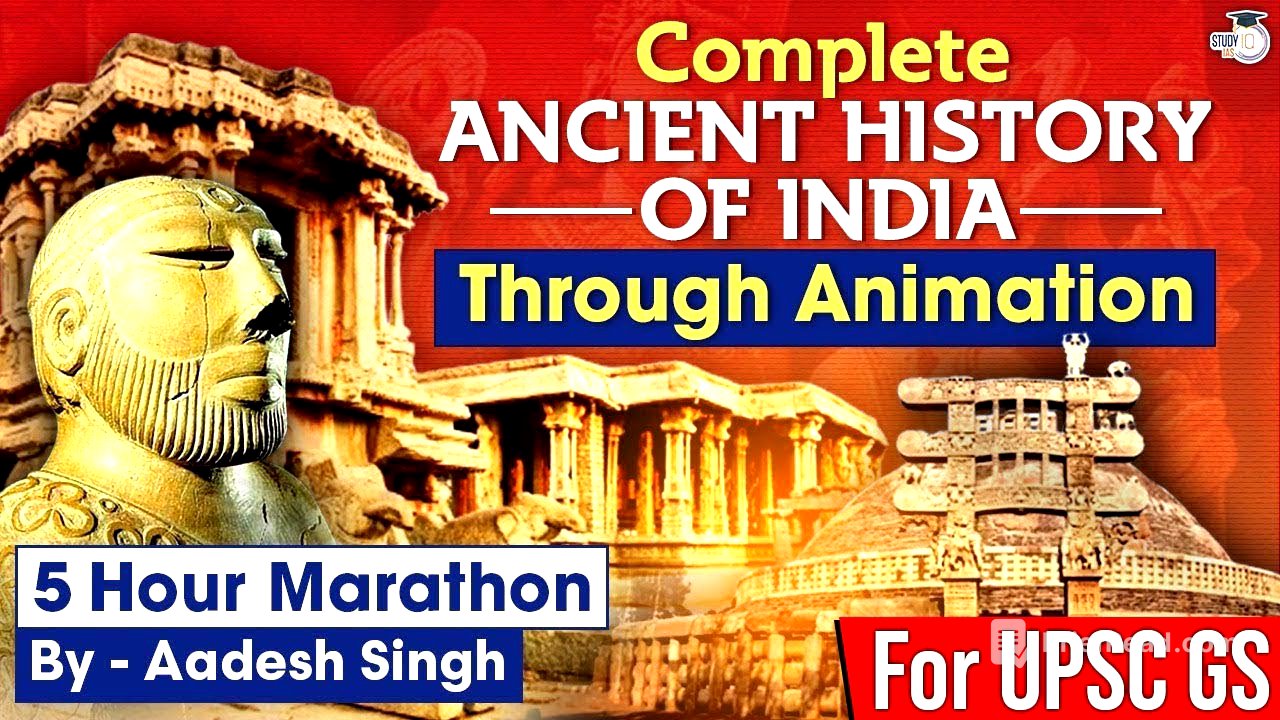
TLDR;
This YouTube video provides a comprehensive overview of Ancient Indian History, covering key periods and empires. It begins with prehistoric India, moves through the Indus Valley Civilisation and Vedic ages, and then discusses the rise of Jainism and Buddhism. The video also explores the emergence of the Magadh Empire, the Mauryan Dynasty, and the Gupta Empire, as well as South Indian dynasties like the Cholas.
- Prehistoric India, including the Paleolithic, Mesolithic, and Neolithic periods.
- The Indus Valley Civilisation, its geography, features, and important sites.
- The Vedic Age, divided into early and later periods, focusing on societal and religious changes.
- The rise of Jainism and Buddhism, including their key figures and principles.
- The Mauryan and Gupta Empires, their administration, society, economy, and cultural contributions.
- South Indian dynasties, including the Cholas, Pallavas, Chalukyas, and Pandyas.
Complete Ancient Indian History [0:00]
The video introduces a comprehensive marathon covering Ancient Indian History, starting from prehistoric times through to the major empires and South Indian history. It promises to cover the syllabus comprehensively, making exam preparation affordable.
Prehistoric India [0:59]
The chapter begins by defining history and its reliance on both non-literary (coins, inscriptions, monuments) and literary sources. It divides the study of the past into prehistory (before writing), protohistory (written records exist but are undecipherable), and history (decipherable written records). The focus then shifts to India's prehistoric period, spanning from 200,000 BCE to 2500 BCE, characterised by hunter-gatherer societies gradually transitioning to settled life. The period is divided into the Paleolithic (Old Stone Age), Mesolithic (Middle Stone Age), and Neolithic (New Stone Age) ages, based on geological age, stone tool types, and lifestyles.
The Paleolithic Age (300,000 BCE - 10,000 BCE) is further divided into Lower, Middle, and Upper phases. The Lower Paleolithic Age features rough, heavy stone tools like hand axes and choppers, with sites like Bori in Maharashtra and the Belan Valley in Uttar Pradesh. Humans sought locations with good quality stone, creating factory sites and using natural caves for shelter. The Middle Paleolithic Age (100,000 BCE - 40,000 BCE) saw the development of smaller, lighter tools like flakes and points, found near the Narmada and Tungabhadra rivers. The Upper Paleolithic Age (40,000 BCE - 10,000 BCE) coincides with the last phase of the Ice Age and the emergence of Homo sapiens, featuring advanced tools like needles and fishing tools, with bone tools found in Andhra Pradesh.
The Mesolithic Age (10,000 BCE - 6000 BCE) began with climate changes, including rising temperatures and melting ice, leading to changes in flora and fauna. This era is characterised by microliths, miniature stone tools used for hunting smaller animals and birds, and for plant gathering. Key sites include rock shelters in Uttar Pradesh and Bagor in Rajasthan. Humans began to learn about animal domestication, with evidence found in Madhya Pradesh, and started wearing clothes made from animal skins.
The Neolithic Age (6000 BCE - 1000 BCE) marks a revolution in human life, with people transitioning from food gatherers to food producers. Agriculture became significant, with evidence of rice cultivation in Uttar Pradesh. Polished stone tools and bone tools were used, and crops included ragi, cotton, rice, wheat, and barley. Animal domestication included cattle, sheep, and goats, with evidence from sites in Kashmir and Karnataka. Pottery making emerged, and people lived in rectangular and circular houses, laying the foundation for settled societies and early villages.
The Chalcolithic Age (2000 BCE - 2500 BCE) saw the use of metal, mainly copper, alongside stone. This age represents a transition to the Harappan phase, with settlements and animal rearing becoming common. Houses were made of stone and mud bricks, and social inequalities began to emerge. The culture is known for polychrome painted pottery. Key cultures include the Ahar or Banas culture in Rajasthan, the Kayatha culture in Madhya Pradesh, and the Jorwe culture in Maharashtra.
The Megalithic Period (1250 BCE - 1000 BCE) involved the use of large stones for burials and memorials. These structures are divided into polylithic (multiple stones) and monolithic (single stone) types, mainly found in South India. Burials included red and black ware pottery, iron tools, weapons, and ornaments. The period marks a transition from prehistory to history, coinciding with the Iron Age.
Indus Valley Civilization_ Geography and Characteristic Features [25:35]
The Indus Valley Civilisation (IVC), emerging around 2600 BCE, is highlighted as one of the oldest urban civilisations. Its discovery challenged colonial narratives by demonstrating advanced organisation and urban planning in India during a time when Europe was less developed. The IVC is also known as the Harappan Civilisation and was contemporaneous with other major civilisations like Mesopotamia, Egypt, and China, with evidence of trade relations with Mesopotamia. The IVC's economy was based on agriculture and mercantilism, with extensive exports via sea and land routes.
The history of IVC excavations is briefly reviewed, noting early records from the East India Company in the 1840s. Alexander Cunningham's initial visits to Harappa in 1853 did not fully recognise its significance. Later, in 1921, Daya Ram Sahni excavated Harappa, and in 1922, R.D. Banerji excavated Mohenjo-daro. Post-independence, significant discoveries include the stone inscription and Indus sign board at Dholavira by R.S. Bisht in 1990, and the Rakhigarhi site, identified as the largest IVC site by Vasant Shinde in 2014.
Historians classify the IVC into four phases: pre-Harappan, early Harappan, mature Harappan (2600-1900 BCE), and late Harappan (1900-1300 BCE). The mature Harappan phase is considered the most developed. The IVC spanned across Punjab, Haryana, Sindh, Balochistan, Gujarat, Rajasthan, and western Uttar Pradesh, located around the Indus River and its tributaries. Theories suggest that environmental changes led to a decline in the Indus Valley, prompting migration towards the Ganges Valley. Key sites include Sutkagendor (westernmost), Alamgirpur (easternmost), and port cities like Lothal and Kuntasi in Gujarat.
The chapter concludes by discussing the town planning of the IVC, noting the citadel to the west for the ruling class and smaller brick houses to the east for commoners, indicating social stratification. Dholavira's citadel was made of stone and included a middle town. The grid system of streets intersecting at right angles and the advanced underground drainage system are highlighted as remarkable features. The Great Bath at Mohenjo-daro and the massive water tank at Dholavira are mentioned as significant architectural achievements.
Indus Valley Civilization_ Important Sites and Inferences [44:06]
This section focuses on important IVC sites and the inferences drawn about Harappan society, politics, and economy. Harappa, located on the Ravi River in Punjab, Pakistan, was a key trade point with granaries, workers' rooms, and evidence of bronze smelting. It is unique for its coffin burials. Mohenjo-daro, meaning "Mound of the Dead," is situated on the Indus River in Sindh, Pakistan, and features the Great Bath, Great Granary, Dancing Girl statue, and Pashupati Seal. Dholavira, in Gujarat's Rann of Kutch, is known for its reservoirs and water harvesting systems.
The chapter explores theories about the IVC's political system, suggesting a centralised state due to the uniformity in architecture and artefacts. Citadels may have been seats of power, and the Great Granary at Mohenjo-daro could have been a state treasury. The absence of archaeological evidence of temples suggests a secular polity focused on trade and commerce, possibly ruled by merchants. However, alternative theories propose that different cities had separate rulers, similar to Italian city-states.
Agriculture was a primary economic activity, supported by the Indus River's fertility. Major crops included wheat, barley, sesame, and mustard, with rice evidence in Lothal and Rangpur. The IVC may have been the first to produce cotton, with weaving being a common practice. While metal ploughs are absent, ploughed fields in Rakhigarhi and Kalibangan suggest wooden ploughs were used. Animal domestication was common, including oxen, buffaloes, goats, and sheep. The Harappans were not familiar with horses.
Trade and commerce were significant, evidenced by seals, uniform scripts, and weights and measures. Lothal was an important port in the Gulf of Khambhat. Trade was largely based on the barter system, with goods exchanged for other goods. The IVC traded with Mesopotamia, Central Asia, and the Persian Gulf, exporting goods like cotton, ivory, and copper.
The chapter also discusses Harappan society and religion, noting a well-established social hierarchy indicated by citadels and lower towns. Differences in residential structures and the presence of valuable materials in larger settlements suggest social stratification. Harappans had a keen fashion sense, with widespread use of beads and ornaments. Religious practices are inferred from terracotta figurines of mother goddesses and the Pashupati Seal, suggesting the worship of earth and a male deity. The presence of amulets indicates a belief in evil forces.
The chapter concludes by discussing Harappan language and burial practices. The Harappan script, largely pictographic, remains undeciphered. Burial practices included complete burial, fractional burial, and post-cremation burial. Artefacts found in burials, such as pottery and ornaments, suggest a belief in the afterlife.
Early Vedic Age [1:01:49]
The Vedic Period, starting around 1500 BCE after the decline of the Indus Valley Civilisation, is divided into the Early Vedic Age (1500-1000 BCE) and the Later Vedic Age (1000-500 BCE). The Early Vedic Age, also known as the Rig Vedic Age, is characterised by the composition of the Rigveda. The chapter discusses the arrival of the Indo-Aryans, whose culture is primarily understood through the Rigveda.
The Rigveda, the earliest Veda, is recognised by UNESCO as a World Human Heritage. It contains 1028 hymns divided into 10 mandalas, offering prayers to deities like Agni, Indra, Mitra, and Varuna. The Rigveda provides insights into the social, political, and economic life of the early Vedic people.
The chapter also draws parallels between Aryan culture and other ancient cultures, such as the Avestan culture of Iran and the Homeric texts of Greece. Similarities are noted in language, religious practices, and social customs. The importance of horses, chariots, and cremation is highlighted as common traits among these cultures.
The political life of the Rig Vedic Age was tribal, with the tribe known as Jana and the tribal chief as Rajan. The Rajan's responsibilities included protecting the tribe and praying to the gods. Tribal assemblies like Sabha, Samiti, Vidhata, and Gana played roles in decision-making. The society was patriarchal, with the family as the basic unit. Marriage was an established institution, and child marriage was not evident. Society was not strictly divided by caste, and occupations were not based on birth.
The Rig Vedic economy was primarily pastoral, with cattle being the main form of wealth. Agriculture was practised, but not as prominently. Trade was mostly based on the barter system, with cows being a valuable unit of exchange. The kingdom functioned on voluntary offerings, and there was no regular revenue system. Various crafts were mentioned, including carpenters, chariot makers, weavers, and potters.
The Rig Vedic religion involved the worship of natural forces, such as earth, fire, wind, rain, and thunder, personified as different gods. Prayers and sacrifices were the dominant modes of worship, and there were no idols or temples. Key deities included Indra, Agni, and Varuna.
Later Vedic Age [1:18:31]
The Later Vedic Age (1000-500 BCE) is characterised by the composition of texts other than the Rigveda, including the Samaveda, Yajurveda, Atharvaveda, Brahmanas, Aranyakas, and Upanishads. This period saw the expansion of Aryan culture from Punjab to the western Uttar Pradesh region. The Bharatas and Purus merged to form the Kuru tribe, capturing new regions and establishing Kuru territory, known as Kurukshetra.
The political life of the Later Vedic Period saw the emergence of larger kingdoms, with terms like Janapadas and Rashtra coming into use. The king's position became hereditary, and rituals like Rajasuya and Ashvamedha enhanced the king's power. Tribal assemblies lost importance, and royal power increased.
Socially, the Later Vedic Society was divided into four varnas, which became more rigid. The importance of Brahmanas increased due to their role in performing sacrifices. The Upanayana ceremony, involving the wearing of a sacred thread, was common among the upper three varnas. Shudras were not allowed to wear the sacred thread and faced social disabilities. The gotra system emerged, regulating marriage practices. The four stages of life (Brahmacharya, Grihastha, Vanaprastha, and Sanyasa) became more defined.
Economically, iron tools were used, and agriculture expanded with the use of ploughs. Rice and wheat became the main crops. Various crafts were practised, including smithing and weaving. Trade was primarily based on barter, but Nishka was used as a unit of value. The collection of taxes and tributes became compulsory.
The religion of the Later Vedic Age saw a decline in the importance of Indra and Agni, with Prajapati gaining prominence. New gods like Rudra and Vishnu also became important. Sacrifices became more elaborate, with public and domestic sacrifices being common.
Jainism [1:33:03]
The chapter discusses the rise of Jainism in the 6th and 5th centuries BCE, a period of significant social and religious change in India. The rigid structure of the varna system and the dominance of rituals led to the emergence of new religious sects, including Jainism. The spread of agriculture and the use of iron in the mid-Gangetic plains led to economic growth and the rise of cities, which in turn supported the growth of Jainism.
Jainism's real founder is considered to be Vardhaman Mahavira, although the tradition traces its origins to earlier Tirthankaras, with Rishabhdev being the first. Mahavira, born in 540 BCE in Vaishali, abandoned his princely life at the age of 30 to become an ascetic. After 12 years of wandering, he attained Kevala (enlightenment) at the age of 42 and became known as Mahavira or Jina (conqueror).
Jainism's core doctrines include five principles: do not commit violence, do not lie, do not steal, do not hoard, and observe continence. The most important doctrine is ahimsa (non-injury to living beings). Jainism recognised the existence of gods but placed them below the Jinas. It did not entirely condemn the varna system but believed that a person's birth in a higher or lower varna depended on their past deeds.
Mahavira organised his followers into an order that included both men and women. He used Prakrit to communicate his teachings to the common people. After Mahavira's death, the Jain community split into two sects: Svetambaras (who wear white clothes) and Digambaras (who are naked).
Jainism spread to South and West India, with Karnataka being a major centre. A council was convened in Pataliputra to compile the main teachings of Jainism. The chapter concludes by discussing Jainism's contributions to society, including its emphasis on non-violence, its use of Prakrit, and its contributions to art and architecture.
Buddhism [1:50:16]
The chapter discusses the rise of Buddhism in the 6th and 5th centuries BCE, alongside Jainism, as a response to social and economic changes in India. The rigid varna system and the rise of agriculture and trade contributed to the emergence of new religious sects.
Gautama Buddha, the founder of Buddhism, was a contemporary of Mahavira. Born as Siddhartha in 567 BCE in Lumbini, near Kapilavastu, he belonged to a Shakya Kshatriya family. Influenced by the suffering he witnessed, he left his home at the age of 29 and attained enlightenment at the age of 35 under a peepal tree in Bodh Gaya.
Buddha's teachings emphasise that the world is full of sorrow and that suffering is caused by desires. The goal is to achieve Nirvana, a state of liberation from suffering. Buddhism does not establish a supreme deity but recommends the Eightfold Path to eliminate human misery.
Buddhism's key features include the denial of the existence of God and soul, an attack on the varna system, and the use of Pali to reach the common people. Buddha organised a religious order (Sangha) that was open to people of all castes, creeds, and sexes.
After Buddha's death, councils were convened to compile his teachings. The First Council, held in 483 BCE, divided Buddha's teachings into three Pitakas: Vinaya Pitaka, Sutta Pitaka, and Abhidhamma Pitaka. The Fourth Council, held in Kashmir, led to the division of Buddhism into Hinayana and Mahayana sects.
Buddhism spread rapidly, with rulers like Ashoka embracing the religion and promoting it through missionary activities. However, Buddhism eventually disappeared from India due to various factors, including the revival of Brahmanism, the adoption of Sanskrit, and the corruption of Buddhist monasteries.
Despite its disappearance from India, Buddhism left a significant impact on Indian society and economy. It promoted non-violence, challenged the varna system, and contributed to the development of art and architecture.
Mahanjanapadas [2:13:57]
The chapter discusses the emergence of the Mahajanapadas, large territorial states, in India around the 6th century BCE. These states represent a significant phase in Indian history, marking the beginning of empire-building.
The Buddhist text Anguttara Nikaya lists 16 Mahajanapadas: Kashi, Kosala, Anga, Magadha, Vajji, Malla, Chedi, Vatsa, Kuru, Panchala, Machcha, Surasena, Assaka, Avanti, Gandhara, and Kamboja. These states were located north of the Vindhya mountains, except for Assaka.
The rise of the Mahajanapadas was driven by several factors, including the increasing use of iron, which led to agricultural surpluses and the rise of a warrior class. The emergence of new religious sects like Buddhism and Jainism, which supported non-violence, also contributed to economic stability.
The Mahajanapadas were either monarchies or ganasanghas (republics). Monarchies had a hereditary king, while ganasanghas were ruled by a group of people. Key Mahajanapadas included Kashi, Kosala, Anga, and Magadha.
The chapter also discusses the differences between monarchies and ganasanghas, noting that monarchies had a single ruler with the right to collect revenue, while ganasanghas had multiple rulers with this right. Ganasanghas also lacked a standing army and were less influenced by Brahmanas.
The chapter concludes by noting that by the end of the 6th century BCE, monarchical states had annexed most of the ganasanghas. This set the stage for the rise of the Magadha Empire, which would become the first major empire in India.
Rise of Magadh Empire and Formation of Mauryan Empire [2:29:26]
The chapter discusses the rise of the Magadha Empire and the subsequent formation of the Mauryan Empire. Magadha, located in present-day Bihar, rose to prominence due to its fertile soil and rich iron mines. Key rulers of Magadha included Bimbisara and Ajatashatru.
Bimbisara expanded Magadha's power through strategic marriages and conquests. Ajatashatru continued this expansion, defeating Kosala and Vajji. The Shishunaga dynasty further expanded Magadha's territory, with the most significant achievement being the destruction of the Avanti kingdom.
The Nanda dynasty, founded by Mahapadma Nanda, is considered the first empire builder in India. Mahapadma Nanda conquered several kingdoms in northern India. The last Nanda ruler, Dhanananda, was overthrown by Chandragupta Maurya, who established the Mauryan Dynasty.
The chapter also discusses Alexander's invasion of India, noting that his army refused to advance further east due to the fear of Magadha's strong army. Alexander's invasion had several effects, including the establishment of new trade routes and the creation of a power vacuum in northwest India, which facilitated the rise of the Mauryan Empire.
Chandragupta Maurya, with the help of Chanakya, overthrew Dhanananda and established the Mauryan Dynasty around 321 BCE. Chandragupta defeated Seleucus Nicator, a general of Alexander, and gained control over a vast territory. He later abdicated the throne and spent his final years in Karnataka, where he died.
The chapter also discusses the Mauryan administration, noting that the empire was highly centralised and divided into provinces. Key officials included ministers, army commanders, and justice ministers. The Mauryan administration is primarily understood through two sources: Kautilya's Arthashastra and Megasthenes' Indica.
Ashoka_ The Great [2:54:37]
The chapter discusses Ashoka, a Mauryan ruler who transformed from a cruel king to a propagator of peace and dharma. Ashoka, grandson of Chandragupta Maurya, initially followed an expansionist policy, leading to the Kalinga War in 261 BCE. The Kalinga War, marked by immense death and destruction, deeply affected Ashoka and led to his conversion to Buddhism.
After his conversion, Ashoka embraced the principles of ahimsa (non-violence) and dharma (righteous conduct). He embarked on pilgrimages to sacred Buddhist sites and promoted dharma through his policies. Ashoka organised the Third Buddhist Council in 240 BCE to address corruption within the Sangha and sent missionaries to various parts of the world to spread Buddhism.
Ashoka's policy of dharma emphasised non-violence, truthfulness, respect for elders, and humane treatment of animals. He appointed special officers called Dharma Mahamatras to promote dharma and ensure the welfare of all religious sects.
Ashoka's contributions to architecture include the construction of numerous stupas and pillars, with the Lion Capital of Sarnath being the most famous. These pillars, inscribed with edicts, served to communicate Ashoka's messages to the public.
Time period between Mauryan and Gupta Empire [3:11:43]
The chapter discusses the period between the Mauryan and Gupta Empires (200 BCE to 300 CE), often referred to as a "dark period" due to the absence of a large, unified empire. However, this period saw significant developments in various regions of India.
Following the decline of the Mauryan Empire, several dynasties rose to prominence, including the Shungas, Kanvas, Satavahanas, and various foreign rulers such as the Indo-Greeks, Shakas, Parthians, and Kushans. The Shungas, founded by Pushyamitra Shunga, succeeded the Mauryans and faced invasions from the Indo-Greeks. The Satavahanas, ruling in the Deccan, also played a significant role during this period.
The Indo-Greeks, originating from Bactria, established their rule in northwest India. Key Indo-Greek rulers included Menander, who is known for his dialogues with the Buddhist monk Nagasena, recorded in the Milinda Panha. The Shakas, migrating from Central Asia, established several branches in India, with notable rulers including Rudradaman I.
The Parthians, originating from Iran, established a small kingdom in northwest India, with Gondophernes being a prominent ruler. The Kushans, also from Central Asia, established a vast empire that included parts of India, Afghanistan, and Central Asia. Key Kushan rulers included Kujula Kadphises, Vima Kadphises, and Kanishka, who is known for his patronage of Buddhism and the convening of the Fourth Buddhist Council.
The chapter also discusses trade developments during this period, noting the growth of both internal and external trade. Guilds played a significant role in promoting trade and commerce.
Sangam Age [3:32:56]
The Sangam Age in South India, spanning from the 3rd century BCE to the 3rd century CE, is explored. The term "Sangam" refers to assemblies of poets and scholars held in Madurai, which produced significant literary works.
The chapter discusses Sangam literature, which is divided into two groups: narrative and didactic. Key works include the Tolkappiyam (a grammar text), the Ettutogai (eight anthologies), and the Pattuppattu (ten idylls). The chapter also mentions the two epics, Silappatikaram and Manimekalai.
Other sources of information about the Sangam Age include inscriptions and foreign accounts, such as those by Megasthenes, Strabo, and Pliny. These sources provide insights into the trade contacts between South India and the Roman Empire.
The political history of the Sangam Age is characterised by three major dynasties: the Cheras, Cholas, and Pandyas. The Cheras controlled central and northern Kerala and the Kongu region of Tamil Nadu, with their capital at Vanchi. The Cholas controlled the Kaveri Delta, with their capital at Uraiyur. The Pandyas controlled southern Tamil Nadu, with their capital at Madurai.
The chapter also discusses the administration, society, religion, and economy of the Sangam Age. The government was a hereditary monarchy, with a council of ministers assisting the king. The society was divided into five divisions based on land type. The primary deity was Lord Murugan, and the economy was based on agriculture, trade, and handicrafts.
Gupta Empire_ Polity, Administration and Society [3:47:46]
The chapter discusses the Gupta Empire, often referred to as the "Golden Age" of India, focusing on its political history, administration, and society. The Gupta Dynasty, founded by Sri Gupta, reached its zenith under rulers like Chandragupta I, Samudragupta, and Chandragupta II.
Chandragupta I, considered the real founder of the Gupta Empire, expanded his kingdom through strategic alliances and conquests. Samudragupta, known as the "Napoleon of India," further expanded the empire through military campaigns in the north and south. Chandragupta II, also known as Vikramaditya, conquered the Saka territories in western India, extending the Gupta Empire to the Arabian Sea.
The Gupta administration was less centralised than the Mauryan administration, with a well-developed bureaucracy and a system of hereditary offices. The king was assisted by a council of ministers, and the empire was divided into provinces governed by officials known as Uparikas.
The Gupta society saw significant changes, with the varna system becoming more rigid and the emergence of caste as a dominant social reality. Brahmanism flourished, and the position of women declined.
Gupta Empire_ Economy and Art & Culture [4:04:45]
The chapter discusses the Gupta Empire's economy, art, and culture, highlighting the prosperity and achievements that led to its designation as the "Golden Age" of India.
The Gupta economy was robust, with advancements in agriculture, trade, and crafts. Land revenue was the primary source of income, and regular land surveys were conducted. Trade flourished, with exports of textiles, indigo, silk, and spices to regions ranging from Rome to Southeast Asia. The Gupta period is renowned for its gold coins, known as dinaras, which reflect artistic excellence and economic prosperity.
The Gupta period saw significant advancements in art and architecture. Structural temples, built using brick and stone, became prominent, with the Dashavatara Temple at Deogarh being a notable example. The Gupta period also saw the development of distinct styles of sculpture, with the Mathura and Sarnath schools producing exquisite works of art.
Literature flourished during the Gupta period, with Sanskrit becoming the dominant language. Key figures included Kalidasa, considered the "Shakespeare of India," who wrote plays like Abhijnanashakuntalam. Scientific literature also thrived, with mathematicians and astronomers like Aryabhata making significant contributions.
Reign of Harshavardhana [4:17:23]
The chapter discusses the reign of Harshavardhana, a ruler of the Pushyabhuti dynasty who dominated northern India in the 7th century CE. Following the decline of the Gupta Empire, Harshavardhana consolidated his power and established a significant empire.
Harshavardhana's early life was marked by the death of his father and brother, leading him to assume the throne of Thanesar. He formed an alliance with Bhaskaravarman, the ruler of Kamarupa, and launched a campaign against Shashanka, the ruler of Gauda, to avenge his brother's death.
Harshavardhana shifted his capital from Thanesar to Kannauj, making it a major centre of power. His empire extended from the Himalayas to the Narmada River and included much of northern India. However, his attempt to expand further south was thwarted by the Chalukya ruler Pulakeshin II.
Harshavardhana was known for his efficient administration, which was influenced by the Mauryan and Gupta models. He maintained a large and well-trained army and implemented various administrative reforms.
Palas, Pratiharas and Rashtrakutas [4:35:02]
The chapter discusses the tripartite struggle for control of Kannauj between the Palas, Pratiharas, and Rashtrakutas from 800 to 1000 CE. This period marked a significant phase in Indian medieval history, shaping the political and economic landscape of northern India.
Following Harsha's death, Kannauj became a strategic centre, and the Palas, Pratiharas, and Rashtrakutas vied for control of the region. The Palas, based in eastern India, gained prominence under Gopala and Dharmapala. The Pratiharas, also known as the Gurjara-Pratiharas, controlled western India and the Gangetic Valley. The Rashtrakutas, based in the Deccan, also played a significant role in the struggle.
The tripartite struggle led to frequent conflicts and shifting alliances between the three empires. The Rashtrakutas, under rulers like Dhruva and Indra III, launched successful campaigns into northern India, weakening the Pratiharas. However, the Pratiharas, under rulers like Bhoja and Mahendrapala I, managed to regain control of Kannauj and expand their empire.
The chapter also discusses the administration, society, and economy of the three empires. All three empires had a monarchical system of government, with a council of ministers assisting the king. The economy was based on agriculture and trade, with land revenue being the primary source of income.
Chola Dynasty [4:56:23]
The chapter discusses the Chola Dynasty, a significant power in South India that rose to prominence around 850 CE. The Cholas, known for their naval power and efficient administration, established a vast empire that extended beyond India's borders.
The Chola Dynasty's origins can be traced back to the Kaveri Delta, but the imperial Cholas emerged under Vijayalaya, who captured Tanjore from the Pandyas. Key Chola rulers included Rajaraja Chola I and Rajendra Chola I, who expanded the empire through military conquests.
Rajendra Chola I's most notable achievement was his naval expedition to Southeast Asia, where he defeated the Srivijaya Empire and established Chola influence in the region. The reasons for this campaign are debated, but it is believed to have been driven by economic interests and the desire to protect Tamil merchant guilds.
The Chola period is considered a "Golden Age" due to advancements in infrastructure, temple construction, and bronze sculpture. The Brihadeeswarar Temple in Thanjavur, built by Rajaraja Chola I, is a prime example of Chola architecture.
The Chola administration was highly organised, with a well-developed secretariat and a system of local self-government. Villages were governed by assemblies known as Ur and Sabha, which enjoyed significant autonomy.
The Chola Dynasty began to decline in the 13th century, with the rise of the Pandyas and the Hoysalas. The last Chola ruler, Rajendra III, was defeated by the Pandya ruler Maravarman Kulasekara I in 1279, marking the end of the Chola Empire.
Struggle for supremacy_ Pallavas, Chalukyas & Pandyas [5:12:28]
The chapter discusses the struggle for supremacy between the Pallavas, Chalukyas, and Pandyas in South India from 300 to 750 CE. This period saw intense conflicts and shifting alliances between the three kingdoms.
The Chalukyas of Badami, under Pulakeshin II, emerged as a dominant power in the Deccan, challenging the Pallavas' authority. Pulakeshin II defeated Harshavardhana and extended his influence into Pallava territory. However, the Pallava ruler Narasimhavarman I retaliated, capturing the Chalukya capital of Vatapi in 642 CE.
The conflict between the Pallavas and Chalukyas continued for several decades, with both sides experiencing periods of victory and defeat. The Pandyas, based in Madurai, also emerged as a significant power, challenging both the Pallavas and Chalukyas.
The chapter also discusses the religious and economic aspects of the period, noting the rise of Brahmanism and the construction of stone temples dedicated to Shiva and Vishnu. The economy was largely agrarian, with land grants to temples and Brahmanas being a common practice.