TLDR;
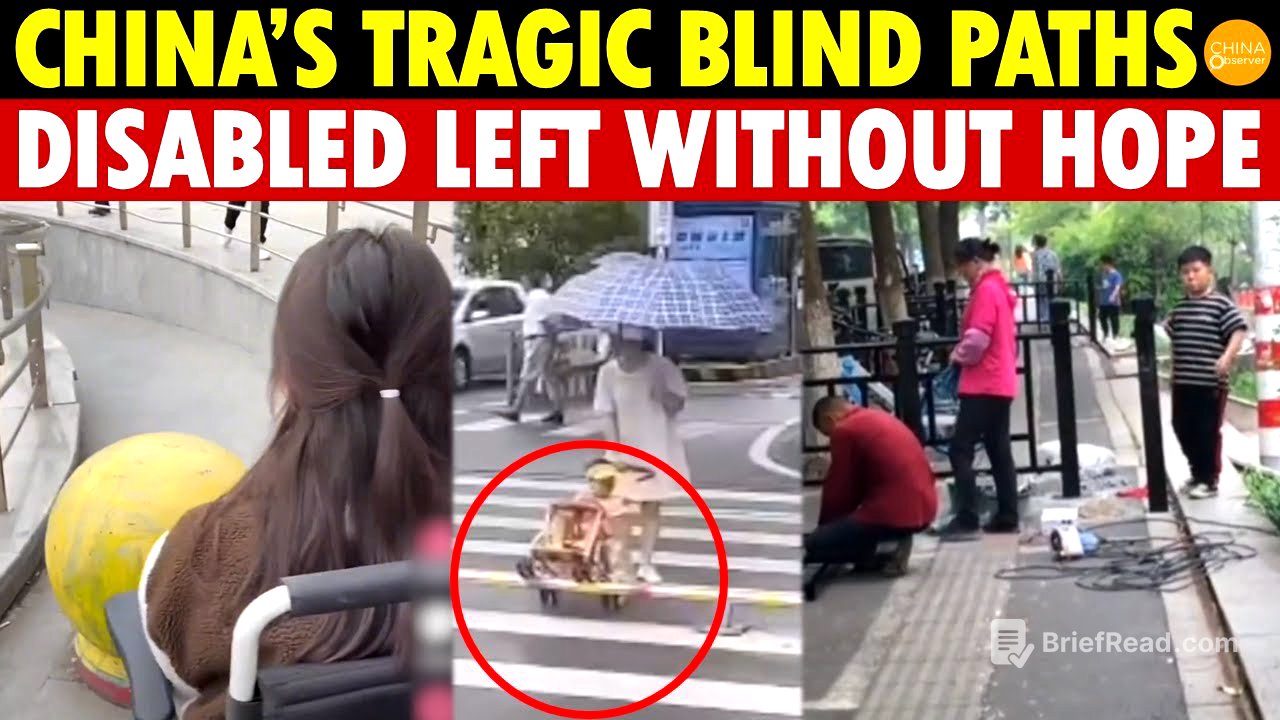
This video highlights the numerous obstacles faced by people with disabilities in China, focusing on inadequate infrastructure and societal indifference. It covers issues such as inaccessible entrances to public spaces, blocked tactile paving for the blind, and instances of blatant disregard for the needs of disabled individuals. The video contrasts these issues with the accessibility found in places like Taiwan and Japan, pointing out the systemic failures within China's governance and societal attitudes towards disability.
- Inaccessible infrastructure and public spaces
- Blocked tactile paving and dangers for the blind
- Societal indifference and lack of empathy
- Government negligence and suppression of support
- Contrast with accessibility in Taiwan and Japan
Inaccessible Shopping Malls [0:02]
The video begins by illustrating the challenges faced by wheelchair users when trying to access a shopping mall. Despite the mall being a large and supposedly accessible space, the subway exit only had escalators, forcing the user to go to ground level. Upon reaching the ground level, stone pillars blocked the entrance, preventing wheelchair access. The vlogger had to navigate a circuitous route, only to find all entrances similarly blocked, highlighting a lack of consideration for disabled individuals. Eventually, a friend had to physically lift the wheelchair over the pillars to gain entry.
Ramps and Parking Lot Obstacles [1:13]
The video shows that the frustrating barriers are not isolated incidents. At another mall, similar stone pillars blocked access, and ramps marked as accessible were also obstructed. The only available route led through a narrow gap into the parking lot's vehicle lane, forcing wheelchair users into a dangerous situation. This "accessible passage" required a detour into a car lane, with cars honking at the wheelchair user to move faster, further demonstrating the lack of proper planning and consideration.
Improvements and Basic Human Rights [1:55]
After offering suggestions to the service counter, the vlogger returned to find a new, winding path created between the stone pillars, but it remained extremely narrow. The vlogger stresses that accessibility is a basic human right, not just a convenience for wheelchair users. The hope is that one day, people in wheelchairs will have convenient and unobstructed routes everywhere, allowing them to participate fully in public life.
Obstacles for the Blind [2:24]
The video shifts focus to the challenges faced by blind individuals, highlighting obstructed tactile paving paths. Street vendors and other obstacles frequently block these paths, making navigation dangerous and frustrating. One blind individual expresses fear and frustration, noting that the blocked paths prevent blind people from going out.
Abuse and Neglect [3:04]
The video presents a disturbing incident where a blind man's white cane was damaged by a delivery rider on an electric bike who was riding on tactile paving. The rider blamed the blind man for tripping him, refused to listen to his explanation, and attempted to leave. Bystanders recovered the damaged cane, and the police were called. The rider falsely claimed the blind man intentionally placed the cane in his path, ignoring that he was riding on the tactile paving. The blind man, visibly upset, explained that this was the second time his cane had been damaged, leaving him unable to get home alone.
Heartbreaking Encounters [4:24]
The video shares a story of a blind person navigating a tactile paving path filled with obstacles like electric bikes and stone pillars, apologising for each obstruction. The vlogger recounts another incident where a blind man's cane touched a delivery rider's bike, leading to public shaming and accusations of faking blindness. The man was reduced to tears, repeatedly showing his disability certificate. Even with police intervention, onlookers were unsympathetic. The vlogger contrasts these experiences with her time in Taiwan, where she observed wheelchair users moving freely with the assistance of bus drivers and without attracting undue attention.
Ridiculous Designs and Barriers [6:32]
The video criticises the installation of U-shaped barriers across pedestrian crosswalks in Yin Chuan Ning Sha, which block strollers and wheelchairs. Footage shows people struggling to lift strollers over these barriers. Netizens criticised the design as dangerous, especially at night or in low visibility conditions. Similar barriers have existed for years in other regions, highlighting a widespread problem of government projects ignoring public convenience.
Ironic Advertisements and Neglect [7:49]
The video points out the irony of public service advertisements promoting assistance for the disabled while tactile paving paths are blocked by garbage bins, bus stop signs, and utility poles. One video shows a bus stop sign obstructing a tactile paving path with an advertisement that reads, "Support people with disabilities. Walk together without obstacles. Leave a path for the blind." Such examples highlight the local authorities' tendency to prioritise appearance over functionality.
Dangerous Blind Paths [8:49]
The video shows a blind path in Quanzo built at the edge of a high drop-off, questioning how such construction passed inspection. Another video shows a tactile paving path along the Jawing River in Chongqing that ends abruptly at the water's edge without warning signs, creating a life-threatening hazard. This footage garnered millions of views and widespread condemnation.
Inhumane Treatment at Airports [10:31]
The video discusses Taiwanese singer Jen Zu Hua's experience at Shenzhen Baoan International Airport, where he described the treatment of disabled passengers as inhumane. He clarified that the issue was not a lack of assistance, but the deliberate actions of an elevator operator who refused to make a minor adjustment to the boarding lift, leaving a significant gap that forced him to crawl aboard. He criticised the operator's indifference and reliance on a questionable regulation to create unnecessary difficulty.
CCP Rule and Neglect [12:35]
The video argues that under CCP rule, vulnerable groups receive minimal attention despite economic growth and rising education levels. The unelected government fails to provide adequate support for marginalized communities and neglects their basic needs. This is contrasted with Japan, where exceptional care is given to people with disabilities, particularly following the 1964 Tokyo Paralympics, which led to laws requiring accessible facilities.
Accessibility in Japan [13:26]
The video showcases the well-maintained tactile paving in Japan, free from obstacles and leading to clear pathways. Subway stations are equipped with ramps and low-floor carriages, and guide dogs travel free of charge. The video contrasts this with the situation in China, where people with disabilities are rarely visible in public spaces due to inadequate infrastructure.
A Society's True Level of Civilisation [14:15]
The video concludes by stating that a society's true level of civilisation is measured by whether every wheelchair can travel the streets safely and with dignity. It highlights the large disabled population in China, which remains largely overlooked by the government and society. The CCP's poor governance creates and neglects disadvantaged groups, hindering support and concealing their existence through media control, revealing a fundamental difference between societies that lean towards goodness and those that lean towards corruption.