TLDR;
This video analyses potential conflict scenarios between China and Japan, focusing on the Senkaku Islands dispute. It outlines three possible types of engagement: minor skirmishes, limited military clashes, and full-scale war, assessing the risks and potential outcomes of each. The analysis considers military capabilities, geopolitical factors, and the potential for miscalculation, ultimately suggesting that a limited conflict is the most tempting but also the most dangerous option for China.
- Minor skirmishes expose China's structural weaknesses and carry high political risks.
- Limited conflict is tempting for China but could easily escalate and backfire.
- Full-scale war is the least likely but most catastrophic scenario, potentially involving nuclear weapons.
Introduction [0:00]
The video begins by highlighting the rising tensions between Japan and China, sparked by a statement from the Japanese Prime Minister regarding a potential Taiwan contingency. This has led to heated rhetoric and displays of military might from China, raising concerns about a potential conflict. The video aims to rationally analyse the possible scenarios that could unfold if a conflict were to occur.
Minor Skirmishes and Grey Zone Conflicts [0:39]
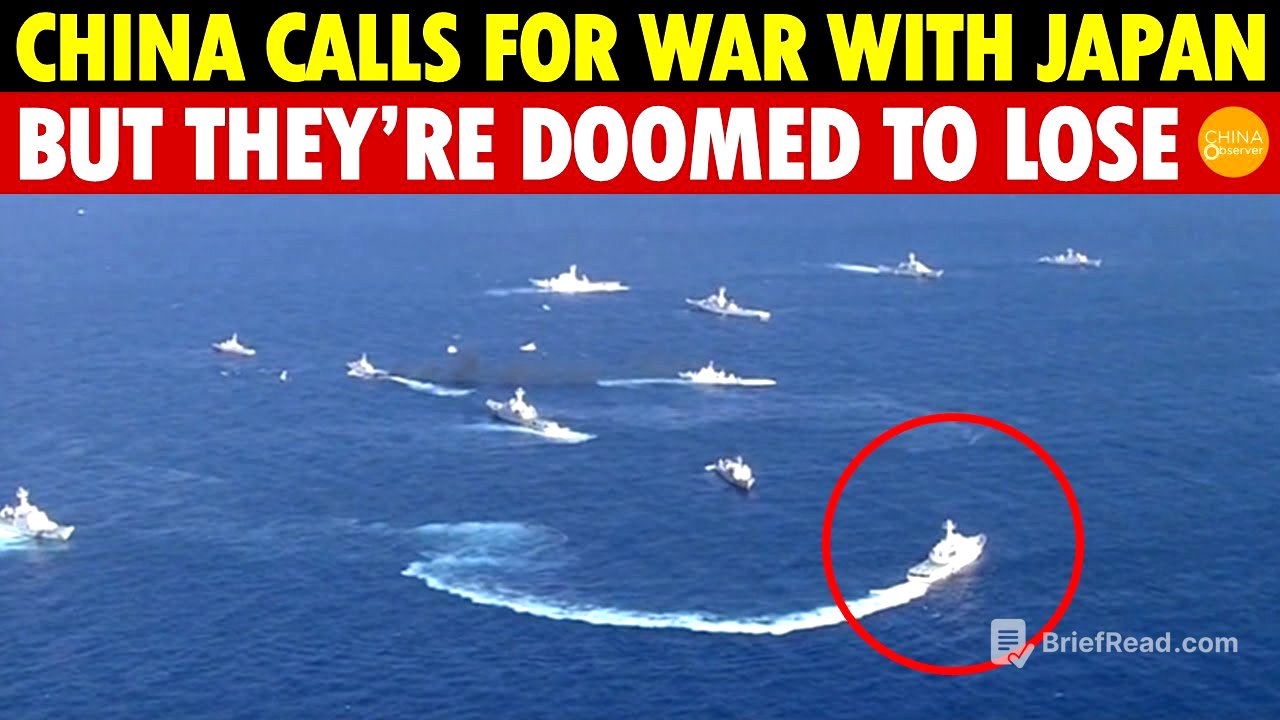
Minor skirmishes refer to quasi-military friction around the Senkaku Islands, involving maritime law enforcement forces in standoffs and pressure tactics, avoiding formal naval engagements or missile launches. This approach operates in the grey area between war and peace, making it difficult to trigger the US-Japan security treaty while allowing China to demonstrate a tough stance domestically, similar to Beijing's strategy in the South China Sea. However, applying this model in the East China Sea may not subdue Japan and could expose critical structural vulnerabilities.
Structural Vulnerabilities in Ship-Bumping Contests [1:55]
China's maritime law enforcement fleet has expanded significantly, but many ships are converted military vessels with thinner hull plating than purpose-built law enforcement vessels. In contrast, Japan's Coast Guard is rapidly updating its fleet with specialised vessels designed for collisions and enforcement, featuring reinforced hulls and advanced automation. Japan's strategy involves outlasting Chinese vessels by leveraging superior endurance and logistics, creating a silent war of attrition where China's human wave tactics prove ineffective.
Hidden Concerns Behind Naval Support [5:23]
The Japan Maritime Self-Defense Force (JMSDF) emphasises seaorthiness and power redundancy, using combined gas and gas propulsion systems for speed and maneuverability. China's navy has only recently adopted gas turbine propulsion, with many ships still using diesel or steam turbines. China's naval designs prioritise speed over maneuverability, making them less effective in close-quarters combat. If China loses a minor skirmish, it would be seen as a national disgrace, potentially threatening the government's legitimacy. Therefore, minor skirmishes are a trap that exposes technical shortcomings and carries high political risks.
Limited Conflict: A Calculated Gamble [8:11]
Limited conflict involves a short, intense, and clearly defined military clash aimed at gaining political capital through a decisive strike while testing the US-Japan alliance. In this scenario, land-based air forces in the Eastern Theater Command take the lead, targeting high-value, slow-moving aircraft like Japan's P1 anti-submarine patrol aircraft or RQ4 Global Hawk UAVs. The logic is to achieve high propaganda value, controllable war costs, and tactical advantage.
The Trump Factor and the US-Japan Security Treaty [11:25]
This strategy bets that the United States will not risk everything over a small incident. The US-Japan security treaty has room for interpretation, and a transactional president like Trump might not go to war for Japan over a downed UAV or accidental strike. This creates an opening for Beijing to achieve political gains and solidify power domestically, potentially positioning the leader as an emperor-like figure.
The Gambler's Fallacy and the Spiral of Accidents [13:56]
The biggest mistake is assuming control over the scale of the war. Japan's Air Defense Force is capable, and a self-defence response could escalate the conflict. This could turn a showcase of power into a lose-lose situation, forcing Beijing to escalate further.
Geostrategic Boomerang Effect and Economic Suicide Impact [14:58]
A limited conflict could backfire, collapsing pacifism in Japan and leading to military expansion and nuclear armament. This could push other countries towards the US-Japan side, solidifying an Asian version of NATO and suffocating China's security environment. Furthermore, it could trigger panic in capital markets, causing foreign investment to flee and energy routes to be blocked, devastating China's fragile economy. A limited conflict is a one-way street to national ruin.
Full-Scale War: The Suicide Spiral Among Nuclear Nations [16:39]
Full-scale war is the least likely but most catastrophic outcome, evolving into a broader Asia-Pacific conflict. US intervention is inevitable due to attacks on US military bases. Russia's Pacific fleet is weak, making its support unrealistic. However, Russia's nuclear capabilities are a significant variable. If conventional forces fail, Putin might threaten the use of tactical nuclear weapons, leading to a terrifying chain of suspicion and potential nuclear strikes.
Conclusion [19:22]
A small-scale conflict risks exposing structural weaknesses, while a full-scale war would be suicidal. A limited conflict is the most feasible but dangerous option, tempting a dictator to take risks. However, war has a life of its own, and decision-making power is lost once the first missile is fired. History shows that gamblers often think they are the exception, but the outcome may be the "Emperor's twilight" rather than the glory of Emperor Wu.