TLDR;
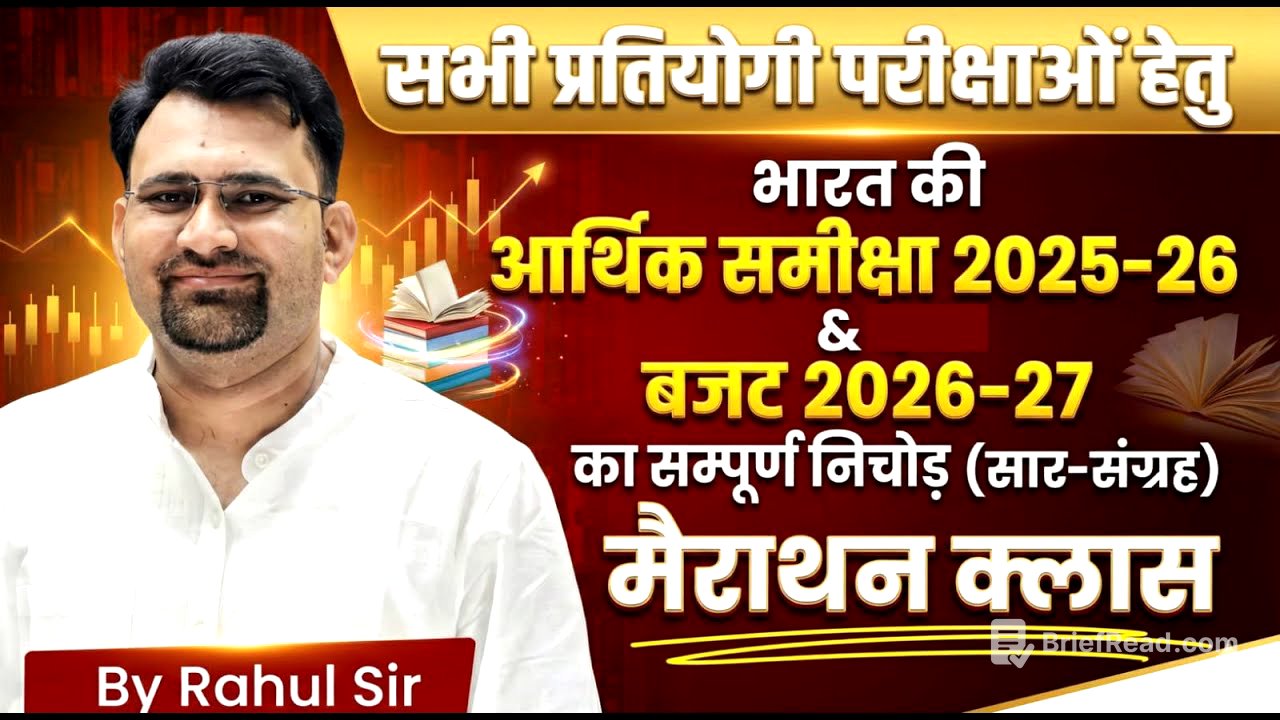
This session provides a comprehensive overview of the Indian Union Budget 2026-27 and the Economic Survey, focusing on key announcements, economic indicators, and policy initiatives. It uses a theory-cum-MCQ approach to help viewers understand the critical data and potential exam questions.
- The budget was presented on a Sunday for the first time in Indian history, coinciding with Magh Purnima.
- The budget is based on predictions for the financial year 2026-27 (1 April 2026 to 31 March 2027).
- The Economic Survey provides a real data-based assessment of the economy.
Introduction to Budget and Economic Survey [0:54]
The session will cover the latest updates from the Indian Union Budget 2026-27, presented on 1 February, and the Economic Survey, released on 29 January. The approach will be MCQ-based with theoretical explanations to aid memorisation and understanding of potential exam questions. The presenter emphasises that the budget is based on predictions for the financial year 1 April 2026 to 31 March 2027, while the Economic Survey is based on real data, assessing the performance of various sectors.
Key Aspects of the Union Budget 2026-27 [8:23]
The Union Budget 2026-27 was prepared in the Kartavya Bhawan within the Parliament Hall and is inspired by three key duties: accelerating economic growth, fulfilling people's aspirations and capacity building, and promoting सबका साथ सबका विकास (collective effort, inclusive growth). The presenter clarifies that the budget was presented under Article 112, which refers to the Annual Financial Statement, as the term "budget" is not explicitly mentioned in the Indian Constitution. The budget is presented by the President through the Union Finance Minister, currently Nirmala Sitharaman, who is a Rajya Sabha member from Karnataka.
Historical Context and Preparation of the Budget [11:26]
Historically, until 2016, the Railway Budget was separate from the General Budget, a practice that began in 1924 based on the William Ackworth Committee's recommendation. However, starting 1 February 2017, the Railway Budget was merged back into the General Budget, following the Vivek Debroy Committee's recommendation. The budget is prepared by the Department of Economic Affairs under the Ministry of Finance. Nirmala Sitharaman has presented the budget for the ninth consecutive time and is a Rajya Sabha MP from Karnataka.
Key Announcements and Allocations in the Budget [19:16]
The budget includes several key announcements and allocations. A network of 1,000 recognised testing sites for biopharma is to be established. The "Bio Pharma Shakti" initiative, aimed at making India a global biomanufacturing hub, has been allocated ₹10,000 crore for the next five years. This initiative focuses on using knowledge, technology, and innovation to improve healthcare strategies.
Economic Growth and Fiscal Deficit Projections [22:36]
The financial year 2025-26 is projected to have a growth rate of 7.4%. The estimated fiscal deficit for the financial year 2026-27 is projected to be 4.3% of GDP, down from 4.4% in the financial year 2025-26. The revenue deficit is expected to remain constant at 1.5%, while the effective revenue deficit is set to decrease from 0.6% to 0.3%. The primary deficit is aimed to be reduced from 0.8% to 0.7%.
Infrastructure and Connectivity Initiatives [30:00]
Over the next five years, 20 new national waterways will be developed, starting with National Waterway Five in Odisha. In the past decade (2015-2025), 25 crore people have been lifted out of multidimensional poverty. The Semiconductor Mission 2.0 has been launched with an allocation of ₹400 crore to boost electronics component manufacturing. An additional ₹2,000 crore has been allocated to the Aatmanirbhar Bharat (Self-Reliant India) fund.
Debt Management and Healthcare Investments [34:26]
The debt-to-GDP ratio is projected to decrease from 56.1% to 55.6% in 2026-27. Three new National Pharmaceutical Education and Research Institutes (NIPER) will be established, while seven existing ones will be reconstructed. The budget includes a container manufacturing plan with a budget of ₹100 crore over five years. The Mahatma Gandhi Gram Swaraj initiative will be launched to strengthen Khadi, handloom, and handicraft sectors. A ₹10,000 crore SME Growth Fund is proposed to support small manufacturing enterprises.
Environmental and Transport Initiatives [42:54]
The share of inland waterways and coastal shipping in transportation is targeted to increase from 6% to 12% by 2047, supported by the Coastal Cargo Promotion Scheme. ₹500 crore has been allocated for carbon capture, utilisation, and storage technologies over the next five years. Seven high-speed rail corridors will be developed to promote sustainable passenger transport, including routes like Mumbai-Pune-Hyderabad-Bengaluru-Chennai, Delhi-Varanasi-Siliguri.
Municipal Bonds and Skill Development [49:55]
To promote the issuance of high-value municipal bonds by large cities, an incentive of ₹100 crore will be provided for single bonds exceeding ₹1,000 crore. A high-level committee will be formed to focus on banking for developed India. The Power Finance Corporation and Rural Electrification Corporation will be merged and restructured. One lakh associated health service professionals will be added over the next five years. Every district will establish a women's hostel.
Education, Employment, and Healthcare Initiatives [53:17]
A permanent committee will be established to link education with employment and entrepreneurship, aiming to increase India's global share in education to 10% by 2047. Three new All India Institute of Ayurveda will be established. The WHO Global Traditional Medicine Centre will be promoted in Jamnagar, Gujarat. The National Hotel Management and Catering Technology Council will be upgraded to the National Hospitality Institute. A pilot programme will be launched to skill 10,000 guides across 20 tourist sites.
Global Branding and Financial Measures [57:20]
The goal is to establish Indian cashew and cocoa as premium global brands by 2030, with a dedicated programme proposed for this purpose. The 16th Finance Commission has recommended providing ₹1.4 lakh crore to states in the financial year 2026-27. A new Income Tax Act 2025, aimed at simplifying income tax, will be effective from 1 April 2026. The TCS rate on the sale of foreign travel programme packages will be reduced to 2%.
IT Sector and Tariff Reductions [1:02:46]
The safe harbour margin for IT services has been increased from ₹300 crore to ₹2,000 crore. Foreign cloud service providers will be tax-free in India until 2047. The tariff rate on goods imported for personal use has been reduced from 20% to 10%.
Rare Earth Magnet Corridor and Government Revenue [1:06:06]
A rare earth magnet corridor will be established in Odisha, Kerala, Andhra Pradesh, and Tamil Nadu. The government's primary income source is from taxes, with direct taxes contributing more than indirect taxes. Income tax is the largest source of tax revenue, followed by corporate tax and GST.
Government Expenditure and Budget Allocation [1:15:14]
The government's major expenditures include states' share of taxes, interest payments, central sector schemes, and defence. The budget for 2026-27 is ₹53 lakh crore. The largest expenditure is on interest payments (₹14 lakh crore), followed by transport, defence, and pensions. Subsidies are provided for fertilisers, food, and petroleum, with the largest allocation for fertiliser subsidies.
Revenue and Expenditure Analysis [1:17:50]
The budget totals ₹53 lakh crore, with significant allocations for interest payments (₹14 lakh crore), transport (₹6 lakh crore), defence (₹6 lakh crore), and pensions (₹3 lakh crore). The government's revenue sources are primarily from income tax, and expenditures are mainly directed towards states' share of taxes and interest payments.
Source of Information and Economic Survey Preview [1:26:57]
The presenter shares that the information is sourced from the Press Information Bureau (PIB), the official government source. The session concludes with a preview of the next session, which will cover the Economic Survey 2025-26. Viewers are encouraged to read the Economic Survey from the PIB website before the next class.