TLDR;
This video explores the origins and evolution of the ghoul, tracing its roots from Arabic and Islamic folklore to its modern depictions in popular culture. It examines the ghoul's characteristics, its relationship with jinn, and the varying interpretations of its nature by Islamic scholars. The video also discusses the ghoul's appearance in "The Arabian Nights" and its subsequent influence on European literature, highlighting the discrepancies between traditional Arabic lore and modern portrayals.
- The ghoul originates from Arabic and Islamic culture, with the term derived from the Arabic word "rul," meaning "to kill."
- Islamic scholars have varying views on ghouls, with some rejecting their existence and others considering them a type of jinn.
- Shape-shifting and luring travellers are common characteristics of ghouls in Arabic folklore.
- The association of ghouls with corpse eating is likely a later addition from European interpretations, particularly through translations of "The Arabian Nights."
Introduction: The Ghoul in Popular Culture and its Arabic Origins [0:00]
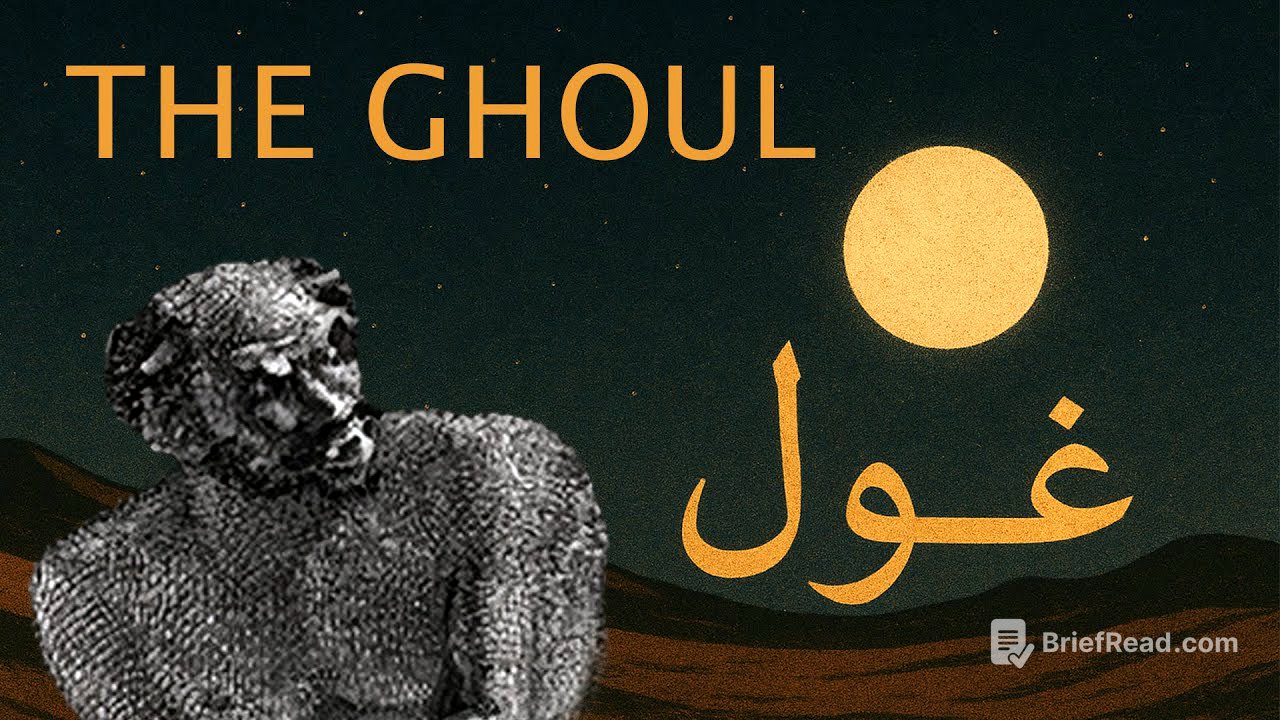
The ghoul is a popular creature in modern media, appearing in video games like Fallout, Dungeons and Dragons, and as the original zombies in George Romero's "Night of the Living Dead". Despite their varied depictions, the ghoul originates from Arabic and Islamic culture, where it is featured in numerous folk tales and has been the subject of theological, rational, scientific, and philosophical discussions. This video aims to explore the ghoul's origins and characteristics within its original cultural context.
The Ghoul in Pre-Islamic Arabia [1:39]
The term "ghoul" comes from the Arabic word "rul". While its exact origin is uncertain, some connect it to the Mesopotamian demon Gallu. In pre-Islamic Arabia, ghouls were seen as dangerous creatures inhabiting desolate deserts and ruins, posing a threat to travellers. The name "Rul" is linked to the Arabic root meaning "to kill", highlighting their deadly nature. Stories feature ghouls disguising themselves to kidnap or deceive people, such as the tale of a ghoul kidnapping the son of Arkham bin Abdul Arkham. Another story tells of Omar Katab encountering and slaying a ghoul with a single sword strike, a detail that becomes significant later.
The Ghoul in Islamic Scholarship and its Relation to Jinn [4:33]
The Quran does not directly mention ghouls, and hadith literature offers unclear references, leading to varied interpretations by Muslim scholars. Some reject the existence of ghouls as mere myths, while others accept them, often linking them to jinn. Jinn are beings created from smokeless fire, generally invisible but capable of being good or evil. While the existence of jinn is widely accepted in Islam, the ghoul's status is debated, with many scholars considering it a type of jinn. Descriptions of ghouls vary, with some considering the ghoul a male genie and others a female enchantress.
Conflicting Descriptions and Characteristics of the Ghoul [7:41]
Descriptions of ghouls are diverse and sometimes contradictory. Some accounts describe ghouls as female creatures that lure travellers to their deaths, while others present them as shape-shifters capable of taking on various forms. Zakariel Kazwini's "The Wonders of Creation" describes ghouls as deformed animals that can resemble humans or beasts, preying on solitary travellers. Al-Jahed, in his "Book of Animals," identifies ghouls as a type of genie that shapeshifts and leads travellers astray. A key detail in many stories is that a ghoul can only be killed with a single sword strike; additional blows are ineffective and part of the ghoul's deception.
Rationalist Skepticism and the Ghoul in "The Arabian Nights" [14:47]
Some Islamic scholars, particularly those from the Mu'tazila school, were sceptical of the existence of ghouls, viewing them as products of fear and hallucination in the desolate desert. Al-Jahes questioned the validity of ghoul stories, attributing them to the confusion and fear of people alone in the desert. Stories of jinn and ghouls are prominent in "The Arabian Nights," but mentions of ghouls are less frequent. The story of Sid Noman features his wife Amina, a shape-shifting ghoul who consumes corpses.
The Corpse-Eating Ghoul and its European Influence [18:56]
The characteristic of ghouls eating corpses is not found in traditional Arabic sources. This association likely originated from Antoine Galland's translation of "The Arabian Nights," where he added stories and details influenced by European folklore, such as vampires. The story of Sidi Noman, featuring the ghoul Amina, is one such addition. While corpse eating is now a widely known trait of ghouls, it is a modern invention rather than an original aspect of the Arabic ghoul.
Ghouls in Modern Folklore and Literature [20:57]
Despite the European influence on the ghoul's modern image, traditional ghoul stories persist in the Arabic-speaking world. Aisha Kandicha, a female ghoul from Moroccan folklore, lures men with her beauty near water sources, revealing her monstrous nature through her cloven feet. Another story tells of a ghoul who helps a man escape after eating his companion's liver, instructing him to recite prayers that cause her fiery demise. The ghoul's image was further popularised in European literature through "The Arabian Nights", influencing authors like Charles Dickens and Bronte. Today, the ghoul remains a prominent figure in movies, video games, and folklore, particularly in rural areas where traditional beliefs persist.