TLDR;
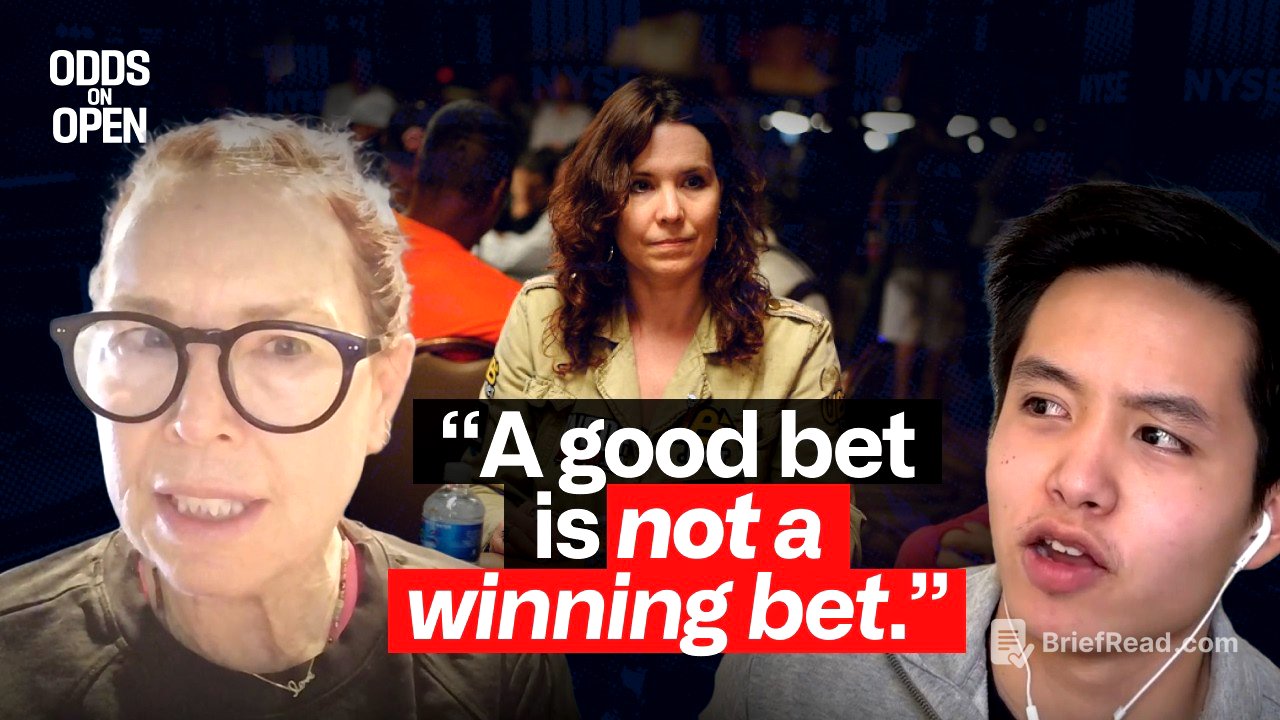
This podcast features Annie Duke discussing how to make better bets in life by viewing every decision as a bet made under uncertainty. She emphasises the importance of focusing on the decision-making process rather than the outcome, calculating expected value, and embracing uncertainty. Annie also touches on the psychological aspects of risk-taking, the role of intuition, and tools for improving decision-making, such as mental time travel. The key takeaway is that internalising a probabilistic worldview can lead to better decisions, greater success, and increased happiness.
- Every decision is a bet made under uncertainty.
- Focus on the decision-making process, not just the outcome.
- Embrace uncertainty and understand the role of luck.
- Use mental time travel to improve decision-making.
- Internalise a probabilistic worldview for long-term success and happiness.
Intro [0:00]
The podcast begins with an introduction to the topic of what constitutes a great bet. The hosts highlight that every decision is essentially a bet because it's made under uncertainty. A good bet is defined as one that carries positive expectancy, but it's crucial to remember that a winning outcome doesn't automatically mean it was a good decision. The hosts use examples like LeBron James' height and traffic lights to illustrate the role of luck and the importance of not working backwards from outcomes to determine the quality of a decision.
Defining bets as resource allocation under uncertainty [1:12]
Annie Duke defines a bet as the investment of resources – time, attention, effort, or money – into an option with a forecast of the expected value of the outcome. The goal is to invest in options with the highest expectancy, considering risk tolerance. She explains that risk is a relatively small part of the equation if you're within a margin. Examples include investing in financial instruments, choosing a job, or even ordering a meal at a restaurant. Every decision involves opportunity costs and an expected value, whether explicitly calculated or not, all under uncertainty.
Positive expectancy vs. outcome-based evaluation [4:52]
A good bet is one that carries a positive expectancy, given the available options and limited resources. The best bet is choosing the option with the highest expectancy, though uncertainty makes this challenging. A good bet helps advance towards goals, whether financial, health-related, or happiness-related. It's emphasised that a good bet isn't necessarily one that wins, nor is a bad bet one that loses. The focus should be on the expected value, potential outcomes, probabilities, payoffs, and risk tolerance.
Resulting: Why outcomes are not proxies for decision quality [6:11]
Annie elaborates on focusing on the process of the bet rather than the outcome, highlighting the role of luck. Any option has a range of possible outcomes, and the observed outcome isn't under your control. She uses the example of going through a green light and still getting into an accident to illustrate that a bad outcome doesn't necessarily mean a bad decision. Similarly, winning the lottery doesn't mean it was a good decision to play those numbers. The key is to focus on the calculation at the time, the available information, the forecast of possible outcomes, and the probability of those outcomes occurring.
Calculating expected value in high-variance career paths [15:19]
The discussion shifts to calculating expected value in uncertain scenarios, such as choosing between a career in law and software engineering. Annie asserts that when making such decisions, you're implicitly calculating expected value, even if not explicitly. She introduces the concept of utility, which translates to happiness and includes factors beyond money, such as time in nature, fulfilment, and a sense of agency. The goal is to choose the career that will bring the most happiness, and this calculation should be made explicit to avoid bias and error.
Moving from implicit intuition to explicit decision modeling [18:55]
Annie argues that it's better to make expected value calculations explicit rather than implicit to reduce bias and error. She compares it to doing math in your head versus writing it down. To do this explicitly, you need to identify what you value and what your goals are. She suggests researching average happiness levels in different careers and consulting with people who know you well to get their perspectives on which path would be more fulfilling. Additionally, she recommends conducting a premortem, imagining negative outcomes in the future to identify potential downsides.
Using base rates and reference classes for startups [24:27]
The conversation addresses how to estimate probabilities when no one has walked the path before, such as starting a unique business. Annie suggests that there's likely something similar that others have done. She advises using base rates and reference classes to avoid large errors. For example, if starting a SAS company, look at the success rate of other SAS startups. Even if you believe your innovative approach increases your chances, downgrade your initial estimate to be more realistic. This helps manage resources and think about risk more effectively.
Psychological traits of elite risk takers and traders [30:26]
The discussion moves to the qualities that make great risk-takers, focusing on being sanguine about short-term outcomes. Great risk-takers embrace uncertainty, understand they can't know everything, and accept that luck influences short-term results. This allows them to make more decisions under uncertainty. A big factor in decision-making is loss aversion, which is part of prospect theory.
How prospect theory and loss aversion distort risk [31:33]
Annie explains that loss aversion, stemming from prospect theory, affects how we cognitively weigh losses versus gains. We tend to focus on potential losses, leading to decisions with lower or even negative expectancy. For example, loss aversion might prevent someone from starting a startup, even if it has positive expectancy, because of the high probability of losing. Loss aversion makes us prefer options without large potential losses, regardless of expected value, and is fundamentally an uncertainty problem.
Deconstructing gut feel and the role of intuition [45:12]
Annie discusses the role of intuition or "gut feel" in decision-making. She divides it into two categories: how good your gut is and when it's okay to rely on it. Intuition can be helpful but is subject to cognitive biases. Decisions made purely on gut feel have a higher probability of error. It's important to consider the long-term impact of a bad outcome and the optionality of the decision. When the impact is low and there's optionality, it's more acceptable to go with your gut.
Evaluating optionality and impact in fast-moving environments [49:36]
Annie explains that optionality and willingness to exercise it are crucial for risk-taking. Silicon Valley's concept of a minimum viable product embodies this, allowing for faster movement with smaller, less impactful changes. When something doesn't feel right despite calculations, it's important to articulate what feels off. This could be due to missing information or bias. If it's bias, the decision should be made anyway. She uses the example of marriage to illustrate how "plus love" is essential, even when all other boxes are checked.
Mental time travel: Tools for managing temporal discounting [57:13]
Annie shares tools for teaching children to be great decision-makers, including mental time travel. This involves imagining the future and oneself in that future, which is important because immediate moments can have an outsized effect on decisions. Mental time travel helps improve the discount function, which is our tendency to prefer immediate gratification over long-term benefits. By considering how future self will feel, better decisions can be made.
Quantifying the intersection of luck and hard work [1:01:31]
Annie emphasises the importance of discussing luck with children. While hard work is essential, luck plays a significant role in outcomes. She shares personal examples of how being born at a certain time and poker becoming televised influenced her career. It's crucial to understand that many people work harder but have fewer opportunities due to luck. Success requires intersecting luck with hard work and good decision-making to improve the probabilities of positive outcomes.
Internalizing a probabilistic worldview for long-term edge [1:04:43]
The most important takeaway from the conversation is that every decision is a bet involving a forecast of the future. Because it's a bet, all you've done is invested in a range of possibilities with certain probabilities. Embracing this uncertainty is crucial for happiness. It avoids the extremes of feeling like the world is just happening to you or believing you have complete control over outcomes. Instead, it promotes a balanced view where you're an agent making choices in a probabilistic world, influencing the likelihood of different outcomes.