TLDR;
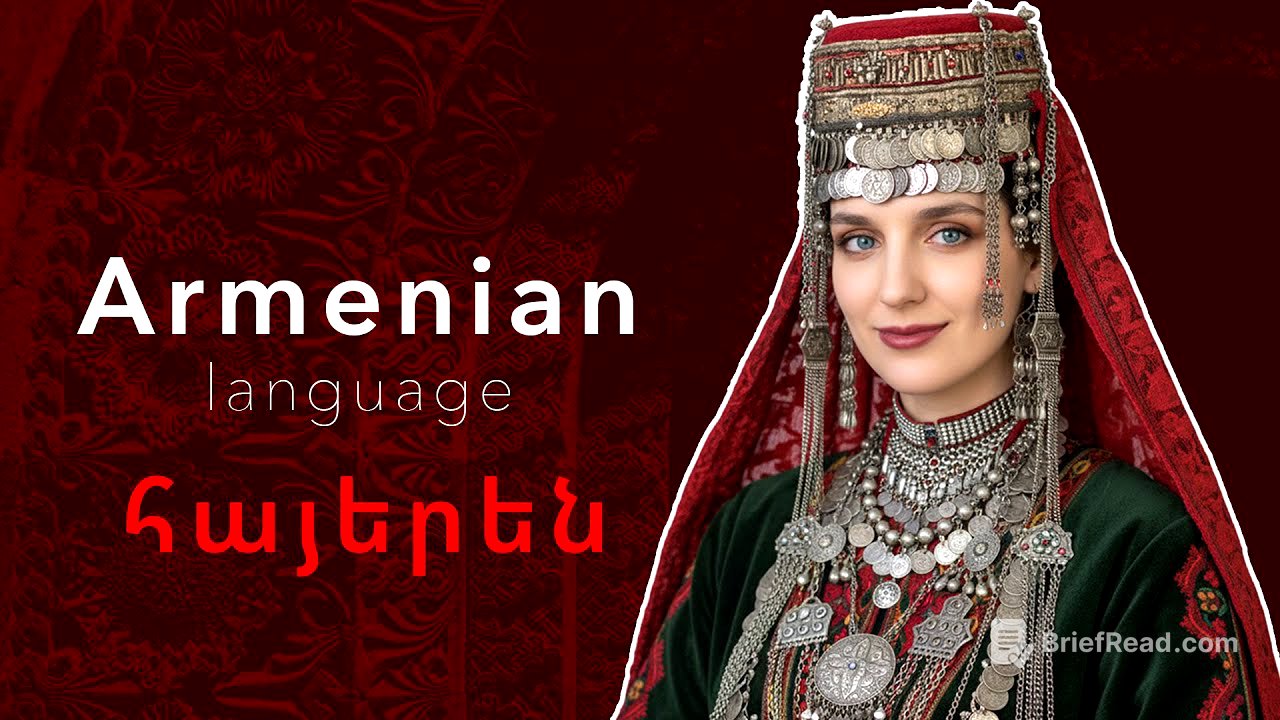
This video provides an in-depth look at the Armenian language, exploring its historical significance, the evolution of its writing and pronunciation, and its unique characteristics. It covers the language's connection to ancient civilisations, the influence of various empires, and its structure.
- The Armenian language is spoken by about 5-6 million people, primarily in Armenia and the diaspora.
- Armenian has two main varieties: Eastern and Western, with numerous dialects.
- The language has a rich history linked to early civilisations like Urartu and influences from the Hurrian language.
- The writing system was created in 405 AD, and Armenian has a unique set of phonemes.
Intro [0:00]
The Armenian language is not widely known, yet it holds a significant historical narrative intertwined with the ancient civilisations of its region. Julie introduces the language as being spoken by 5-6 million people, predominantly in Armenia, with a strong diaspora presence worldwide. She highlights the resilience of the language despite the tumultuous history of the region.
Official info [0:36]
Julie discusses the two primary dialects of Armenian: Eastern Armenian, which has about 4 million speakers, and Western Armenian, with approximately 2 million speakers. While these dialects are largely mutually intelligible, they may be viewed as separate languages due to significant differences in pronunciation and usage. Additionally, the existence of 50 to 60 dialects showcases the language's rich linguistic variety.
History [3:25]
The history of the Armenian language is traced back to ancient civilisations that lived on the Armenian plateau, with Urartu cited as a key origin point. Although inscriptions from this era are in a language related to Hurrian, the connection to what ancient Armenians spoke remains uncertain. Historical documentation links the name "Armenia" to the region's complex past involving multiple empires, underscoring the language's endurance through these changes.
Writing and pronunciation [9:45]
Julie explains that the Armenian writing system was developed in 405 AD by Mesrop Mashtots, featuring 36 letters plus three additional characters introduced later. The original written form of Armenian, known as "grabar," was used officially until the 19th century, which led to the emergence of modern Eastern and Western standards. The structure of the language includes eight vowels and a complex consonant system, with marked differences between dialects.
Native speakers [11:56]
The video showcases native speakers of Armenian, providing insights into the language's sound and pronunciation. Julie invites viewers to draw comparisons with other languages and share their impressions. This section highlights the differences between various forms of Armenian and encourages audience engagement in understanding the language's nuances.
Language structure [13:36]
The structure of Armenian is described as relatively free, with a basic word order of Subject-Verb-Object (SVO), though variations can occur due to grammatical cases. Armenian verbs are complex, conjugating for person, number, tense, and mood. Julie also discusses unique aspects of Armenian, such as intonation-based questioning and culturally specific expressions that convey empathy, illustrating the language's depth and richness.