TLDR;
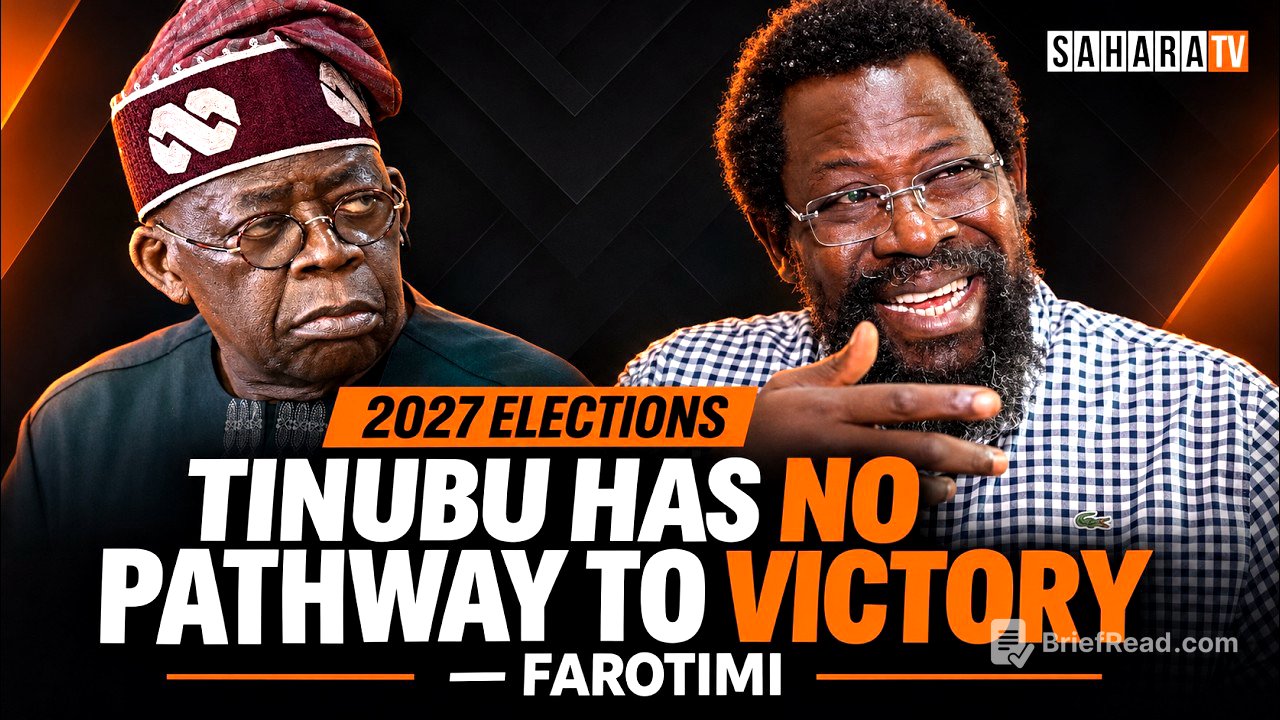
The interview argues that Nigeria’s 2027 election risks becoming a “coronation” rather than a genuine contest because of alleged electoral manipulation, judicial interference and political intimidation. The guest says voting can still matter if people unite around their interests, defend their votes and demand accountability. He calls for a peaceful, ideas-led revolution to replace Nigeria’s centralised political system with a fundamentally reimagined country, while stressing that citizenship, the rule of law and a fair democratic process must be protected.
- Nigerians should not assume their votes are useless, but must be ready to defend them.
- The guest views the electoral process and judicial decisions as compromised, while maintaining that public mobilisation could still change the outcome.
- He defines revolution as a non-violent transformation driven by ideas, political organisation and citizens’ commitment to their votes.
- He argues that Nigeria needs fundamental restructuring, not minor reforms, and that political leaders must unite people around shared interests.
Election or Coronation? [0:07]
The guest questions whether Nigeria’s 2027 poll will be a genuine election or a “coronation”. He cites concerns about alleged AI-generated voters, which he compares to the country’s earlier reports of ghost workers, and says the judiciary may play an outsized role in narrowing political competition. He argues that the Independent National Electoral Commission (INEC) and the courts cannot be relied on to guarantee a free and fair process.
Despite these concerns, he points to an election in Osun State as evidence that voters can make their choice prevail. He says nearly 30 people were killed, police and political pressure were substantial, and the APC had more money, yet voters supported their preferred candidate. For him, an election only becomes meaningful when people value their votes and are willing to stand behind them.
Voting, Public Mobilisation and Nigeria’s Political Crisis [2:42]
Asked why voters should participate if the process is compromised, the guest rejects offering false reassurance. Based on his experience of Lagos State’s local-government elections, he says he does not believe the authorities are capable of conducting a genuinely free and fair election. However, he argues that this is no reason to abandon voting: citizens must organise, find common purpose and demonstrate that they will not accept political control without resistance.
He says ordinary Nigerians across social and economic groups have been harmed by the country’s conditions, while those benefiting from the ruling establishment are relatively protected. The challenge, in his view, is for political leaders to explain how people’s lives could improve and help them recognise their shared interests. He says he is not a candidate or campaigner, but will cast his own vote and leave it to Nigerians to decide whether they have had enough.
Citizenship, Rights and the Need for a Political Revolution [7:59]
The guest clarifies that when he speaks of a “revolution”, he does not mean an armed uprising. He believes Nigeria’s present political structure cannot deliver a better future, and that the country needs a powerful idea of citizenship: the understanding that people’s rights should not depend on ethnicity, religion or political status. He argues that even members of the ruling class can become victims of a system that denies due process and enables impunity.
He criticises people who celebrate the imprisonment of political opponents without asking whether the courts have acted lawfully, warning that accepting injustice against one person can make it easier for the same system to harm anyone. He also looks back to the 2015 election, arguing that voters were misled by the “change” campaign, and says he warned of this at the time. In 2023, he says, voters were encouraged to register and participate, but ethnic, religious and ideological divisions prevented them from uniting behind the result they believed was right.
Judicial Decisions, Opposition Candidates and Political Choice [14:47]
Asked about a court ruling that reportedly nullified an opposition candidate’s nomination, the guest says he has not read the judgment and cannot assess its legal reasoning. Nevertheless, he says the reported decision does not surprise him, given what he sees as signals from the ruling party and public statements by political figures about their plans for 2027. He is concerned that the courts could further restrict the choices available to voters.
He rejects the idea that removing a particular candidate would automatically benefit his preferred contender, saying it is wrong to try to achieve a good outcome through an unjust process. He also challenges the framing of candidates as representing a single, unified “North”, arguing that Nigeria contains distinct ethnic and regional communities with differing experiences. While he has chosen to support Peter Obi, he says this is a political choice rather than partisan loyalty; his main concern is the national interest and the protection of democratic space.
A Non-violent Revolution Through Ideas and Organised Voting [23:33]
The guest says Nigerians have been conditioned to associate revolution with bloodshed, partly because of military interventions and violent groups that have claimed revolutionary credentials. He distinguishes his own position from that tradition: revolution means turning the country around by changing people’s thinking, presenting a better plan and persuading citizens to support it politically. He says violence is not the goal and argues that ideas and democratic organisation are more important.
In practical terms, he calls for people to organise locally, including around wards and polling stations, and to protect the integrity of their votes. He cites the Osun election as an example of voters overcoming pressure and asserting their choice, even though the outcome brought another politician from the same broader political class to power. For him, the revolutionary element was that the people’s expressed will prevailed over the wishes of political actors and their allies.
Restructuring the Nigerian State [29:32]
The guest explains his claim that Nigeria’s existing state structure must “die” for a new Nigerian nation to emerge. He argues that the country’s 36 states, 774 local government areas and additional local structures contribute to an expensive, centralised system in which too much power and money are concentrated in Abuja. He says this arrangement encourages politicians to seek the presidency by any means and sustains institutions that protect impunity.
He argues that Nigeria must reconsider its political and fiscal arrangements, judiciary and wider national structure rather than rely on limited reforms. He points to failing public services as evidence: education and healthcare are in crisis, millions of children are out of school, and people can struggle to receive basic treatment even in major cities. He also criticises the country’s inability to train engineers and other professionals to meet national needs, concluding that Nigeria must be fundamentally reimagined.
Why He Will Vote Despite His Concerns [31:29]
Asked why he does not formally boycott an election he considers compromised, the guest says participating allows him to tell his conscience that he has done his part. He argues that a large, motivated turnout can place pressure on electoral authorities and political forces. Again, he points to Osun, where voters participated despite alleged political manoeuvres, a heavy police presence and violence, and says their determination helped their choice prevail.
He describes democracy as capable of producing outcomes people may dislike, but insists that the people’s will must ultimately be respected. The key, he says, is not simply casting a ballot but being committed enough to defend it. Political leaders have a responsibility to make voters understand what is at stake and help them see how democratic participation serves their own interests.
Political Intimidation and the Defence of Democracy [33:53]
The guest discusses attacks on Peter Obi’s convoy and other incidents of political violence, alleging links between attackers, security personnel and government actors. He says the removal of CCTV footage and the presence of police at some attacks make official denials less credible. He argues that these incidents show a state uncomfortable with plural democracy and unwilling to let political competition open up.
He also describes intimidation against opposition supporters in Lagos, including the tearing down of campaign posters and violence against people putting them up. In his view, this conduct is inconsistent with a functioning democracy and supports his warning that the 2027 process could become a coronation. He says responsibility for preventing instability lies primarily with the government and those benefiting from injustice, rather than with the people being attacked. He warns that victims have a right to respond, while arguing that political intolerance already exists and is reflected in detentions he considers unjust.
Nigeria Needs Fundamental Reconstruction, Not Minor Reforms [40:32]
Asked which five reforms he would prioritise in a future government, the guest rejects the premise that Nigeria can be repaired through a short list of reforms. He compares the country to a house with a defective foundation and says it may need to be brought down and reconstructed. He argues that the existing system’s inequalities are built into its structure, including the many costly state institutions and offices that must be maintained.
He cites shortcomings in education, where children are still taught basic material while other countries advance, and points to more than 20 million children living outside the school system. He also describes public healthcare as deeply inadequate, recalling accounts of patients being taken to several hospitals before dying and people losing their lives to treatable illnesses such as malaria. He says Nigeria continues to rely on foreign expertise while graduating engineers who cannot meet the country’s infrastructure needs, reinforcing his case for fundamental change rather than superficial reform.
Election Credibility and the Role of Political Leaders [43:43]
The guest says a central problem is the failure of political leaders to build a convincing public narrative. He argues that the government has become deeply unpopular, pointing to the removal of the fuel subsidy and the subsequent hardship, which he says pushed many people into poverty. He questions how authorities could claim popular support after decisions that have imposed such costs on Nigerians.
Nevertheless, he says he would accept a result if Nigerians genuinely chose it, even if he considered the outcome unpleasant. His concern is that the coming election has already been compromised by the conduct of INEC and the judiciary, although he believes strong citizen mobilisation could counteract that influence. He distinguishes voting from defending a vote: people are more likely to stand behind their ballots when they understand the stakes and feel personally invested in the result. He says mobilising citizens around their enlightened interests is the political class’s responsibility.
Final Message to Undecided Voters [46:53]
Asked what an undecided voter should do, the guest dismisses the idea that anyone could still be undecided so close to the election. His answer reflects his belief that Nigerians must recognise the political choices before them and take their responsibilities as voters seriously. The interview ends with the host thanking him for his time.